Overview
Grenada is an island country in the eastern Caribbean, the southernmost of the Windward Islands. It lies just south of Saint Vincent and the Grenadines and roughly 140-160 km north of Trinidad and the South American coast.
The state includes the main island of Grenada, the smaller islands of Carriacou and Petite Martinique, and several islets in the southern Grenadines. Its total area is about 344 sq km (133 sq mi) and its estimated 2026 population is about 117,000.
The capital is St. George's, on the southwest coast of the main island. Grenada is nicknamed the 'Island of Spice' because of its nutmeg and mace production.
It is a Commonwealth realm: King Charles III is head of state, represented by a governor-general. The country gained independence from Britain in 1974.
History
Grenada was probably first settled by peoples from South America during the Caribbean Archaic Age, though firm evidence is scarce. Lake-core evidence hints at human presence from around 3600 BC, and permanent villages appeared around AD 100-200. Population peaked between about 750 and 1250 and then shifted substantially, possibly because of conflict (the contested 'Carib invasion'), regional droughts, or both. The Indigenous languages were Iñeri and Karina.
Christopher Columbus sighted the island in 1498 on his third voyage and called it La Concepción. Spain claimed it but made no known settlement attempt. An English colonising effort in 1609 failed when the settlers were killed or driven off by the island's Carib inhabitants.
In 1649 a French party of about 200 men sailing from Martinique and led by Jacques Dyel du Parquet established the first lasting colony, called La Grenade. A peace deal with the Carib chief Kairouane soon collapsed, and by 1654 the French had overpowered the island's people. Cocoa was introduced in 1714.
Britain received the island under the Treaty of Paris on 10 February 1763. France retook it in 1779 after the Battle of Grenada, led by Comte d'Estaing, and returned it to Britain under the 1783 Treaty of Versailles. In 1795-96 Julien Fédon led a pro-French revolt that the British put down. Slavery underpinned the plantation economy: roughly 127,600 enslaved Africans were brought in between 1669 and 1808 according to the Voyages database, and the island held over 23,900 enslaved people in 1785.
Grenada became a Crown colony in 1877. Theophilus Marryshow founded the Representative Government Association in 1918, and the Wood Commission of 1921-22 led to a limited elected element in the Legislative Council, with a franchise restricted to about the wealthiest 4% of adults. Grenada was part of the Federation of the West Indies from 1958 to 1962 and became a self-governing Associated State on 3 March 1967.
Independence came on 7 February 1974 under Eric Gairy, the first prime minister. Tension grew between Gairy's government and opposition parties including the Marxist New JEWEL Movement. In March 1979 the NJM seized power in a coup and set up the People's Revolutionary Government under Maurice Bishop.
In mid-1983 a dispute arose between Bishop, who sought to stay non-aligned, and hardliners around Deputy Prime Minister Bernard Coard. On 16 October 1983 Coard's faction, backed by the army, overthrew Bishop, who was then executed along with others. Days later, in late October 1983, the United States and Eastern Caribbean partners invaded. The US cited concerns including Cuban personnel building a long airstrip and the safety of foreign nationals; the airstrip's backers said it was for commercial jets.
After the invasion the pre-revolutionary constitution was restored. Eighteen PRG/PRA figures were tried over the killings; fourteen received death sentences, later commuted, and the prisoners became known as the 'Grenada 17'. Elections resumed in December 1984, won by Herbert Blaize's New National Party.
Later governments alternated between the NNP and the National Democratic Congress. Nicholas Brathwaite (NDC) led from 1990 to 1995, and Keith Mitchell (NNP) served from 1995 to 2008, re-establishing ties with Cuba and reforming the banking sector. A truth and reconciliation commission sat in 2000-02. Tillman Thomas (NDC) won in 2008, then Mitchell and the NNP returned in 2013 and 2018, winning all 15 seats each time.
Hurricane Ivan (Category 3) struck on 7 September 2004, killing 39 people and damaging or destroying about 90% of homes. Hurricane Emily hit the north in July 2005, causing about US$110 million in damage and hurting the nutmeg industry. The first COVID-19 case was confirmed in March 2020.
In the election of 23 June 2022 the NDC won under Dickon Mitchell, who became prime minister the next day. On 1 July 2024 Hurricane Beryl struck Carriacou as a Category 4 storm, devastating it and causing wide damage across the country, including near-total power loss on the main island.
Climate
Grenada has a tropical climate: hot and humid in the dry season, tempered by moderate rainfall in the wet season. Temperatures typically run from about 22 to 32 °C and rarely drop below 18 °C. The wet season runs roughly from June to November, and the dry season from about December to May.
The capital St. George's has a tropical climate with warm temperatures year-round (approx. 24-31 °C) and a drier, breezier first half of the year. The mountainous interior, with peaks such as Mount St. Catherine (840 m), is cooler and wetter than the coast. Carriacou, the largest island among the dependencies, is generally drier.
Grenada sits at the southern edge of the Atlantic hurricane belt, so direct hits are uncommon but severe: Janet (1955), Ivan (2004), Emily (2005) and Beryl (2024). Beryl was a Category 4 hurricane when it passed over Carriacou and caused severe damage on Petite Martinique too. Recovery from Ivan took more than five years.
The island is volcanic, with crater lakes (Grand Etang, Lake Antoine), hot springs, and the active submarine volcano Kick 'em Jenny offshore. Four ecoregions occur, from moist forest to dry scrub.
Government and politics
Grenada is a unitary parliamentary constitutional monarchy. King Charles III is head of state, represented by a governor-general whose role is largely ceremonial. Executive power rests with the prime minister, usually the leader of the largest party in Parliament.
Parliament has a 13-member appointed Senate (the government and opposition recommend senators to the governor-general) and a 15-member elected House of Representatives with five-year terms. The main parties are the centre-right New National Party and the centre-left National Democratic Congress. Dickon Mitchell (NDC) has been prime minister since June 2022. Future elections are constitutionally scheduled, and any result after the retrieval date is not covered here.
The state is unitary, so power is concentrated nationally. Tax, health, law, education and policing are national responsibilities. The country is divided into six parishes, which are administrative divisions, and Carriacou and Petite Martinique have the status of a dependency with their own local arrangements.
Grenada belongs to CARICOM, the OECS, the Commonwealth, the OAS and ALBA (joined 2014). It shares the East Caribbean dollar and a central bank with other OECS members. It has no standing army: policing and coast guard duties fall to the Royal Grenada Police Force and the Royal Grenada Coast Guard, and it participates in the Eastern Caribbean Regional Security System.
Freedom House gave it a score of 89 out of 100 in 2023. Same-sex sexual activity is illegal under the source's account, punishable by imprisonment.
Economy
Grenada has a small, open economy in which tourism is the main earner of foreign exchange. It uses the East Caribbean dollar, shared with other OECS members. Concerns include a high public debt burden; debt service took about 25% of revenue in 2017, and fiscal and external-account pressures persist.
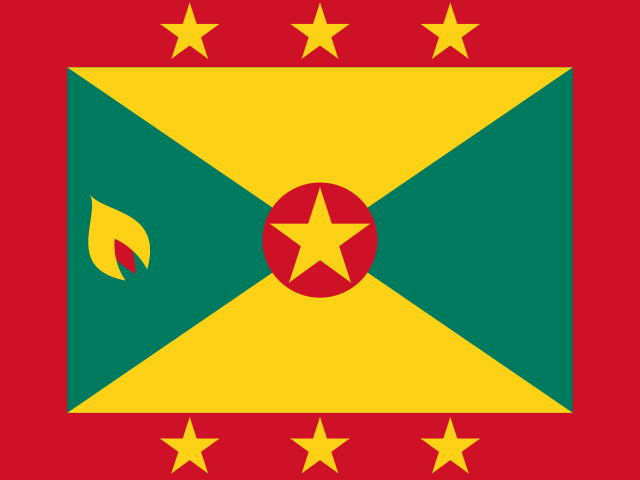
Spices are the heart of the agricultural sector. Nutmeg, the country's leading export, is featured on the national flag along with mace. The country also ships bananas, cocoa, fruit and vegetables, clothing, chocolate and fish abroad. Small growers dominate nutmeg production: roughly 74% of them sell under 500 lbs annually, whereas the few whose sales exceed 2,500 lbs generate about 40% of output. The industry suffered heavy damage from Hurricanes Ivan and Emily.
Tourism is concentrated in the southwest around St. George's, the airport and the coast, with ecotourism growing. Attractions include the 3 km Grand Anse Beach, waterfalls such as Annandale, and events like Spice Mas carnival in August, sailing week and the Carriacou Maroon and String Band Music Festival. St. George's University, a major medical school founded in 1976, is also an important source of foreign students and income (general knowledge).
Maurice Bishop International Airport links Grenada with the Caribbean, the US, Canada and Europe; Lauriston Airport serves Carriacou. Privately owned minibuses run on 9 zones and 44 routes on the main island, at a fare of EC$2.50 per segment, and there are taxis and the local ride-hailing service Haylup.
Demographics and urbanization
Roughly 82% of Grenadians are mainly of African descent, about 13% are of mixed descent, and about 2.2% are of Indian descent, descended from indentured workers brought between 1857 and 1885. There are small European-descended communities. Few Indigenous people survived after French colonisation.
The population is about 117,000, and most people live on the main island. Roughly a third to a half of residents live in urban areas (approx.). Main towns include the capital St. George's (city proper only a few thousand people, with a wider urban area of tens of thousands, approx.), Grenville and Gouyave; Hillsborough is the largest settlement on Carriacou.
Out-migration is high, especially among young people, to Barbados and other Caribbean islands, to New York, Toronto and Montreal, and to the United Kingdom.
English is the official language and the language of government, law and schooling. Grenadian Creole English is used informally. Grenadian Creole French (patois) is endangered, with very few elderly speakers left in the rural north and on Carriacou. Some Hindustani terms survive in Indo-Grenadian communities.
Religion (2011 estimates): Protestants about 49% (Pentecostals 17.2%, Seventh-day Adventists 13.2%, Anglicans 8.5%, Baptists 3.2%, others), Catholics 36%, no religion 5.7%, Jehovah's Witnesses 1.2%, Rastafari 1.2%, and other faiths about 5.5%. Freedom House gave religious freedom a score of 4 out of 4 in 2022.
Education runs from kindergarten through tertiary level. Literacy is about 98.6%, and the government devoted 10.3% of its 2016 budget to education. St. George's University specialises in medicine, veterinary medicine and public health.
Capital city
St. George's is the capital, on the southwest coast of the main island of Grenada. It is built around a horseshoe-shaped natural harbour called the Carenage, in the crater of an old volcanic formation, with hills rising steeply around it.
Its population is small, roughly 3,000-4,000 in the town itself and a few tens of thousands in the wider parish and urban area (approx.). The climate is tropical, with warm temperatures all year (approx. 24-31 °C), a wetter season from about June to November and a drier season in the first half of the year.
St. George's is the political and administrative seat, with Parliament and government ministries. It is also the main commercial and port centre, and the tourist zone of the southwest, including Grand Anse Beach, the airport at the southern tip and the university area, lies close by. Because the country is so small, it is effectively both the capital and the main economic city; Grenada has no separate administrative or economic capital.
About this summary
Capital-city details (approx. population, climate, role), city and town populations, urbanization rate, and a few economic and currency details come from general knowledge and are approximate.