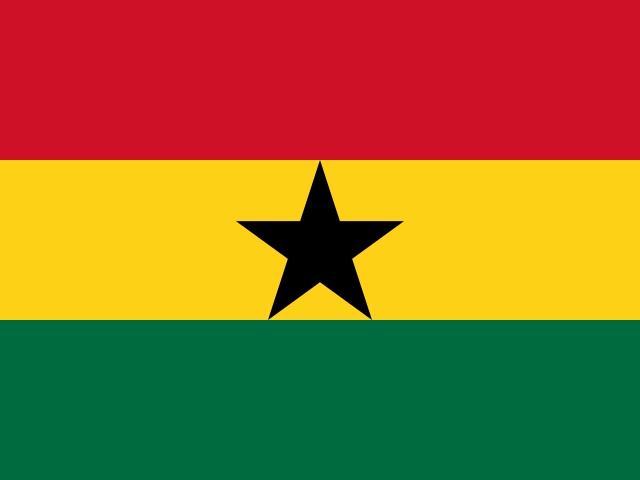
Overview
Ghana, officially the Republic of Ghana, is a West African country on the Gulf of Guinea and the Atlantic Ocean. It borders Ivory Coast to the west, Burkina Faso to the north and Togo to the east. It covers about 239,567 km2 (the source also gives 238,540 km2 in its geography section) and has an Atlantic coastline of roughly 560 km.
The population is about 34.6 million (UN, 2024), with a median age of about 21. The capital and most populous city is Accra. The landscape runs from coastal plains and savanna to forested hills in the centre and drier savanna in the north.
Ghana became the first Sub-Saharan African colony to gain independence, on 6 March 1957, under Kwame Nkrumah. Today it is a unitary presidential constitutional democracy, generally described as one of the more politically stable states in the region. It is a member of the UN, African Union, ECOWAS, Commonwealth and the Non-Aligned Movement (as a founder), and is an associate member of the Francophonie.
The economy is middle-income and built on gold, cocoa, oil and gas, and services. English is the official language, and Christianity is the largest religion (71.3% in the 2021 census).
History
Early states: The earliest known kingdoms in the area were Bonoman in the south, which existed by the 11th century, and Dagbon in the north. From about the 17th century, Akan states based largely on the gold trade grew up, including Adansi, Asante, Denkyira, Akyem, Akwamu and the Mankessim Kingdom. By the 19th century, much of southern Ghana was under the Asante Kingdom.
European contact: The Portuguese arrived in the 15th century to trade for gold and built a trading base they called São Jorge da Mina. In 1481 King John II of Portugal commissioned Diogo de Azambuja to build Elmina Castle, completed in three years. Dutch and other European powers later competed for the coastal trade, first in gold and then in enslaved people. The British eventually controlled the coast by the 19th century. The forts and castles, such as Elmina and Cape Coast, are UNESCO World Heritage monuments.
Colonial borders: After more than a century of resistance, the modern borders took shape from four British territories: the Gold Coast, Ashanti, the Northern Territories and British Togoland.
Independence: In 1947 the United Gold Coast Convention called for self-government in the shortest possible time. Kwame Nkrumah formed the Convention People's Party in 1949 with the motto 'self-government now' and led non-violent 'positive action' protests. He was jailed, then elected to Parliament in 1951 and released. At midnight on 6 March 1957 the four territories became one independent dominion within the Commonwealth under the Ghana Independence Act 1957. On 1 July 1960 Nkrumah declared a republic and became president. Independence Day is 6 March and Republic Day is 1 July.
Nkrumah era: Nkrumah promoted Pan-Africanism, helped found the Non-Aligned Movement and repressed political opposition. A 1964 amendment made Ghana a one-party state with him as president for life.
Coups and instability: On 24 February 1966 the armed forces overthrew Nkrumah in a coup codenamed Operation Cold Chop, led by Colonel Emmanuel Kotoka and Brigadier Akwasi Afrifa, while he was abroad. A National Liberation Council under Lieutenant General Joseph Ankrah took power. Alternating military and civilian governments, mostly troubled by economic problems, followed until Flight Lieutenant Jerry Rawlings took power in 1981 and suspended the constitution. He negotiated a structural adjustment plan and growth recovered in the 1980s.
Fourth Republic: A new constitution restoring multi-party politics came with the 1992 elections, which Rawlings won; he won again in 1996. A 1994 conflict in the north between the Konkomba and groups including the Nanumba, Dagomba and Gonja killed 1,000 to 2,000 people and displaced about 150,000.
Recent politics: John Kufuor (NPP) became president on 7 January 2001 and served two terms, the first peaceful transfer between elected leaders in the Fourth Republic. John Atta Mills (NDC) won in 2008 and died in office, and Vice President John Mahama succeeded him on 24 July 2012, then won the 2012 election. Nana Akufo-Addo took office in January 2017 and was re-elected in 2020. John Mahama won the 2024 election, defeating Mahamudu Bawumia. In 2021 Ghana launched Green Ghana Day to plant five million trees against deforestation.
Climate
Ghana has a tropical climate with wet and dry seasons. It sits across three zones: the eastern coast is warm and comparatively dry, the south-west is hot and humid, and the north is hot and dry.
Approx. city climates: Accra has a tropical savanna climate with temperatures around 24-33 C, a main rainy season in roughly April to June and a lesser one in September to October. Kumasi, in the forest belt, is hotter and wetter, with a tropical wet-and-dry pattern. Takoradi on the south-west coast is humid with heavier rainfall. Tamale in the north is hot and dry with one rainy season and a dusty Harmattan from December to February.
Geography: The highest point is Mount Afadja (885 m). The Volta system feeds Lake Volta, formed by the Akosombo Dam (1965), which the source describes as the world's largest reservoir by surface area. The Prime Meridian passes through Tema, near Accra.
Climate risks: Rising temperatures, changing rainfall, drought, floods, wildfires and sea-level rise are expected to affect infrastructure, hydropower, food security, water supply, farming and fisheries. Diseases such as malaria, dengue and cholera may increase. Ghana signed the Paris Agreement in 2016, aims to avoid 64 million tonnes of greenhouse gas emissions by 2030 compared with business as usual, and has committed to net zero by 2060.
Government and politics
Ghana is a unitary presidential constitutional democracy with a multi-party system dominated by two parties, the National Democratic Congress (NDC) and the New Patriotic Party (NPP). The 1992 constitution divides power among the president (head of state, head of government and commander-in-chief), Parliament, the Cabinet, the Council of State and an independent judiciary. Elections are held every four years by universal suffrage, and presidents are limited to two terms.
Because the state is unitary, sub-national bodies hold delegated powers. Approx.: the country is divided into 16 regions and a few hundred metropolitan, municipal and district assemblies. These handle local planning, local services and local revenue, while taxation, health policy, the legal system, courts and education policy are set nationally. Regions mainly coordinate rather than legislate. There are no federal-style states, though traditional authorities such as chiefs and the Asante kingdom keep important customary roles in land and local affairs.
Governance indicators in the source: Ghana ranked 7th in the 2022 Ibrahim Index of African Governance and 10th in Africa for electoral democracy in the 2023 V-Dem indices. It scored 41 on Transparency International's 2018 Corruption Perceptions Index (78th of 180).
Foreign policy: Ghana follows non-alignment, is a founding member of the Non-Aligned Movement and the African Union, and is active in the UN. China is a major investor in infrastructure, resources and manufacturing, with concerns raised about project sustainability and transparency.
Security: The Ghana Armed Forces operate under the Ministry of Defence and take part in peacekeeping, with training linked to the Kofi Annan International Peacekeeping Training Centre. The Ghana Police Service has 12 divisions, including one for Tema and a Marine Police Unit. Ghana is also used as a transshipment point for narcotics.
Human rights: Homosexual acts are illegal. The source says further laws in 2026 created a duty to report such acts and criminalised 'supporters' of LGBTQ+ people. Accusations of witchcraft against elderly women, especially in the north, persist; camps house about 1,000 people. An anti-witchcraft bill passed in 2023 was not signed by the president and was reintroduced in 2025.
Economy
Ghana is a middle-income, mixed economy and emerging market. By the source's breakdown, services are about 50% of GDP, manufacturing 24.1%, extractives 5% and taxes 20.9%. The 'Ghana Vision 2020' plan aimed at developed-country status by 2020-2029.
Gold and minerals: Ghana was the 7th-largest gold producer in 2019 (about 140 tonnes), overtaking South Africa to become Africa's largest. It also exports silver, timber, diamonds, bauxite and manganese. The government has discussed nationalising mining to raise revenue.
Cocoa: Ghana is the world's second-largest cocoa producer and a member of the ICCO.
Oil and gas: The Jubilee field, discovered in 2007, holds up to about 3 billion barrels. Total reserves are put at 5 to 7 billion barrels plus large gas reserves. The state firm GNPC oversees exploration and production.
Energy: The Volta River Authority and GNPC are the main power producers. Hydropower comes from Akosombo, Bui, Kpong and other dams. Shortages in 2015-2016 caused 'dumsor' outages, but the source reports a surplus by 2019.
Other sectors: Manufacturing includes vehicle and ship assembly and electronics. Urban electric cars have been made since 2014. The Ghana Stock Exchange was Africa's fifth-largest and sub-Saharan Africa's third-largest in 2012 by the source's account. In autumn 2021 Ghana announced social and green bond plans, billed as a first in Africa, after recording its lowest growth in 37 years in 2020. Free senior high school began in 2017-2018.
Poverty: In 2012-2013, 38% of rural dwellers lived in poverty versus 11% of urban dwellers, and 94% of rural poor households worked in agriculture.
Approx. recent context: Ghana went through a sovereign debt crisis and restructuring from 2022, with high inflation and cedi depreciation, followed by stabilisation under an IMF programme.
Technology and tourism: Ghana ranked 101st in the 2025 Global Innovation Index. Ghana has a space agency, and mobile networks launched in 1992. Tourism is the fourth-largest foreign exchange earner, with about 1.09 million arrivals in 2011. Attractions include Wli Falls, Lake Volta, Lake Bosumtwi, beaches, national parks and the Cape Coast and Elmina castles.
Demographics and urbanization
The population is about 34.6 million (UN, 2024), with a median age of 21. About 29% were under 15 in 2018. Ethnic groups in the 2010 census were Akan 47.3%, Mole-Dagbani 18.5%, Ewe 13.9%, Ga-Dangme 7.4%, Gurma 5.7% and Guan 3.7%.
Urbanization: approx. 58-60% of people live in towns and cities, mostly in the south. The Greater Accra and Kumasi areas and the coast hold the most people, while the north is more rural. The fertility rate is lower in urban areas (2.78 versus 3.94 rural in 2010).
Largest cities, approx.: Greater Accra about 5 to 6 million; Kumasi (Ashanti region) about 3 million in its metro area; Tamale in the north and Sekondi-Takoradi on the coast each have under 1.5 million.
Migration: The 2010 immigration service report put economic migrants and undocumented immigrants at 14.6% (3.1 million) of the population, mostly Nigerians, Burkinabe, Togolese and Malians. Skilled immigrants with Ghana Cards include growing numbers of Chinese, Indian, Middle Eastern, American and European nationals. In 1969 the Aliens Compliance Order expelled over 3 million people, and in 2013 over 4,000 Chinese miners were deported.
Languages: English is official. Eleven languages are government-sponsored, including Asante Twi (the most widely spoken), Akuapem Twi, Fante, Nzema, Dangme, Ewe, Ga, Gonja, Kasem, Dagaare and Dagbanli. Hausa is common in the north. French is taught in schools, and Ghanaian Pidgin English is spoken in Accra and southern towns.
Religion: Christians make up 71.3% (2021 census) and Muslims 16.8%, with others including traditional faiths and those with no religion.
Health: The National Health Insurance Scheme covers Ghanaian nationals only. Life expectancy in 2021 was 68.6 (women) and 63.7 (men). Urban centres have most hospitals and clinics, and Ghana is a destination for medical tourism.
Education: Basic education lasts 11 years (ages 4-15), followed by three years of senior high school and then tertiary study. Senior high became free from 2017-2018. Over 95% of children are in school, and youth literacy was 81% in 2010. Universities include the University of Ghana, KNUST and the University of Cape Coast.
Capital city
Accra is on the Gulf of Guinea coast in the south-east and is Ghana's capital and most populous city. The Greater Accra area has roughly 5 to 6 million people (approx.), and the city proper is smaller.
Climate (approx.): tropical savanna, hot all year (about 24-33 C), relatively dry for a coastal West African city, with rains peaking in May-June and a smaller season in October. The Harmattan brings dry, hazy air in December-February.
Role: Accra is the political capital, housing the presidency (Flagstaff House), Parliament and the ministries. It is also the main economic and commercial centre, with the central bank, the Ghana Stock Exchange, most corporate headquarters, embassies, international organisations and many expat residents. It is a cultural centre with museums, music and nightlife. The nearby port city of Tema, on the Prime Meridian, is the main seaport and industrial hub. The University of Ghana is in the Accra area.
Ghana has a single capital, and it is also the main economic city, so there is no split between administrative and economic centres. Kumasi is the major secondary city and the traditional Asante centre.
About this summary
Capital-city details (Accra metro population, climate, institutions), major-city populations and climates, recent economic events (debt restructuring, inflation) and the 2024 election context are from general knowledge and approximate.