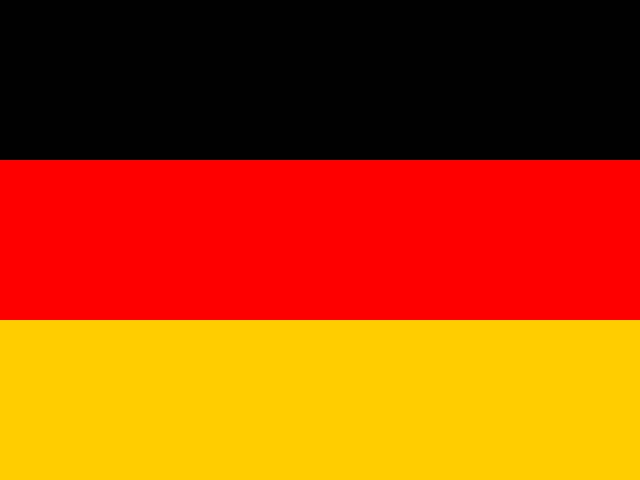
Overview
Germany, officially the Federal Republic of Germany, sits in Western and Central Europe between the North Sea and Baltic Sea in the north and the Alps in the south. It is made up of 16 states and has a population of over 83 million, the largest of any EU member state.
It shares borders with nine countries: Denmark, Poland, the Czech Republic, Austria, Switzerland, France, Luxembourg, Belgium and the Netherlands. Its territory covers about 357,000 km2, ranging from the Zugspitze (2,963 m) in the Alps to areas below sea level in the northern marshes.
Berlin is the capital and the most populous city. Frankfurt is the main financial centre, and the Ruhr is the largest urban area.
Germany is a developed country with the largest economy in Europe by nominal GDP. It is the world's third-largest exporter and third-largest importer, and it is widely regarded as a great power. It holds 55 UNESCO World Heritage Sites, 52 of them cultural, the third-highest count of any country.
Major natural resources include coal, lignite, potash, iron ore, salt, natural gas, timber, copper and nickel. About 51% of the land is farmed, 30% is forest and 14% is settlement or infrastructure (2016). There are 16 national parks, 17 biosphere reserves and 105 nature parks.
History
Humans have lived in the area for at least 600,000 years. The first recognised Neanderthal fossil was found in the Neander Valley. Caves in the Swabian Jura have produced 42,000-year-old flutes, the oldest known musical instruments, as well as the 40,000-year-old Lion-man and the 41,000-year-old Venus of Hohle Fels.
Celtic-speaking peoples of the La Tène culture lived in the south and were later absorbed by Germanic groups expanding from southern Scandinavia and northern Germany. Under Augustus, Rome pushed into Germanic lands and briefly held a province between the Rhine and Elbe. In 9 AD Arminius defeated three Roman legions at the Battle of the Teutoburg Forest.
Charlemagne created the Carolingian Empire in 800, and it was split in 843. Its eastern part, East Francia, reached from the Rhine to the Elbe and from the North Sea to the Alps, and from it grew the Kingdom of Germany and the Holy Roman Empire. The Ottonian dynasty (919 to 1024) brought several large duchies under firmer royal control. In 996 Gregory V became the first German pope, and he soon crowned his cousin Otto III as emperor. Under the Salian emperors (1024 to 1125) the empire also took in northern Italy and Burgundy.
In the 16th century northern German lands became the heart of the Protestant Reformation. The Holy Roman Empire was dissolved in 1806 during the Napoleonic Wars. After Napoleon's fall, the Congress of Vienna set up the German Confederation in 1815, a loose league of 39 sovereign states led by an Austrian president. A customs union, the Zollverein, strengthened economic ties, while liberal movements met repression and fed into the revolutions of 1848.
Prussia led the unification of Germany, and the German Empire was founded in 1871. After defeat in World War I and a revolution, a republic was proclaimed on 9 November 1918 by the Social Democrat Philipp Scheidemann. The Treaty of Versailles (1919) cost Germany around 13% of its European territory and all its colonies, and many Germans saw it as humiliating. The democratic Weimar Constitution was signed on 11 August 1919.
The Nazis came to power in 1933 and built a totalitarian dictatorship, which led to World War II and the Holocaust. After surrender, the Allies abolished the German state and divided the country and Berlin into four occupation zones.
The three western zones were reorganized on 23 May 1949 as the Federal Republic of Germany, whose provisional capital was Bonn. Later that year, on 7 October 1949, the Soviet zone turned into the German Democratic Republic, governed from East Berlin. West Germany was set up as a federal parliamentary republic built on a social market economy. It received Marshall Plan aid, and during Konrad Adenauer's term as Chancellor it enjoyed a lengthy period of economic growth called the Wirtschaftswunder. In 1955 it became a member of NATO, and it also helped found the European Economic Community. Saarland became part of it on 1 January 1957.
East Germany stayed under Soviet control, belonged to the Warsaw Pact and Comecon, and was ruled by the Socialist Unity Party. The Stasi ran a large network of informants to suppress dissent. The Berlin Wall, built in 1961, became a symbol of the Cold War. Chancellor Willy Brandt's Ostpolitik eased tensions in the late 1960s.
In 1989 Hungary opened its border with Austria, triggering mass emigration from East Germany, and large demonstrations followed. The Berlin Wall fell in 1989. The Two Plus Four Treaty restored full sovereignty, and Germany renounced claims to former eastern territories. Reunification took place on 3 October 1990, when the five re-established eastern states joined the Federal Republic. Full sovereignty was regained on 15 March 1991.
The Berlin/Bonn Act of 1994 made Berlin the capital again, with Bonn keeping the status of federal city and some ministries. The government move was completed in 1999. Germany signed the Maastricht Treaty (1992) and Lisbon Treaty (2007) and co-founded the eurozone. It sent peacekeepers to the Balkans and troops to Afghanistan.
Angela Merkel became the first female chancellor in 2005. A €50 billion stimulus plan was approved in 2009. Major projects of the early 21st century include European integration, the Energiewende, the debt brake, pronatalist measures and the Industry 4.0 strategy. During the 2015 migrant crisis Germany took in over a million refugees and migrants.
Climate
Most of Germany has a temperate climate, oceanic in the north and west and more continental in the east and southeast, with a small humid subtropical portion. Winters are generally cool and overcast with limited precipitation, and colder in the Alps. Summers range from hot and dry to cool and rainy. Westerly winds bring moist North Sea air to the north, which moderates temperatures and adds rainfall, while the southeast sees more extreme temperatures.
Monthly average temperatures from February 2019 to February 2020 ran from about 3.3 °C in January 2020 to about 19.8 °C in June 2019. Monthly sunshine ranged from roughly 45 hours in November to about 300 in June.
City examples (approx.): Berlin has a temperate, transitional oceanic-continental climate, with cold winters around 0 °C and warm summers with highs near 24 to 25 °C. Hamburg is oceanic, cool and damp, with mild summers and winters just above freezing. Munich lies near the Alps and has colder winters with frequent snow and warm summers with heavy rain. Frankfurt in the Rhine-Main area is among the warmer large cities, with mild winters and hot summers. Cologne and the Ruhr are oceanic and mild.
Climate change is bringing more intense heat waves and cold spells, flash and coastal flooding, reduced water availability and long-term effects on agriculture.
Government and politics
Germany is a federal, parliamentary, representative democratic republic governed under the 1949 Basic Law (Grundgesetz). Amendments usually need a two-thirds majority in both the Bundestag and the Bundesrat. The principles of human dignity, separation of powers, federal structure and rule of law cannot be changed.
The Bundestag is elected directly through personalised proportional representation with a 5% threshold (or 3 direct seats). The Bundesrat represents the 16 state governments. Together they form the legislature.
The president is head of state with mainly representative duties. Frank-Walter Steinmeier has held the post since 2017, elected by the Federal Convention, made up of Bundestag members and an equal number of state delegates. The chancellor is head of government and runs the executive through the cabinet. Friedrich Merz has been chancellor since 2025. The president of the Bundestag ranks second in the order of precedence.
Since 1949 the Christian Democratic Union (centre-right) and Social Democratic Party (centre-left) have dominated, and every chancellor has come from one of them. The Free Democratic Party and the Greens have served as junior coalition partners. The Left has sat in the Bundestag since 2007 and the far-right Alternative for Germany since 2017.
Germany has 16 states (Länder). Thirteen are area states, and Berlin and Hamburg are city-states where state and local government are not separate. Bremen is also called a city-state and includes the city of Bremen and the exclave of Bremerhaven. Each state has its own constitution and is largely autonomous in how it organises itself. States are responsible for education supervision, and criminal and civil law are codified nationally. Below the states are 401 districts (Kreise): 294 rural and 107 urban (2017).
The legal system is civil law based on Roman law. The Federal Constitutional Court handles constitutional matters and can review laws. Specialised federal courts cover civil and criminal, labour, social, fiscal and administrative cases. Serious cases are heard by mixed panels of professional and lay judges (Schöffen). The penal system emphasises rehabilitation and public protection.
The murder rate was 1.18 per 100,000 in 2016. Overall crime fell to its lowest level since 1992 in 2018, though reports for 2024 showed violent crime at a 15-year high and overall crime rising. Same-sex marriage has been legal since 2017.
Germany has 227 diplomatic missions and relations with more than 190 countries. It belongs to NATO, the OECD, the G7, the G20, the Council of Europe, the World Bank and the IMF. It is a key EU member with close ties to France and the United States, and it was the world's second-largest aid donor in 2019.
The Bundeswehr has army, navy, air force and cyber branches, with about 180,000 active soldiers and 81,000 civilians (May 2024). Conscription was suspended in 2011 and women may serve in all roles. After Russia's 2022 invasion of Ukraine, Germany announced a one-time 100 billion euro fund and higher defence spending. Reported spending to NATO for 2026 is about $147 billion, or 2.69% of GDP. About 3,000 troops are deployed abroad (2026), including about 1,800 in Lithuania and nearby countries. Germany was the fourth-largest major arms exporter in 2021 to 2025.
Economy
Germany has a social market economy with a skilled workforce, low corruption and high innovation. It is the largest economy in Europe by nominal GDP, third-largest in the world by nominal GDP and sixth-largest by PPP. PPP GDP per capita was 115% of the EU average in 2024. Services make up about 72% of GDP, industry 27% and agriculture 1% (2023). Europe's largest manufacturing output is German.
Germany adopted the euro in 2002, with monetary policy handled by the European Central Bank in Frankfurt. The country accounted for 28% of the eurozone economy in 2017. It ranks third in the world for both exports and imports, and only China runs a larger trade surplus. In 2025, China, the United States and the Netherlands were its biggest trade partners. Vehicles, machinery and chemicals are the main goods it exports.
The car industry is among the most competitive in the world, the largest in the world by export value in 2023. Volkswagen Group is the world's second-largest carmaker by output. Other leading firms include Mercedes-Benz, BMW, Audi, Porsche, Siemens, Adidas, SAP, Bosch and BASF. 29 Fortune Global 500 companies were based in Germany in 2024. The DAX index covers 30 major companies on the Frankfurt Stock Exchange.
Many small and medium firms, the Mittelstand, make up around 48% of global market leaders in their niches, called hidden champions. Berlin is a start-up hub and a leading European location for venture-capital-funded companies.
Germany has ranked fourth in R&D spending since 2005 and ranked 11th in the Global Innovation Index in 2025. Key institutions are the Max Planck Society, Helmholtz Association, Fraunhofer Society and Leibniz Association. Germany is the largest contributor to the European Space Agency.
Germany is a central European transport hub with one of the densest road networks in Europe. The Autobahn has no general speed limit for some vehicle classes. ICE high-speed trains run up to 300 km/h. Main airports are Frankfurt, Munich and Berlin Brandenburg. The Port of Hamburg is the third-busiest in Europe.
The Energiewende aims at a sustainable economy through efficiency and renewables. Renewables supplied about 40% of power in 2018, and all nuclear plants closed in 2023. The household recycling rate is around 65% (2017). Germany ranked 14th among greenhouse gas emitters in 2023 and is committed to the Paris Agreement.
Tourism contributed over €105 billion to GDP in 2015 and supported nearly 4.2 million jobs. Germany is the seventh-most-visited country (2024). Landmarks include Cologne Cathedral, the Brandenburg Gate, the Reichstag, Neuschwanstein Castle and Heidelberg Castle. Unemployment was 3.2% in January 2020 per Eurostat.
Demographics and urbanization
The 2023 census recorded 84.7 million people, density of about 236 per km2. The fertility rate is 1.36 (2024 estimate), below replacement but slightly above the EU average of 1.34. Deaths have exceeded births since the 1970s, though births and migration have risen since the early 2010s. The average age is 47.8, among the oldest in the world.
Germany is a major immigration destination. In 2015 it hosted about 12 million international migrants, roughly 5% of the global total. Over 1.06 million Ukrainian refugees were recorded by April 2023. In 2022, 23.8 million people (28.7%) had a migration background.
Germany has over 2,000 cities and towns and 11 recognised metropolitan regions. Berlin is the most populous city (approx. 3.7 million), and the Ruhr is the largest urban area (approx. 5 million). Other large cities (approx.) are Hamburg (1.9 million), Munich (1.5 million), Cologne (1.1 million) and Frankfurt (0.8 million). Urbanization is high, approx. 77%.
National minorities are Danes in Schleswig-Holstein, Sorbs in Lusatia, Roma and Sinti across the country, and Frisians on the north-western coast. German is the official language, with around 100 million native speakers in the EU. Recognised minority languages include Danish, Low German, Sorbian, Romani and North and Saterland Frisian. Common immigrant languages include Turkish, Arabic, Kurdish, Polish, Italian and Russian. 74% of Germans speak at least one foreign language.
Per the 2022 census 49.7% were Christian (23.1% Protestant, 25.1% Catholic). A 2025 estimate based on membership rolls put 48.1% as non-members of any religious body, and irreligion is strongest in big cities and the former East. Islam is the second-largest religion, with an estimated 5.3 to 5.6 million Muslims with a migrant background in 2019, mostly from Turkey. The Jewish community is small, with 60% of its members living in Berlin (2011).
Education is run by the states. Kindergarten is optional, and school is compulsory for at least nine years. Secondary school has academic and vocational tracks, and the dual apprenticeship system combines company training with state trade schools. Most universities are public and traditionally free of fees, with the Abitur as the usual entry requirement. Heidelberg (1386), Leipzig (1409) and Rostock (1419) are the oldest. Humboldt University of Berlin (1810) became a model for many Western universities.
Germany has the world's oldest universal health care system, dating from the 1880s. Health insurance is statutory, with some groups able to choose private cover. Health spending was 12.27% of GDP in 2024. Life expectancy in 2019 was 78.7 years for men and 84.8 for women, with infant mortality of 4 per 1,000. Cardiovascular disease causes 37% of deaths. About 52% of adults were overweight or obese in 2014. Mental health demand is rising, and there is a shortage of psychotherapists.
Capital city
Berlin, in the north-east, is the capital and the most populous city, with about 3.7 million residents (approx.) and a wider metro area of about 6 million (approx.). It is a city-state, so it is also one of the 16 states. It became the capital of reunified Germany under the 1994 Berlin/Bonn Act, and the government move was completed in 1999. Bonn remains a federal city with some ministries.
Berlin is the seat of the main political institutions, including the Bundestag and the chancellery. It is also a cultural centre, with the oldest zoo in Germany (1844), and a major start-up hub, leading in venture-capital-funded firms in Europe. Its history includes serving as East Germany's capital and being divided by the Berlin Wall from 1961.
Climate (approx.): temperate with cold winters near 0 °C, warm summers with highs around 24 to 25 °C, and moderate rainfall year-round.
Berlin is not the main financial centre. Frankfurt is, hosting the European Central Bank and the Frankfurt Stock Exchange. The Ruhr is the largest urban area, and economic power is spread across several cities, including Munich, Hamburg and Stuttgart (approx.).
About this summary
Some history details (medieval and 20th-century periods), city populations and climates, metro areas, and capital-city details come from general knowledge and are approximate.