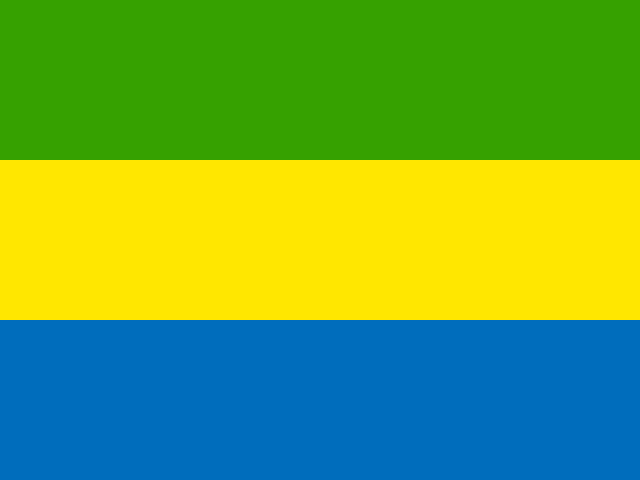
Overview
Gabon sits on the Atlantic shore of Central Africa and straddles the equator. Equatorial Guinea lies to its northwest, Cameroon to its north, and the Republic of the Congo to its east and south. At sea it faces São Tomé and Príncipe across the Gulf of Guinea. Its territory covers about 270,000 square kilometres and it has roughly 2.3 to 2.6 million inhabitants (sources differ).
The land is a mix of coastal plains, the Cristal Mountains and Chaillu Massif in the centre and north, and savanna in the east. Rainforest covers close to 89% of the land, which makes Gabon one of the most heavily forested countries anywhere. Libreville is the capital and largest city; Port-Gentil and Franceville are other major centres.
Gabon has been independent from France since 1960 and has had four presidents. The Bongo family held power for 55 years, first through Omar Bongo (from 1967) and then his son Ali Bongo, until a military coup in August 2023. General Brice Oligui Nguema then led a transition and won the April 2025 presidential election.
Gabon is classed as a developing country and ranks 108th on the Human Development Index. Its per capita income is among the higher ones in Africa, with nominal GDP per capita of about $10,149 in 2023, but income is very unevenly shared and a large part of the population is poor. Oil and foreign private investment underpin this relative wealth.
French is the official language and is widely spoken, especially in cities. Bantu groups make up about 95% of the people, and most Gabonese are Christian.
History
The earliest known inhabitants were rainforest hunter-gatherers, collectively called the Bambenga. Bantu-speaking migrants began to settle from about the 13th century BCE and formed farming communities. After ironworking spread in the 7th century CE, Bantu groups became dominant and largely absorbed or replaced the Bambenga. By the 14th century the Vili Kingdom of Loango had extended its influence north along the Gabonese coast. The Kingdom of Orungu emerged around 1700. From the late 16th to the 18th centuries European merchants visited the coast for ivory and the slave trade.
In 1875, Pierre Savorgnan de Brazza, an explorer, headed his initial expedition into the Gabon-Congo region; he later established Franceville and rose to serve as colonial governor. The French made their occupation of the territory official in 1885. Two years later, in 1887, French officers shut down the slave warehouses located at Cape Lopez and Mayumba. Gabon was incorporated into French Equatorial Africa in 1910, a federation that remained in place until 1958. Under colonial rule, the indigénat subjected most inhabitants to a legal status inferior to that of the colonizers. Independence came to Gabon in 1960.
Léon M'ba was elected the first president in 1961, with Omar Bongo as vice president. M'ba curtailed the press, protests and free expression, pushed other parties out and reshaped the constitution on French lines to concentrate power in the presidency. When he dissolved the National Assembly in 1964 to establish one-party rule, army officers staged a coup, but French paratroopers arrived within 24 hours and restored him.
M'ba died in 1967 and Bongo succeeded him. In 1968 he declared a one-party state, replacing M'ba's Gabonese Democratic Bloc with the Parti Démocratique Gabonais (PDG), which he used to damp down regional and tribal rivalries. His rule rested on a client network linked to France, often called Françafrique.
Following a national political conference in March–April 1990, reforms were approved: a Senate, a more decentralised budget process, freedom of assembly and press, and the end of exit visas. Bongo gave up the PDG chairmanship and set up a transitional government under Prime Minister Casimir Oyé-Mba that included some opposition figures. A transitional constitution in May 1990 was followed by a final version adopted in March 1991, and opposition parties were legalised in January 1991.
Bongo was re-elected in 1993 with about 51% of the vote and the opposition rejected the result. Unrest and repression led to the Paris Accords of November 1994 and a short-lived government of national unity. The 1996–1997 legislative and municipal elections restored party competition, with the PDG winning the legislative vote.
Omar Bongo died on 8 June 2009 and Senate president Rose Francine Rogombé became interim president. In the 2009 election, the first without Omar Bongo as a candidate, 18 candidates stood and his son Ali Bongo was declared the winner by the Constitutional Court after a three-week review. Some opposition candidates doubted the result. Violent protests in Port-Gentil killed four people, damaged property including the French Consulate and a prison, and a curfew lasted more than three months. In June 2010 a partial by-election saw both the PDG and the new Union Nationale coalition, mostly PDG defectors, claim victory.
In January 2011 André Mba Obame declared himself president, named 19 ministers and took shelter in a UN office in Libreville; the government dissolved his party. The 2016 election between Ali Bongo and Jean Ping was disputed. Protests in the capital were repressed, the opposition headquarters was bombed (allegedly by the presidential guard), and reports cite 50 to 100 deaths and about 1,000 arrests. Observers criticised irregularities and the European Parliament passed resolutions calling for an investigation.
In January 2019 soldiers made an unsuccessful coup attempt while Ali Bongo was in Morocco recovering from a stroke. In June 2021 Gabon became the first African country to be paid for reducing deforestation and related emissions. It joined the Commonwealth in June 2022.
In August 2023, after Ali Bongo was announced as winner of a third term, military officers took power, cancelled the results and dissolved state institutions including the judiciary and parliament. On 31 August General Brice Oligui Nguema was named transitional leader and sworn in as interim president, ending 55 years of Bongo family rule. Gabon was partly suspended from the Commonwealth and suspended from the African Union.
A referendum in November 2024 approved a new constitution. Nguema won the presidential election of 12 April 2025 with over 90% of the vote and became the fourth president. The Commonwealth said the vote largely reflected voters' will and restored Gabon's full membership in July 2025; the African Union also reinstated Gabon.
Climate
Gabon has an equatorial climate: hot and humid all year, with heavy rainfall and dense rainforest. It lies between roughly 3°N and 4°S. Temperatures are fairly steady, typically around 22–32°C (approx.), with a main dry season roughly from June to August or September and rainy seasons around the rest of the year.
Libreville, on the northwest coast, has a tropical monsoon climate (approx.): warm and humid year-round, with annual rainfall of around 2,500–3,000 mm (approx.), and a dry spell in the middle of the year. Port-Gentil, on the coast to the south, is similar but somewhat drier and slightly cooler during the dry season (approx.). Franceville, in the southeast interior at higher elevation, has a tropical climate with slightly lower temperatures and a more marked dry season (approx.).
Gabon is highly exposed to climate change because much of its population and economy sits along the coast and agriculture depends on rain. Rising seas threaten to erode the shore and salt freshwater supplies, and floods, droughts and storms are becoming more frequent. The vast forests absorb more carbon than the country emits, and Gabon is widely regarded as one of the most carbon-positive countries. About 10% of the land became national park in 2002, in 13 parks.
Wildlife is exceptionally rich: about 604 bird species, 98 amphibians, roughly 95 to 160 reptiles and 198 mammals, with more than 6,000 plant species. Gabon holds more than half of Africa's forest elephants, plus important populations of chimpanzees and gorillas. The black panther is a national symbol. Elephants in Minkébé National Park fell by roughly 78–81% between 2004 and 2014, mainly because of poaching. The Ogooué is the longest river at about 1,200 km, and the natural Oklo fission reactor zones date back about 2 billion years.
Government and politics
Gabon operates as a presidential republic. Its constitution dates to 1961 and was revised in 1975, replaced in 1991 and revised again in 2003. In November 2024, voters approved a new constitution in a referendum, though this paragraph does not cover that text's details. Under the earlier framework, citizens elected the president by universal suffrage to a seven-year term, and after 2003 there was no limit on the number of terms. The president named and removed the prime minister, the cabinet and the Supreme Court judges. The president also had the power to call referendums, put off the passage of laws, proclaim a state of siege, or dissolve the National Assembly.
The parliament has been bicameral: a National Assembly of 120 deputies elected for five years, and a Senate of 102 members chosen by municipal councils and regional assemblies for six-year terms. The Senate president is next in line to the president. After the 2023 coup the transitional authorities dissolved the main institutions; the current structure follows the 2024 constitution.
Gabon is a unitary state, not a federation. It has 9 provinces and 50 departments, and the president appoints provincial governors, prefects and sub-prefects. Sub-national units therefore act mainly as administrative arms of central government. Taxation, law, health and education policy are set nationally; the Ministry of Education runs schooling up to the end of secondary school and a separate ministry handles higher education. Municipal councils and regional assemblies exist and elect the Senate. There are no autonomous special jurisdictions. The provinces and capitals are Estuaire (Libreville), Haut-Ogooué (Franceville), Moyen-Ogooué (Lambaréné), Ngounié (Mouila), Nyanga (Tchibanga), Ogooué-Ivindo (Makokou), Ogooué-Lolo (Koulamoutou), Ogooué-Maritime (Port-Gentil) and Woleu-Ntem (Oyem).
In 2009 Ali Bongo cut 17 minister-level posts, abolished the vice presidency and launched the 'Gabon Emergent' programme with three pillars (Green, Service and Industrial Gabon) aiming to diversify away from oil, reduce corruption and modernise the workforce. Raw timber exports were banned and a national oil company was created.
In foreign policy Gabon has been nonaligned, favouring dialogue, and has mediated in Chad, the Central African Republic, Angola, both Congos and Burundi. Bongo's mediation helped produce a 1999 peace accord in Brazzaville and he took part in the DRC peace process and an Ivory Coast crisis. Gabon belongs to the UN, World Bank, IMF, African Union, CEMAC, ECCAS, the Organisation of Islamic Cooperation, the Non-Aligned Movement and the Commonwealth (since 2022). It left OPEC in 1995 and rejoined in 2016. In 2024 Nguema told American and French leaders that Gabon would be a Western ally as part of a plan to tackle its debt problems.
The armed forces have about 5,000 professional personnel across army, navy, air force, gendarmerie and police, plus a presidential guard of about 1,800.
Economy
Gabon's economy depends heavily on oil and other natural resources. Oil provides roughly 46% of government revenue, 43% of GDP and 81% of exports. Output was about 200,000 barrels per day in 2023. The Grondin field, discovered offshore in 1971, had about 60% of its estimated reserves extracted by 1978. Before oil, logging was the economic mainstay, and timber and manganese remain important.
Overspending on the Trans-Gabon Railway, the 1994 CFA franc devaluation and low oil prices created debt problems. In the 1990s, at the urging of the World Bank and IMF, the government began privatising state companies and reforming administration. IMF programmes included a Stand-By Arrangement completed in 2005 and another approved in 2007, which was not met in 2009 amid the financial crisis and Omar Bongo's death. The IMF has repeatedly criticised off-budget spending and borrowing from the central bank.
Per capita GDP is high for the region (about $8,600 in one cited estimate and $10,149 nominal in 2023), but distribution is highly skewed: the richest 20% receive over 90% of income and about a third of people live in poverty. Rural households without jobs in extraction often rely on subsistence farming or remittances from relatives in cities.
Gabon is the world's second-largest manganese producer; manganese ore was 16% of exports in 2023. Because it has no domestic processing, the government announced in June 2025 a ban on raw ore exports from 1 January 2029, to encourage local plants, skilled jobs and tax revenue, through a public-private partnership. Exploration also suggests a very large unexploited iron ore deposit.
Diversification is held back by a small domestic market (about a million consumers, in one description), dependence on imports from France, limited use of regional markets, a steady stream of oil rent, and poor infrastructure that complicates agriculture and tourism. Some processing and service sectors are dominated by a few big local investors.
Energy comes mostly from solid biofuels and waste (about 75% of the energy supply) and from oil. Nearly half of power generation is renewable. Nearly two-thirds of people have electricity, but only 15% of rural areas did in 2014. The goal is universal access by 2035. Gabon emitted about 24.7 million tonnes of greenhouse gases in 2023 (about 0.04% of the global total) and has pledged to remain carbon neutral beyond 2050, maintaining net removals of about 100 million tonnes of CO2 equivalent a year with adequate support.
Demographics and urbanization
Gabon's population is roughly 2.3 to 2.6 million, depending on the source, and one of the lowest densities in Africa. It fell between 1900 and 1940 because of historical and environmental factors. Gabon has the fourth highest HDI in Sub-Saharan Africa.
With about 92% urbanisation in 2025, Gabon is described as the most urbanised country in Africa. Around 59% of all people live in Libreville and Port-Gentil. Libreville is home to roughly 700,000–800,000 people (approx.), Port-Gentil about 140,000–200,000 (approx.) and Franceville about 110,000–150,000 (approx.). Urbanisation was under 20% at independence in 1960, rose with colonial trading posts and then the oil boom of 1973–1985, and reached two-thirds by 1988. Over 97% of Libreville residents have clean drinking water, compared with under 55% in rural areas.
There are at least 40 ethnic groups, mostly Bantu. In the 2021 survey the Fang account for 23.5%, Shira-Punu/Vili 20.6%, Nzebi-Duma 11.2%, Teke-Mbede 5.6%, Myènè 4.4%, Kota-Kélé 4.3% and Okandé-Tsogho 1.6%, with about 12.6% from other Gabonese groups, including the Bambenga forest peoples (Bongo, Baka and Bakoya). Non-citizens make up 16.2% (about 416,651), mostly male workers from Francophone African countries such as Equatorial Guinea, Mali, Benin, Togo, Cameroon and Senegal, plus Ghanaian and Nigerian communities, an estimated 16,000 Hausa and, in 2016, over 14,000 French citizens. No single group dominates and ethnic discrimination is relatively uncommon.
French is the official language and the main language of business, administration, education and media. About 65% of people could speak it in 2022, and a 2024 survey found 84% using it as their primary home language, so Gabon has the highest share of French speakers in Africa. About 40 indigenous languages exist, mostly Bantu, with Baka (an Ubangian language) as the exception; around 24 are endangered. Fang is the most spoken (about 350,000 speakers), followed by Punu, Njebi and others. In 2013, 63.7% could speak a Gabonese language.
About 85% of people are Christian (Catholic and Protestant), around 10% are Muslim (mainly Sunni), and traditional beliefs persist, sometimes blended with Christianity.
Health: life expectancy was 68.5 years in 2024, the fertility rate fell from 5.76 in 1983 to 3.59 in 2024, infant mortality was 25.9 per 1,000 live births, and maternal mortality was 233 per 100,000 in 2023. HIV prevalence is about 5.2% of adults. Albert Schweitzer's hospital in Lambaréné dates from 1913. Childhood immunisation rates have slipped in recent years (for example about 66% for tuberculosis in 2025). In 2024, 88.6% had at least basic drinking water, but only about 49% of rural residents had access in 2026, and in July 2026 the government declared a nationwide water emergency because of low rainfall and ageing facilities, including in Libreville. The 2024 Global Hunger Index score of 17.4 indicates moderate hunger.
Education is compulsory from ages 6 to 16: six years of primary and seven of secondary school, with graduation planned at 19. Literacy was about 82% in 2012. Oil revenue has funded schools and teacher pay, but problems include overcrowding, poorly qualified teachers, weak planning and declining maintenance.
Capital city
Libreville lies on the Gulf of Guinea coast, on the north bank of the Komo estuary in Estuaire province (approx.). It is the capital and the largest city, with a metropolitan population of about 800,000 (approx.) and a large share of national population and activity.
Its climate is tropical and humid (approx.): average temperatures near 26–27°C, heavy rain in the wet seasons and a drier period around June to September, with little seasonal temperature change. Water supply has been strained by the 2026 national water emergency.
Libreville is the seat of government and the political centre, hosting the presidency and main institutions. Almost all ethnic groups are represented in the city. It is also the main administrative and commercial centre, with French the dominant language. Its infrastructure grew rapidly after the 1977 OAU summit and the 1985 UDEAC Cup. The coup leaders and the transition were based there, and protests after the 2016 election were centred there.
Gabon has a single capital. Libreville is also the main economic city, though the oil industry is centred on Port-Gentil, the capital of Ogooué-Maritime province and an important oil hub (approx.). Together the two cities hold about 59% of the population.
About this summary
Some figures are approximate general knowledge: metro and city populations, city climates, and capital-city details. Other gap-filling covers recent history and economic context.