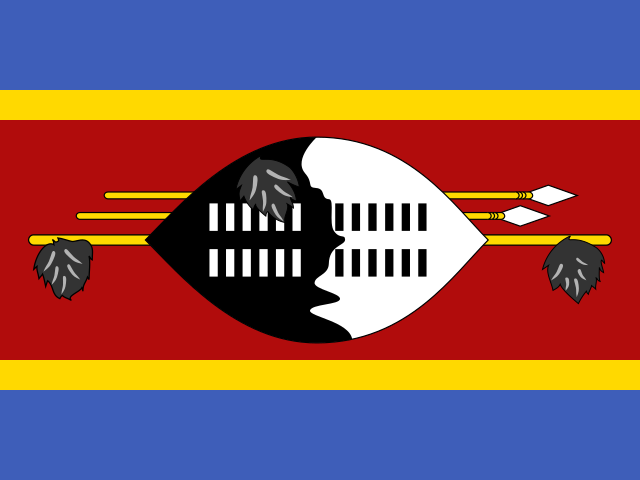
Overview
Eswatini, officially the Kingdom of Eswatini and known until 2018 as Swaziland, is a small landlocked country in Southern Africa. It is bordered by South Africa to the north, west and south and by Mozambique to the east. It measures no more than about 200 km north to south and 130 km east to west, and is the second smallest country in continental Africa according to the source.
Despite its size, the land is varied: cool mountainous highveld in the west gives way to hot, dry lowveld in the east. The executive capital is Mbabane and the legislative capital is Lobamba.
Most people are ethnic Swazi and the main language is siSwati, which shares official status with English. The kingdom took shape in the mid-18th century under Ngwane III, and the country's name derives from the 19th-century king Mswati II. It was a British high commission territory from 1903 and regained full independence on 6 September 1968.
Eswatini is a lower-middle-income developing country. Its currency, the lilangeni, is pegged to the South African rand, and South Africa is the main trading partner. It is governed as an absolute monarchy under King Mswati III, who has reigned since 1986, and is described in the source as the last absolute monarchy in Africa. It belongs to the UN, the African Union, the Commonwealth, SADC, COMESA and SACU.
Health is a major challenge: HIV/AIDS is widespread, with roughly 27 to 28 percent of adults affected, and tuberculosis is also common. Life expectancy was about 58 years as of 2018, and the population is young, with a median age of around 22.
History
Human activity in the area goes back to the Early Stone Age, around 200,000 years ago. Rock paintings found across the country date from about 27,000 years ago up to the 19th century. The earliest known inhabitants were Khoisan hunter-gatherers, who were largely replaced by Nguni-speaking peoples during the Bantu migrations. Farming and iron use are evidenced from about the 4th century.
The Swazi lived for a time along the Tembe River under Tembe chiefs before moving to the Pongola River. Dlamini III led the Swazi from about 1720 to 1744. His son Ngwane III is regarded as the first king of the modern kingdom, and the land was called KaNgwane, meaning country of Ngwane. Under Mswati II in the 19th century the kingdom expanded and unified, and its boundaries were drawn up in 1881 during the European Scramble for Africa.
After the British victory in the Second Boer War, Swaziland became a High Commission Territory in 1903, alongside Basutoland (now Lesotho) and Bechuanaland (now Botswana). No formal protectorate was set up because terms were not agreed with Queen Regent Labotsibeni Mdluli. Early administration was run partly from South Africa until 1906, when the Transvaal Colony gained self-government.
Land concessions granted to Europeans were reviewed from 1904. By 1910 about 1.64 million acres, some 38 percent of the territory, had been set aside for the Swazi, a share that rose to 56 percent by 1964. Sobhuza II was crowned in December 1921 and led an unsuccessful delegation to the Privy Council in London in 1922 over the land question. The royal leadership resisted both the weakening of British authority and the prospect of incorporation into the Union of South Africa.
Britain promulgated a constitution in November 1963 creating Legislative and Executive Councils, and the first Legislative Council met on 9 September 1964. A later constitution provided for a House of Assembly and Senate, with elections in 1967. Independence was regained on 6 September 1968.
In 1973 King Sobhuza II annulled the Westminster-style constitution by decree and ruled until his death in 1982, after almost 83 years on the throne, described in the source as the longest reign of any monarch in history. A regency followed, first under Queen Regent Dzeliwe Shongwe and then, from 1984, Queen Mother Ntfombi Tfwala. Her son Mswati III was crowned in 1986.
A 1982 plan to transfer parts of South Africa's KwaZulu and KaNgwane homelands to Swaziland, which would have given sea access, was never carried out after local opposition.
Student and labour protests in the 1990s pushed for reform, leading to the current constitution in 2005. The first election under it was held in 2008. An economic crisis in 2011, caused by lower Southern African Customs Union receipts, led to a loan request to South Africa that stalled over the attached political reform conditions. Revenues improved from 2012, and a new parliament was elected in 2013.
On 19 April 2018, to mark 50 years of independence, Mswati III announced the renaming of the country as the Kingdom of Eswatini, meaning land of the Swazis, partly to avoid confusion with Switzerland.
Workers held anti-government protests over low pay and a three-day strike in September 2018. In June 2021, pro-democracy protests spread across the country, with riots, looting and clashes with security forces. Buildings linked to the king were set alight. At least 20 people were reported killed by state security forces, and the internet was shut down. The New York Times called it the most explosive unrest in the country's 53 years of independence. Reports that the king had left the country were disputed by officials.
The most recent general election took place on 29 September 2023. In July 2025 the United States deported five men to Eswatini under an arrangement with its government, and by October 2025 ten more had been sent, with the government confirming receipt of $5.1 million from the US under the deal.
Climate
Eswatini has four climatic zones: the Highveld, Middleveld, Lowveld and the Lubombo plateau. Rain falls mainly in summer, from December to March, often as thunderstorms, and winter is dry. Temperature follows altitude.
Annual rainfall is highest on the western Highveld, at about 700 to 1,550 mm, and falls toward the east, with the Lowveld receiving roughly 200 to 550 mm. The Highveld is temperate and seldom uncomfortably hot, while the Lowveld can reach around 40 °C in summer.
Mbabane, on the Highveld at roughly 1,100 m (approx.), has a mild, humid subtropical highland climate with warm, wet summers and cool, dry winters, and occasional mist. Manzini in the Middleveld is warmer (approx.). Lowveld towns such as Siteki and the sugar-growing areas around Simunye and Big Bend are hot and drier (approx.). For comparison, the nearest large South African cities are Johannesburg (cooler, highveld) and Durban (warm, humid coast).
Climate change is a concern for the government, which says it worsens poverty, food insecurity and the burden of HIV. The 2015–16 drought cut output of sugar and soft drink concentrate, the largest exports, and many exports are raw agricultural goods exposed to climate variability.
Government and politics
Eswatini is an absolute monarchy operating under a 2005 constitution together with Swazi law and custom. The head of state is the king, or ngwenyama, currently Mswati III. By tradition he reigns alongside his mother, the ndlovukati, who is seen as a spiritual and national figure, though the role became more symbolic under Sobhuza II.
The king appoints the prime minister from the legislature. He also appoints a majority of senators and some members of the lower house, with advice from a council, including people representing special interests such as women, people with disabilities, business, civil society, scholars and chiefs.
The bicameral parliament (Libandla) has a Senate of 30 seats (10 chosen by the House of Assembly, 20 appointed by the king) and a House of Assembly of 65 seats (55 elected, 10 appointed by the king). Terms are five years. Elections are non-partisan, political parties cannot contest them, and the Elections and Boundaries Commission oversees them. The latest were on 29 September 2023.
Elections use the tinkhundla system. Nominations are made at chiefdom level by show of hands, with at least ten supporters needed, and four to ten nominees. Primary voting in chiefdoms is by secret ballot, and winners advance to the inkhundla constituency for final voting. Until 1993 ballots were not secret and voters chose an electoral college. According to the 2023 V-Dem indices cited in the source, Eswatini is the 9th lowest ranked worldwide and the 2nd lowest ranked electoral democracy in Africa.
National level is where power is concentrated, and the king holds wide-ranging authority. Below that, the country is divided into four regions (Hhohho, Lubombo, Manzini, Shiselweni), and each one is run by a regional administrator who is assisted by elected members of tinkhundla. The country has 55 tinkhundla and 12 municipalities. In rural areas there are three tiers (regional administration, tinkhundla, chiefdoms), and every inkhundla has a development committee (bucopho) elected for five years and chaired by an indvuna ye nkhundla. Urban areas are governed by city councils, town councils and town boards, and there are 12 declared urban areas in total: two are city councils, three are town councils, and seven are town boards. The regional capitals are Manzini, Mbabane, Nhlangano and Siteki. Taxation, health, law and education are mainly determined at national level, while local bodies deal with municipal services and chiefdom matters; land is divided between Swazi Nation Land, under traditional authority, and Title Deed Land.
The judiciary is dual: a Western-style system of four regional Magistrates Courts, a High Court and a Supreme Court (court of appeal), plus traditional Swazi courts for minor offences and customary law. Judges are appointed by the king and are often South African expatriates. The Chief Justice list in the source shows Bheki Maphalala serving from 2015 to 2026.
The defence force (Umbutfo Eswatini Defence Force) has about 3,000 personnel, is used mainly in domestic protests and border and customs duties, and has never fought a foreign conflict. The king is commander-in-chief and defence minister.
Foreign relations: Eswatini belongs to the UN, Commonwealth, African Union, COMESA and SADC. It is the only country in Africa that keeps ties with Taiwan rather than China. On 2 May 2026 Taiwanese President Lai Ching-te made a surprise visit travelling with Deputy Prime Minister Thulisile Dladla, which Chinese officials criticised.
Economy
Eswatini is a lower-middle-income economy. Agriculture, forestry and mining make up about 13 percent of GDP, manufacturing (textiles and sugar-related processing) about 37 percent and services, led by government, about 50 percent. High-value crops (sugar, forestry, citrus) are grown on Title Deed Lands, which have heavy investment, irrigation and high productivity. About 75 percent of people rely on subsistence farming on Swazi Nation Land, where productivity and investment are low.
Sugarcane is the largest export. The source notes that its cultivation has involved evictions of rural communities, child labour and weeks of up to 60 hours, and the International Trade Union Confederation has criticised working conditions and wages.
Growth has lagged: real GDP growth since 2001 averaged 2.8 percent, nearly 2 points below other SACU members. Contributing factors include low productivity on Swazi Nation Land, repeated droughts, the effects of HIV/AIDS and a large, inefficient public sector. Public finances worsened from the late 1990s, with larger deficits.
The economy is closely tied to South Africa, which supplies over 90 percent of imports and takes about 70 percent of exports. Other key partners are the United States (under AGOA, for apparel) and the EU (preferences for sugar). The loss of textile preferences and phasing out of EU sugar price preferences threaten competitiveness. An investment climate assessment found Eswatini firms among the most productive in Sub-Saharan Africa, but hampered by weak governance and infrastructure.
The lilangeni is pegged to the rand, so monetary policy follows South Africa. SACU customs receipts and worker remittances from South Africa supplement income. The country is not poor enough for an IMF programme but is trying to shrink the civil service, control state enterprise costs and attract foreign investment.
As of 2018 public services were weak, with only twelve public ambulances. Much wealth is held by the state and the king, including Royal Eswatini Sugar Corporation, majority owned by the king's fund Tibiyo Taka Ngwane, with 6.5 percent held by the government. About 15,000 private businesspeople include descendants of British settlers and South African investors drawn by wages about a third of South African levels. The king receives 8 percent of the national budget, and the police and armed forces 5 percent each.
Demographics and urbanization
Total population is roughly 1.2 million (approx.). The population is mostly ethnic Swazi, with small Zulu and white African (British and Afrikaner descent) groups, plus Portuguese settlers and Mozambican refugees. Traditionally subsistence farmers and herders, many Swazi now combine this with urban formal work, government jobs or work in South African mines.
Eswatini remains largely rural, with an urbanization rate of roughly 25 to 30 percent (approx.). The Middleveld is the most densely populated region, and the Lowveld is the least populated. Main towns are Manzini (principal commercial and industrial city), Mbabane, Nhlangano and Siteki, all regional capitals. Approximate populations: Manzini around 110,000, Mbabane around 95,000 to 100,000 (approx.), with Lobamba and the Ezulwini valley between them forming a connected urban corridor.
SiSwati, a Nguni Bantu language with about 2.5 million speakers across Eswatini and South Africa, is official with English. English is used in schools, business and the press. About 76,000 speak Zulu and about 19,000 Tsonga, Afrikaans is spoken by some, and Portuguese is taught as a third language in schools.
Around 83 percent are Christian, including Zionist and other indigenous churches (37.6 percent) and Catholics (3.7 percent). About 15 percent follow traditional religions, with small Muslim (0.3 percent), Baháʼí and Hindu communities. In 2012 Ellinah Wamukoya was elected Anglican bishop, the first woman bishop in Africa. Non-civil marriages such as Islamic-rite contracts are not recognised.
Health: in 2019 Eswatini had the world's highest HIV prevalence among ages 15 to 49, at 27.1 percent. Its 2024 Global Hunger Index score was 15.7, ranked 74th. Life expectancy was about 58 in 2018, and 35 percent of people were aged 14 or younger.
Education: primary school starts at age six, lasts seven years, and is free mainly in the early grades and for orphaned and vulnerable children, but not compulsory. Secondary school is five years (three junior, two senior), with the Junior Certificate and the Cambridge-accredited IGCSE. There are 830 public schools and 34 recognised private schools. Waterford Kamhlaba, founded in 1963 as southern Africa's first multiracial school, became Africa's first United World College in 1981.
Higher education includes the University of Eswatini (established 1982, headquartered at Kwaluseni, with campuses in Mbabane and Luyengo), Southern African Nazarene University in Manzini (2010), Eswatini Medical Christian University in Mbabane (2012) and a Limkokwing University campus in Mbabane (2012). Technical training centres include the Eswatini College of Technology and institutes in Matsapha, Manzini, Nhlangano and Siteki. The Mananga Management Centre at Ezulwini has trained managers since 1972.
Capital city
Eswatini has a split capital. Mbabane is the executive and administrative capital, while Lobamba is the legislative capital and the seat of the royal family and traditional ceremonies. Both lie in the western highlands, in the Hhohho region, with Mbabane about 20 km or so from Lobamba (approx.) along the Ezulwini valley.
Mbabane sits on the Highveld at around 1,100 m (approx.) and has roughly 95,000 to 100,000 residents (approx.). Its climate is mild and wet in summer (December to March), with cool, dry winters, and it is cooler and often mistier than the lowland towns. The source notes the Highveld is temperate and seldom uncomfortably hot.
Mbabane is the political and administrative centre, hosting government ministries, diplomatic missions and the main offices of many organisations, plus campuses of the University of Eswatini and Limkokwing and Eswatini Medical Christian University. The Ezulwini valley nearby has hotels, tourism and the Mananga Management Centre, and Mantenga Nature Reserve is close by.
Mbabane is not the main economic city. The source describes Manzini, in the Middleveld, as the principal commercial and industrial city, with the Matsapha industrial area nearby (approx.). The Lowveld holds the sugar and agricultural estates. So the country has two capitals, with the principal economic centre elsewhere, though Mbabane is a major urban and service centre.
About this summary
Approximate general-knowledge facts: city and metro populations, city climates, capital-city details (Mbabane and Lobamba), urbanization rate, and some economic and recent-event context.