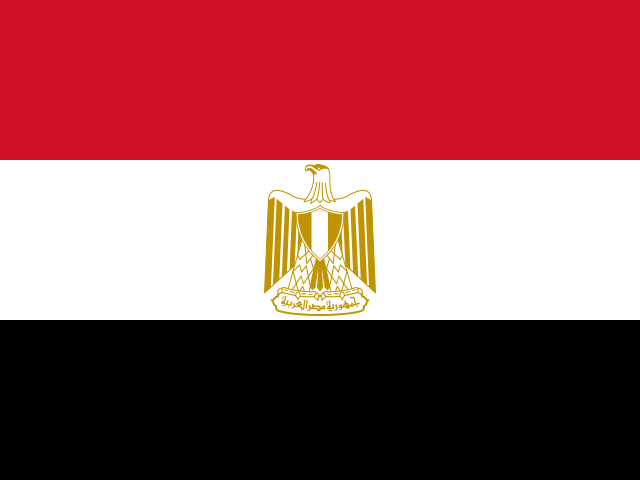
Overview
Egypt, officially the Arab Republic of Egypt, covers the northeastern corner of Africa and, through the Sinai Peninsula, a piece of southwest Asia. It touches the Mediterranean to the north and the Red Sea to the east. Its neighbours are Libya to the west, Sudan to the south, and Israel and the Gaza Strip to the northeast. The Gulf of Aqaba separates the Sinai coast from Jordan and Saudi Arabia.
Cairo is the capital, the biggest city and the main cultural centre. Alexandria, on the Mediterranean, is the second-largest city and an important industrial and tourism hub. The source gives a population of over 107 million in its introduction and about 120 million as of 2026 in its demographics section, so the figure is best read as roughly 107 to 120 million (approx.). By the source's account it is the most populous Arab country and third-most populous in Africa.
Its history reaches back to the 6th to 4th millennia BCE along the Nile. It is regarded as a cradle of civilisation, with early writing, farming, towns, organised religion and central government. Foreign rule began in the 6th century BCE, and the country later became an early Christian centre before adopting Islam from the 7th century.
Today Egypt is a developing country with the second-largest economy on its continent. It is described as a regional power in the Middle East, North Africa and the Muslim world, and as a middle power globally. Islam is the state religion and Arabic the official language. Egypt is a founding member of the UN, the Non-Aligned Movement, the Arab League and the African Union, and is also in the Organisation of Islamic Cooperation and BRICS.
History
Prehistory: Rock carvings along the Nile and in the oases show early settlement. Around the 10th millennium BCE, hunter-gatherers and fishers gave way to people who ground grain. Around 8000 BCE, climate change or overgrazing dried out the pasturelands and the Sahara took shape. Tribal groups moved to the Nile, where farming and more centralised society developed. By about 6000 BCE a Neolithic culture was established in the Nile Valley.
Ancient Egypt: Around 3150 BCE King Menes unified the country, beginning a line of dynasties that lasted about three thousand years. The Old Kingdom (c. 2700 to 2200 BCE) built the pyramids, including those at Giza. After a short interregnum came the Middle Kingdom (from c. 2040 BCE), a period of stability under rulers such as Amenemhat III. After the Second Intermediate Period and Hyksos occupation, Ahmose I reunified the land and founded the Eighteenth Dynasty. Foreign rule began in the 6th century BCE.
Ptolemaic and Roman Egypt (305 BCE to 641 CE): The Ptolemaic Kingdom was a Hellenistic state with Alexandria as capital and a centre of Greek culture and trade. The Ptolemies took on pharaonic traditions to bolster their legitimacy. The Lighthouse of Alexandria, built about 280 BCE, counted among the Seven Wonders of the Ancient World and was later destroyed by earthquakes. Cleopatra VII, the last ruler, died by suicide after Octavian took Alexandria, and Rome annexed the country. Alexandria was also known worldwide for its Library.
Medieval Egypt (641 to 1517): A short-lived Sasanid Persian occupation was followed by renewed Byzantine rule, which lasted until Arab Muslim armies led by Amr ibn al-As took the country between 639 and 642 and introduced Islam. The Byzantines briefly held Alexandria again in 645, but it fell once more in 646, and a fleet dispatched by Constans II was driven back in 654. The Arabs established Fustat, which was superseded by Cairo in 969. During the Abbasid period, Egypt was governed by deputies who answered to Baghdad. In the 10th century Cairo became the seat of the Fatimid Caliphate, and in the 13th century it became the capital of the Mamluk Sultanate.
Ottoman Egypt (1517 to 1867): The Ottomans took Egypt in 1517 after defeating the Mamluks, who kept considerable influence and formed a semi-autonomous power structure. Plagues and famines weakened society; six major famines struck between 1687 and 1731, and the famine of 1784 killed roughly a sixth of the population. Napoleon Bonaparte invaded in 1798. Muhammad Ali later built the base of modern Egypt, and it was formally recognised as an autonomous Khedivate in 1867.
Monarchy and British influence (1867 to 1952): The Suez Canal opened in 1869 with French help and became a vital strategic and commercial asset. Debts and mismanagement led Isma'il Pasha to sell Egypt's canal shares to Britain in 1875. After the Urabi revolt, Britain occupied Egypt in 1882, creating a de facto protectorate under nominal Ottoman sovereignty. The 1899 Anglo-Egyptian Condominium placed Sudan under joint control. Egypt gained independence as a monarchy in 1922, and a 1923 constitution set up a parliamentary monarchy.
Nasser era (1952 to 1970): The 1952 revolution, led by the Free Officers Movement, put the military in charge and banned all political parties. The republic was declared on 18 June 1953 with Muhammad Naguib as first president. Gamal Abdel Nasser, a Pan-Arabist and the movement's main architect, gradually took power, forced Naguib to resign in 1954 and was formally elected in 1956. In 1958 Egypt merged with Syria to form the United Arab Republic, and Syria withdrew in 1961. Egypt fought Israel in 1948, 1956, 1967 and 1973, and it held the Gaza Strip after the 1948 war.
Egypt lost the Sinai Peninsula and the Gaza Strip to Israel in 1967.
Sadat and Mubarak (1970 to 2011): Anwar Sadat succeeded Nasser in 1970. He sidelined Nasserist and leftist groups, expelled Soviet advisers in 1972, moved toward the United States and renamed the state the Arab Republic of Egypt in 1971. His Infitah (open door) liberalisation brought tensions, notably bread riots in 1977 after food subsidies were removed. In 1973 he coordinated with Syria in the fourth Arab-Israeli war to recover Sinai; militarily the result was mixed, but it lifted Arab morale and his domestic standing. His 1977 visit to Jerusalem led to the 1979 peace treaty with Israel, and Egypt was temporarily suspended from the Arab League. Sadat was assassinated in 1981 by an Islamist extremist.
Hosni Mubarak took over in a 1981 referendum in which he was the only candidate. He kept the peace treaty and repaired ties with Arab neighbours. At home he faced poverty, unemployment and crowded cities; the 1986 Security Police riots left 107 dead. Islamist attacks, including by Al-Gama'a al-Islamiyya, hit officials, foreigners and Copts and damaged tourism, a key source of hard currency. The 1997 Luxor massacre killed 62, mostly tourists. The ruling NDP dominated politics and restricted association, expression and participation through laws such as the 1993 Syndicates Law, 1995 Press Law and 1999 NGOs Law. Limited reforms allowed multi-candidate presidential elections in 2005, but Mubarak won easily with turnout under 25%, and opposition figure Ayman Nour was later jailed. Human Rights Watch and Amnesty International reported torture and arbitrary detention. Constitutional changes in 2007 widened presidential powers.
2011 to present: Protests began on 25 January 2011, demanding political freedom, social justice and an end to corruption, and centred on Cairo's Tahrir Square. After 18 days Mubarak resigned on 11 February 2011, and the military took control under Mohamed Hussein Tantawi. The first democratic election in 2012 produced a short-lived Muslim Brotherhood-aligned government under Mohamed Morsi. After mass protests, on 3 July 2013 then-General Abdel Fattah el-Sisi announced Morsi's removal and the suspension of the constitution. A new constitution was adopted on 18 January 2014, and Sisi won the May 2014 presidential election. He is widely regarded as authoritarian.
Climate
Egypt is very hot, sunny and dry. Most of the little rain falls in winter. South of Cairo, rainfall averages only about 2 to 5 mm a year, sometimes with gaps of many years between showers. A thin strip of the northern coast can receive up to about 410 mm, mostly between October and March.
The north is cooler than the interior, since Mediterranean winds temper even the summer heat. Alexandria and the coastal cities have milder, more humid summers than inland areas, and approx. winter highs there are around 18 °C. Cairo has a hot desert climate: approx. summer highs of 34 to 36 °C, mild winters with highs near 19 °C, and very little rain (approx. 25 mm a year).
Snow falls on the Sinai mountains and on some northern coastal places such as Damietta, Baltim and Sidi Barrani, and rarely in Alexandria. Cairo saw a very small amount on 13 December 2013, the first in many decades. Frost occurs in mid-Sinai and central Egypt.
The Khamaseen is a hot, dry wind from the southern deserts in spring or early summer. It carries sand and dust, usually pushes daytime temperatures above 40 °C, and sometimes above 50 °C inland, while humidity can fall to 5% or less.
Before the Aswan Dam, the Nile flooded each year and refreshed the soil, giving steady harvests. Other southern and desert cities such as Aswan and Luxor are known to be extremely hot in summer (approx.), while Red Sea resorts like Hurghada and Sharm El Sheikh are hot and dry with mild winters (approx.).
Climate change is adding strain through extreme heat, drought, floods and sea-level rise. Egypt is considered highly vulnerable, with risks to food security, water supplies, public health and the economy.
Geographically, Egypt lies mostly between latitudes 22° and 32°N and longitudes 25° and 35°E, and is the 29th-largest country by area. Beyond the Nile Valley, most of the land is desert, including parts of the Sahara and Libyan Desert, with scattered oases (Bahariya, Dakhla, Farafra, Kharga, Siwa). Dunes can exceed 30 m. Mount Catherine in Sinai, at 2,642 m, is the highest peak, and the Red Sea coast is known for coral reefs. The Isthmus of Suez, crossed by the Suez Canal, links Africa and Asia.
Biodiversity: Egypt joined the Convention on Biological Diversity in 1994 and submitted a national strategy in 1998. Recorded species include about 15,000 animals (over 10,000 insects), 2,426 plants, more than 2,200 fungi in later counts, and 284 native and naturalised grasses. Protected areas include Ras Mohamed National Park, Zaranik and Siwa.
Government and politics
Egypt is a semi-presidential republic led by President Abdel Fattah el-Sisi. The legislature is the House of Representatives, with five-year terms. The parliament elected in 2011 and 2012 was later dissolved. After Morsi's removal in 2013, a 50-member committee revised the constitution, which was approved on 18 January 2014. The presidential election was held on 26 to 28 May 2014; turnout was 47.5% (about 25.6 million votes), and Sisi won 96.9% to Hamdeen Sabahi's 3.1%. Parliamentary elections followed in two phases from 17 October to 2 December 2015.
Egypt has the oldest continuous parliamentary tradition in the Arab world, dating from a first popular assembly in 1866. The British occupation of 1882 left only a consultative body, and a 1923 constitution created a parliamentary monarchy. Today, Freedom House rates it Not Free (2024 scores: political rights 6 out of 40, civil liberties 12 out of 60). The 2023 V-Dem indices place it eighth least democratic in Africa, and the 2023 Economist Democracy Index classes it an authoritarian regime with a score of 2.93.
Power is highly centralised. The source gives little on sub-national structure; from general knowledge, the country is divided into roughly 27 governorates (approx.) headed by governors appointed by the president, with tax policy, national courts, health and education policy set largely at national level. The capital region and some desert and border areas are handled under special administrative arrangements, and the army has extra roles in Sinai and border zones (approx.).
Law: The legal system blends Islamic law and civil law, especially the Napoleonic Code, with judicial review. The Supreme Constitutional Court, in Cairo's Maadi district, is the highest judicial authority. Islamic jurisprudence is the main source of legislation. Sharia courts are licensed by the Ministry of Justice, and personal status matters such as marriage, divorce and child custody follow Sharia. In family courts a woman's testimony counts for half a man's. A controversial 2012 constitution backed by the Muslim Brotherhood was approved with 64% in a referendum held 15 to 22 December 2012.
Foreign relations: Egypt follows a broadly non-aligned line and acts as a mediator in Middle Eastern conflicts, including ceasefire efforts in Gaza and the Israeli-Palestinian process. The Arab League is headquartered in Cairo; it moved to Tunis in 1978 over the Israel peace treaty and returned in 1989. The US provided about US$1.3 billion in annual military aid as of 2015, and Egypt became a major non-NATO ally in 1989. Ties cooled after the 2013 events and improved under President Trump, with Sisi's 2017 White House visit. Egypt has deepened cooperation with Russia and China (a comprehensive strategic partnership in 2014), upgraded ties with the EU to a strategic and comprehensive partnership in 2024, and receives financial support from Gulf states such as Saudi Arabia and the UAE.
Military: The Armed Forces comprise the Army, Navy, Air Force and Air Defence Forces, with headquarters at the State Strategic Command Center, known as the Octagon, in the New Administrative Capital. Active strength is 438,500, with 479,000 reservists. Military size and budget are kept secret. Men aged 18 to 30 face conscription of 14 to 36 months depending on education, followed by nine years in reserve; voluntary entry is possible from 16 for men and 17 for women. The military is politically influential, largely exempt from many civilian laws, and a major economic actor via the National Service Projects Organization. Equipment comes from China, France, Germany, Italy, Russia and the US, and there is a domestic defence industry. Egypt also runs several observation and communications satellites, including EgyptSat 1 and 2, MisrSat-A, Tiba-1, Horus-1 and 2, MisrSat-2 and NEXSAT-1.
Economy
Egypt's economy is the second largest in Africa, and in 2025 it placed 44th in the world. As a significant emerging market, the country is a participant in the African Continental Free Trade Area. From the early 2000s onward, it shifted toward a market-driven system through fiscal and monetary reforms, privatisation, and incentives meant to attract foreign investment. Even so, the state is still among the biggest employers, and government contracts continue to power much of the activity, particularly large-scale construction.
Under an IMF programme worth $8 billion launched in 2024, Egypt agreed to trim such public spending. The private share of executed investment rose to 47.5% in FY 2024/25 from 39.6%, while the public share fell to 43.3%, the highest private share in five years.
Remittances are a pillar: Egypt is among the top five recipients worldwide, with inflows rising from $17.1 billion in FY 2015/16 to a record $36.5 billion in FY 2024/25. Trade makes up about 40% of GDP per the World Bank, and the government aims for exports of $145 billion by 2030. Egypt has had US aid since 1979, averaging about $1.5 billion a year, mostly military.
Manufacturing: Egypt has Africa's largest manufacturing sector, about 22% of the continent's manufacturing value. Industrial parks, free zones and special economic zones support Egypt Vision 2030. Industries include chemicals (petrochemicals around 12% of industrial output), electronics, steel, cars, pharmaceuticals and textiles. Egypt Makes Electronics has drawn plants of firms such as Samsung, Xiaomi, Oppo, Vivo, Nokia, Electrolux, Hisense, Beko and Haier. Textiles provide around 12% of export earnings and employ 2.5 million people, and Giza cotton is prized. Egypt is Africa's top steel producer (9.8 million tons in 2022, 20th globally); the 2024 to 2030 automotive strategy targets 500,000 vehicles a year.
Retail and services: Retail was worth about $200 billion as of 2020. Food retail is still mostly traditional family stores and wet markets, though hypermarkets and wholesale discounters grew fast between 2015 and 2020. Cairo has over 20 malls, while cities like Mansoura and Tanta have only recently opened their first. Telecom Egypt, state-controlled, dominates telecoms. Mobile internet subscriptions rose from 39 million to 69.4 million between 2019 and 2022, total mobile subscriptions reached 106.2 million in December 2023, and internet penetration was 72.2% in early 2024 (82 million users). Egypt has had the fastest internet speeds in Africa since 2022.
Banking and fintech: About 55% of banking assets sit with four state-owned lenders: National Bank of Egypt, Banque Misr, Banque du Caire and Alexbank. CIB ranks as the biggest private bank. Since 2020, the fintech sector has expanded 5.5 times over and now counts 177 startups.
Hydrocarbons and mining: Crude output peaked near 941,000 bbl/d in 1993 and fell to 630,000 bbl/d by 2008, making Egypt a net oil importer around 2008 to 2009. Gas became the focus. The Zohr field, found by Eni in 2015 and holding about 30 trillion cubic feet, is the largest in the Mediterranean; output began in 2017 and reached 2.7 bcf/d by 2019, though technical issues have since reduced it. BP committed $12 billion in 2015 to the West Nile Delta project. Minerals include gold, copper, iron ore, phosphate, uranium, manganese, coal and more. Gold exports doubled to $2.17 billion in 2024, centred on the Sukari mine.
Tourism, the Suez Canal and agriculture are also major earners (approx., general knowledge); the agricultural section of the source was cut off and is not covered here.
Demographics and urbanization
Population: About 107 million per the source's introduction and about 120 million as of 2026 in its demographic section (approx.). Growth was fast from 1970 to 2010 thanks to medical advances and the Green Revolution; the population was only about 3 million at Napoleon's 1798 invasion.
Where people live: Nearly everyone lives along the Nile Valley and Delta and near the Suez Canal, on roughly 40,000 km² of arable land; the source says about 99% of people use about 5.5% of the land. The inhabited area is 77,041 km², giving a physiological density over 1,200 people per km², similar to Bangladesh. The source says about 43% live in urban areas, concentrated in greater Cairo, Alexandria and Delta cities.
Largest cities (approx., general knowledge): Greater Cairo, including Giza, roughly 22 million; Alexandria about 5 million; other cities include Port Said, Suez, Luxor, Aswan, Asyut, Mansoura, Tanta, El Mahalla El Kubra, Zagazig and Minya.
Emigration and migrants: Emigration was restricted under Nasser and liberalised in 1971 under Sadat. About 2.7 million Egyptians live abroad, around 70% in Arab countries (923,600 in Saudi Arabia, 332,600 in Libya, 226,850 in Jordan, 190,550 in Kuwait) and the rest mostly in the US (318,000), Canada (110,000) and Italy (90,000). Egypt hosts over 9 million migrants (8.7% of population per IOM), from 133 countries; the largest groups are Sudanese (4 million), Syrians (1.5 million), Yemenis (1 million) and Libyans (1 million).
Ethnic groups: Ethnic Egyptians are 99.7% of the population. Minorities include Circassians, Turks, Greeks, Bedouin tribes in the eastern deserts and Sinai, Berber-speaking Siwis, Nubians along the Nile, Beja in the far southeast and Dom clans in the Delta and Faiyum.
Languages: Literary Arabic is official. Spoken varieties include Egyptian Arabic (68%), Sa'idi Arabic (29%), Eastern Egyptian Bedawi Arabic (1.6%), Sudanese Arabic (0.6%), Domari (0.3%), Nobiin (0.3%), Beja (0.1%) and Siwi. Immigrant languages include Greek, Armenian, Italian, Amharic and Tigrinya. Schools teach English, French, German and Italian, in that order of popularity. Coptic survives as the liturgical language of the Coptic Orthodox Church.
Religion: Islam is the state religion. Official data is lacking; estimates are 85 to 90% Muslim, 10 to 15% Coptic Christian and 1% other Christian, with some estimates of Christians up to 15 to 20%. Most Muslims are Sunni, with Shia estimates of 1 to 3 million, fewer than 50,000 Ahmadis and 5 to 6 million Salafis. About 15 million follow Sufi orders. Over 90% of Christians belong to the Coptic Orthodox Church. The state recognises only Islam, Christianity and Judaism; Baha'is and Ahmadis are unrecognised and face persecution, and since a 2008 ruling can leave the religion field blank on identity cards. A November 2017 attack on a Sufi mosque in Sinai killed at least 305.
Education: Adult literacy was 74.5% in 2022 (71.1% in 2017), at 92.2% among 15 to 24 year olds and 32.9% among over-65s (2021). The Ottomans introduced European-style schooling in the early 19th century; British rule cut investment and introduced fees; Nasser phased in free education in the 1950s. Al-Azhar University, founded in the late tenth century, is a leading centre of Islamic learning.
Capital city
Cairo is the capital, the largest city and the leading cultural centre. It lies on the Nile at the head of the Delta in northern Egypt. Its metro area, including Giza, has roughly 22 million people (approx.), among the largest in Africa and the Middle East.
History: Fustat was established by the Arabs, and in 969 Cairo took its place. During the tenth century the city served as the seat of the Fatimid Caliphate, and in the 13th century it became the Mamluk Sultanate's capital as well. Cairo is nicknamed the City of 1,000 Minarets.
Climate (approx.): hot desert, with long hot summers (highs around 35 °C), mild winters (highs near 19 °C) and very little rain. Cairo is exposed to Khamaseen dust winds in spring. A small amount of snow fell on 13 December 2013, the first in many decades.
Role: Cairo is the political centre, home to the Supreme Constitutional Court and the Arab League headquarters. It is also a religious and intellectual hub, hosting Al-Azhar University. It is the main economic city too, with the largest concentration of malls (over 20) and most major corporate and banking activity (approx.). Nearby Giza has the Pyramid of Khufu.
New capital: In March 2015 plans were announced for a new capital east of Cairo, called the New Administrative Capital. The military's State Strategic Command Center (the Octagon) is already there. Cairo remains the main population and economic centre, and the source does not describe a full transfer of government functions.
Alexandria, the former capital and second-largest city, is the main Mediterranean port, an industrial and tourism hub, and historically the site of the great Library (approx. population about 5 million).
About this summary
Some details on the capital's metro population and climate, Alexandria's size, the governorate system and the Senate come from general knowledge and are approximate. The same applies to the Cairo metro area's role in the economy.