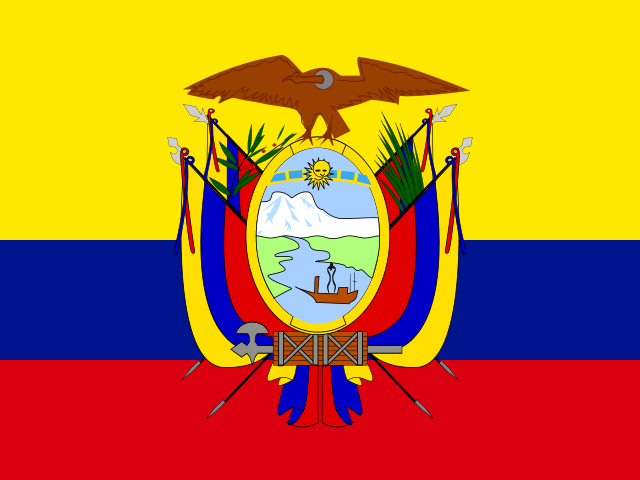
Overview
Ecuador, officially the Republic of Ecuador, sits in northwestern South America. Colombia lies to the north, Peru to the east and south, and the Pacific Ocean to the west. The Galápagos Province, an island group about 1,000 km out in the Pacific, also belongs to the country. Quito is the capital and Guayaquil is the largest city.
The territory was home to several Indigenous peoples who were folded into the Inca Empire during the 15th century, then came under Spanish rule in the 16th century. Independence arrived in the early 1820s as part of Gran Colombia, and Ecuador became a sovereign state in 1830. The population of roughly 17.8 million is mostly mestizo, with sizeable European, Indigenous, African and Asian-descended minorities.
Spanish is the official language and most people speak it. Thirteen native languages, among them Quechua (Kichwa) and Shuar, also have recognition.
Ecuador is a plurinational, representative, presidential republic and a developing economy that relies heavily on commodity exports, chiefly oil and farm products. It is a founding member of the United Nations and the Organization of American States, and belongs to other bodies such as PROSUR and the Non-Aligned Movement. Between 2006 and 2016, according to the Center for Economic and Policy Research, poverty fell from 36.7% to 22.5%, and the Gini index improved from 0.55 to 0.47.
Ecuador is one of 17 megadiverse countries and holds many endemic species, notably in the Galápagos. Its 2008 constitution was the earliest anywhere to give nature legally enforceable rights. In the 2024 Global Hunger Index it scored 11.6 (58th of 127), a moderate level, and the United Nations reported in 2026 that about 2.6 million people face acute hunger.
History
Before the Incas, many peoples lived in the area. Archaeological evidence suggests the first humans entered the Americas around 16,500 to 13,000 years ago, and early arrivals in Ecuador may have come overland from North and Central America or by boat along the Pacific coast. The groups spoke unrelated languages but developed similar cultures adapted to their environments; coastal peoples, for instance, combined farming with fishing. The Inca Empire absorbed them gradually during the 15th century.
Spanish colonization in the 16th century brought epidemics such as smallpox, to which Indigenous people had no immunity, and heavy mortality. Natives were also forced into the encomienda labor system. In 1563 Quito became the seat of a royal audiencia, part first of the Viceroyalty of Peru and later of New Granada. The 1797 Riobamba earthquake killed up to 40,000 people and was studied by Alexander von Humboldt in 1801–02.
On 9 October 1820 Guayaquil became the first territory in present-day Ecuador to break from Spain. The rest followed after Antonio José de Sucre defeated Royalist forces at the Battle of Pichincha near Quito in 1822, and Ecuador joined Simón Bolívar's Gran Colombia, which also included modern Colombia, Venezuela and Panama. Official Independence Day is 24 May, marking the 1822 victory. Ecuador separated from Gran Colombia on 13 May 1830 under its first president, General Juan José Flores.
After separation, Flores claimed the lands of the old Real Audiencia of Quito, citing Spanish royal decrees. Peru contested this with a 1802 decree moving Amazon territories to the Viceroyalty of Peru, and Ecuador disputed that document's political force. The rivalry over the Amazon Basin lasted generations, produced the Cenepa War of 1995, and was finally settled in the early 2000s; Ecuador lost substantial claimed territory over the 19th and 20th centuries.
The Liberal Revolution of 1895 under Eloy Alfaro curbed the power of the clergy and conservative landowners, and liberals held power until the military 'Julian Revolution' of 1925. The 1930s and 1940s were unstable and saw populists such as five-time president José María Velasco Ibarra rise. In 1972 a nationalist military junta overthrew Velasco Ibarra, and a second military government took over in 1976, led by Admiral Alfredo Poveda. Pressure for elections led to a plan to return to constitutional rule.
Democracy returned with the April 1979 election under a new constitution. Jaime Roldós Aguilera took office in August 1979 and died in a plane crash in May 1981; many people believed he was assassinated, though accounts conflict. Osvaldo Hurtado succeeded him. León Febres Cordero (1984) and Rodrigo Borja (1988) followed, with Borja opening the country to foreign trade. Economic problems continued, and Congress removed President Lucio Gutiérrez in April 2005, with Vice President Alfredo Palacio taking over.
Ecuador adopted the U.S. dollar on 13 April 2000 and withdrew the sucre that September to stabilize the economy; the dollar has been the only official currency since.
Rafael Correa won the presidency in 2006. A 2008 referendum approved a new constitution with leftist reforms. In December 2008 Correa declared the national debt illegitimate and defaulted on over $3 billion in bonds, later cutting the price of outstanding bonds by more than 60%. Ecuador joined the Bolivarian Alliance in 2009. Correa served three consecutive terms (2007–2017).
His former vice president Lenín Moreno governed 2017–21 with more liberal economic policies, left the Bolivarian Alliance in 2018, cut relations with Venezuela, and improved ties with the United States. Protests that began on 3 October 2019 against ending fuel subsidies and austerity moved the government temporarily to Guayaquil; subsidies were restored and the package withdrawn on 14 October 2019.
In April 2021 the conservative former banker Guillermo Lasso won the presidency with 52.4% against Andrés Aráuz's 47.6%. His party and ally held only 31 of 137 seats, so he needed support from other parties. He declared a 60-day state of emergency over crime in October 2021, and in a February 2023 referendum voters rejected his proposed constitutional changes.
Centrist Daniel Noboa won the early election of October 2023 with 52.3% against Luisa González and took office on 23 November 2023. In January 2024 he declared an 'internal armed conflict' against organized crime after the escape of Los Choneros leader José Adolfo Macías Villamar ('Fito') and an armed attack on a TV channel. Noboa won the April 2025 run-off, securing a full four-year term. Fito was recaptured and extradited to the United States in June 2025 and has pleaded not guilty. In October 2025 five people were arrested over an alleged plot to assassinate Noboa.
Climate
Ecuador's climate varies mainly with altitude. Mountain valleys are mild year-round, the coast is humid and tropical to subtropical with a pronounced rainy season, the Andean highlands are temperate and relatively dry, and the Amazon lowlands to the east have a rainforest climate. Being on the equator, daylight hours barely change through the year, with sunrise and sunset around 6 o'clock.
Quito, at about 2,850 m, has a cool, spring-like highland climate, with daytime highs typically around 20 °C, cool nights, and wetter and drier seasons rather than hot and cold ones (approx.). Guayaquil, on the coast, is hot and humid, typically 30 °C or more in the wet season from about January to April, with a drier and somewhat cooler period afterward (approx.). Cuenca, in the southern highlands, is cooler and mild, with spring-like temperatures and frequent showers (approx.). Lago Agrio in the Amazon is hot, wet and humid year-round (approx.).
The country's seven glaciers have lost 54.4% of their surface in forty years, and research predicts they will vanish by 2100, a change attributed to climate change that threatens wildlife, plants and people.
Government and politics
Ecuador is a presidential republic with five branches of government: Executive, Legislative, Judicial, Electoral, and Transparency and Social Control. The president, elected for four years and re-electable only once, is head of state and government, directs foreign policy and the armed forces and police, and appoints ministers. The executive has 23 ministries and works from the Palacio de Carondelet in Quito. The present constitution was drafted by an assembly elected in 2007 and approved by referendum in 2008. Voting is compulsory for literate citizens aged 18 to 65 and optional for others over 16.
The National Assembly, seated in Quito, has 137 members elected for four years: 15 from a national constituency, two per province, and one more per 100,000 inhabitants or fraction above 150,000. The judiciary is headed by the Judicial Council and includes the National Court of Justice (21 judges, nine-year terms, renewed by thirds every three years), provincial courts and lower courts, supported by independent prosecutor and public defender offices. A special legal regime exists for Indigenous peoples. The electoral branch comprises the National Electoral Council (seven members) and an electoral court. The Transparency branch includes the Council for Citizen Participation and Social Control, an ombudsman, the Comptroller General and superintendents, with five-year terms.
Ecuador is divided into 24 provinces, each with its own administrative capital. Provincial governors, mayors, councillors and parish boards are directly elected. For planning, provinces are grouped into seven zones or regions to decentralize administration away from Quito, with administrative cities such as Ibarra, Tena, Riobamba, Ciudad Alfaro, Milagro, Cuenca and Loja. Quito and Guayaquil are Metropolitan Districts, and Galápagos, although grouped in Region 5, is under a special unit. The source does not list the detailed split of taxation, health, law and education powers between national and local levels, but the system is centralised in structure, with the national executive responsible for public health policy (the Minister of Public Health is appointed by the president) and national policing and defense.
In foreign affairs Ecuador emphasizes multilateralism and belongs to the UN, the Andean Community, the Latin American Integration Association and other bodies. It joined OPEC in 1973, suspended membership in 1992, rejoined under Correa and left again in 2020. It withdrew from the Union of South American Nations in March 2019. Its 2008 constitution promotes universal citizenship for migrants, and a human mobility law passed in 2017. The armed forces comprise the Army, Air Force and Navy; border disputes with Peru were settled in the early 2000s, and Colombian insurgent activity in the Amazon provinces has shaped military restructuring.
On human rights, Amnesty International (2003) criticized scarce prosecution of security-force abuses, and the UN raised concern in October 2022 about conditions in prisons and detention centers. Human Rights Watch said that under Correa press freedom and judicial independence were weakened, a view Correa disputed, saying he only sought retractions of slander. Freedom House reports that restrictions on media and civil society have eased since 2017. International IDEA places Ecuador mid-range on democratic measures.
Economy
Ecuador has an upper-middle-income, developing economy that depends strongly on petroleum and agricultural exports and is described as the eighth largest in Latin America. Growth averaged 4.6% in 2000–2006 and about 4.3% a year in 2007–2012, with about 8% in 2011. Dollarization in 2000 brought stability after rampant sucre inflation. Unemployment fell from 8.5% in 2009 to 4.8% in 2012, and extreme poverty dropped from about 40% in 2001 to 17.4% in 2011, helped by dollarization, emigration remittances and social spending on education and health.
Oil makes up about 40% of exports, with proven reserves of about 6.5 billion barrels as of 2011, mostly in the Amazon. In late 2021 erosion near the OCP and SOTE pipelines forced a roughly three-week force majeure on exports, costing over $500 million before output returned to around 435,000 barrels per day in early 2022. Ecuador paid off its IMF debt in April 2007.
Agriculture is major: Ecuador is the top banana exporter worldwide, exports flowers, and is the seventh largest cocoa producer. It also produces coffee, rice, potatoes, cassava, plantains, sugarcane, livestock products, fish and balsa wood. It became the world's largest shrimp exporter in 2020, and shrimp farming accounts for about 6% of GDP and 1.6% of employment.
Industry is concentrated in Guayaquil, the largest industrial center, and Quito, the largest business center, with some activity in Cuenca. Output mainly serves the domestic market, with limited exports of canned foods, liquor, jewelry and furniture. Tourism income has grown, drawing on natural diversity: the Galápagos, Yasuní, Cajas and Sangay parks, volcanoes such as Cotopaxi and Chimborazo, the historic centers of Quito and Cuenca, and Pacific beaches such as Montañita and Salinas. UNESCO sites include Quito, Cuenca, the Galápagos and Sangay National Park.
Ecuador belongs to the Andean Community, is an associate member of Mercosur, and sits in the WTO, IDB, World Bank and IMF. It ranked 113th in the 2025 Global Innovation Index. Research focuses on medicine, tropical disease, agricultural engineering and information technology, with banking software such as Cobis developed locally.
Transport is improving: the Pan-American highway is being widened, the Ruta del Sol runs along the coast, and the Amazon trunk road links eastern cities. Cuenca opened a 20.4 km tramway with 27 stations in March 2019. Quito's new Tababela airport opened in February 2013, and Guayaquil has the José Joaquín de Olmedo airport.
Demographics and urbanization
Ecuador had about 17.8 million people in 2021. As of 2010, mestizos made up about 71% (around 79% including Montubio, the coastal mestizo population), white Ecuadorians 6.1%, Amerindians 7%, Montubio 7.4% and Afro-Ecuadorians 7%. Afro-Ecuadorians live largely in Esmeraldas province and parts of Guayas and Manabí, with a small community in the Chota Valley. Smaller groups include people of Lebanese, Palestinian, Japanese and Chinese descent.
The source does not give a national urbanization rate; Ecuador is roughly 65 to 70% urban (approx.), with people concentrated in the coastal lowlands around Guayaquil and the Andean highlands around Quito, and fewer in the Amazon. The largest cities are Quito (about 2.78 million), Guayaquil (about 2.72 million), Cuenca (about 637,000), Santo Domingo (about 459,000) and Ambato (about 387,000). Metro areas of Guayaquil, Quito, Cuenca, Portoviejo-Manta and Ambato are the most populated.
Spanish is the first language of about 93% and a second language of 6% more, with three main regional variants: Equatorial Pacific, Andean and Amazonic. Northern Kichwa and other Indigenous languages were spoken by around 2.5 million people in 1991, and about 24 living Indigenous languages exist, such as Shuar Chicham, A'ingae and Wao Tededeo, though they are gradually giving way to Spanish.
In a 2012 survey, 91.95% had a religion, 7.94% were atheists and 0.11% agnostic. Of the religious, 80.44% were Catholic, 11.30% Evangelical Protestant and 1.29% Jehovah's Witnesses. Folk Catholicism mixing Indigenous beliefs is common in rural areas. The Jewish community has shrunk to about 290 people around 2020, mostly in Quito.
Immigration has included Lebanese from 1875, Europeans in the early 1900s, British workers in Ancón from 1911, and Italians. Colombians (estimated at 350,000 to 400,000) and Venezuelans have arrived in recent decades. Since 2007 the government has encouraged emigrants in the United States, Italy and Spain to return. Ecuador has grown more popular with North American expatriates.
Health care is split between a public system under the Ministry of Public Health, with free basic care since 2008, and Social Security (IESS) services for the formally employed. Life expectancy is 77.1 years and infant mortality 13 per 1,000. About 23% of children under five are chronically malnourished. Some public hospitals lack supplies, while private clinics are well equipped but costly. Schooling is required for about nine years; the average years completed were 10.86 in urban and 7.39 in rural areas in 2014.
Capital city
Quito is the capital, in Pichincha province in the Andean Sierra at about 2,850 m, among the highest capital cities in the world. It is a Metropolitan District with roughly 2.8 million people in the city and more in the wider metro (approx.). The highland climate is mild and spring-like all year, with cool nights and distinct wetter and drier seasons (approx.). Volcanoes such as Cotopaxi are nearby.
Quito is the seat of government: the president works from the Palacio de Carondelet, and the National Assembly and National Electoral Council are based there. It is also the country's largest business center and a major industrial city, though Guayaquil, the largest city, is the biggest industrial hub and main port. Quito's historic center is a UNESCO World Heritage Site and it holds the Military Academy Eloy Alfaro. The Mariscal Sucre airport at Tababela opened in 2013, and the road from the center can take a long time at peak hours. Ecuador has a single official capital, but its economic weight is shared between Quito and Guayaquil.
About this summary
Some details on metro populations, city climates, capital-city details, recent economic figures and the sequence of recent events are approximate and drawn from general knowledge.