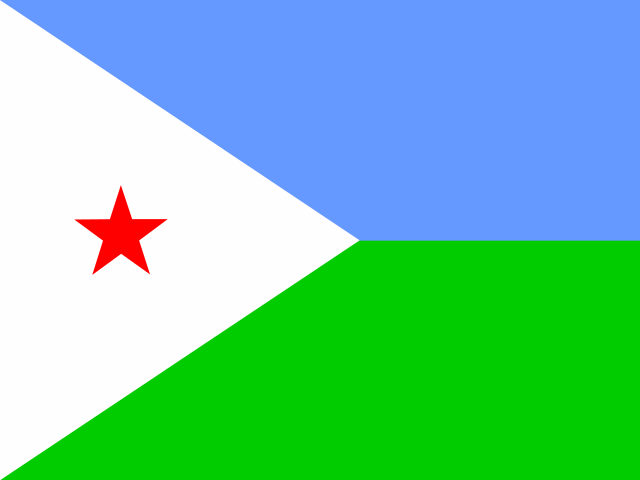
Overview
Djibouti, officially the Republic of Djibouti, is a small country in the Horn of Africa. It borders Somalia (Somaliland) to the south, Ethiopia to the southwest and west, and Eritrea to the north, with the Red Sea and Gulf of Aden along its eastern side. Its area is about 23,200 km2.
The country sits at the southern entrance of the Red Sea, beside the Bab-el-Mandeb strait, close to some of the world's busiest shipping lanes. It works as a refuelling and transshipment centre and is the main sea outlet for neighbouring Ethiopia. Several foreign powers keep military bases there, and the regional body IGAD has its headquarters in Djibouti City.
The 2024 census counted 1,066,809 people, making it the smallest population in mainland Africa. French and Arabic are the official languages, while Somali and Afar are national languages. Around 94% of people were Muslim in 2012 estimates, and Islam is the official religion. The Somali (majority) and Afar are the two largest ethnic groups, and both speak Cushitic languages.
The state is run as a unitary presidential republic with a dominant ruling party. Independence from France came in 1977. The economy is dominated by services built around the port, free-trade policies and the lease income from foreign bases.
History
Humans have lived in the Djibouti area since the Neolithic period. The Bab-el-Mandeb region has often been seen as a key crossing point for early human groups moving from East Africa toward South and Southeast Asia. Linguists disagree on where Afroasiatic-speaking peoples originated: some point to the Nile Valley or the Near East, others to the Horn of Africa itself.
In antiquity the area was part of the Land of Punt, with which Egypt traded from the Old Kingdom onward. Egyptian expeditions are recorded under Sahure of the Fifth Dynasty (about the 25th century BC) and in several later dynasties, and Punt features in the Tale of the Shipwrecked Sailor.
In the Middle Ages, the nearby port of Zeila (now in Somaliland) was the centre of the Adal Sultanate, founded by local Somali clans in the early 9th century. Zeila was among the earliest places to adopt Islam, and its Masjid al-Qiblatayn dates to the 7th century. In 1550 Nur ibn Mujahid became emir of Harar and effective ruler of Adal, and in 1559 his forces defeated the Ethiopian Empire at Fatagar, killing Emperor Gelawdewos, although Adal was then weakened by Oromo invasions.
French involvement began with a treaty signed in Paris on 11 March 1862 by the Afar sultan Raieta Dini Ahmet, selling land around Obock to France, which wanted a coaling station for steamships, especially after the Suez Canal opened in 1869. A protectorate treaty with the Issa followed on 26 March 1885. The colony took shape between 1883 and 1887 through treaties with Somali and Afar sultans. A Russian attempt to settle at Sagallo in 1889 was ended by French forces within a month. In 1894 Léonce Lagarde set up a permanent administration at Djibouti city, and the colony was named French Somaliland.
The railway into Ethiopia, reaching Dire Dawa and later Addis Ababa, turned the port into a boomtown of about 15,000 people and let it overtake Zeila as the main outlet for coffee and goods from southern Ethiopia and the Ogaden. In World War I a Somali battalion raised from the colony fought in France, including at Fort Douaumont in 1916; of 2,434 riflemen deployed, 517 were killed and 1,200 wounded.
During World War II, the colony remained loyal to the Vichy government following France's fall in 1940, and it resisted for more than a year after Italy was defeated in East Africa. The British blockaded the port, and about 4,000 of their troops took control of the city in 1942. In 1944, a battalion raised locally fought in the liberation of France.
A 1958 referendum chose continued association with France, helped by the Afar vote and the resident French, amid allegations of rigging; many Somalis voted no, favouring union with a united Somalia. France rejected a UN recommendation of independence in 1966, and a visit by Charles de Gaulle that year met riots. A second plebiscite in 1967 again favoured a looser tie with France, with voting divided along ethnic lines and more rigging claims. The territory was renamed the French Territory of the Afars and the Issas, and unrest with several deaths followed.
The Front for the Liberation of the Somali Coast (FLCS) fought for independence, recognised by the Organization of African Unity as a liberation movement. It kidnapped the French ambassador to Somalia in 1975, and a 1976 bus hijacking near Loyada further showed the difficulty of holding the colony. A third referendum on 8 May 1977 produced a 98.8% vote for independence, and the Republic of Djibouti was established, named after its capital. Hassan Gouled Aptidon became the first president (1977 to 1999). Djibouti joined the OAU, the Arab League and the UN in its first year, and was a founding member of IGAD in 1986.
In the early 1990s, tensions over representation led to armed conflict between the ruling People's Rally for Progress (RPP) and the Front for the Restoration of Unity and Democracy (FRUD). Fighting lasted roughly from 1991 to 2001, with a peace treaty with the moderate FRUD faction in 2000 and with a radical group in 2001; FRUD became a political party. Ismaïl Omar Guelleh succeeded Gouled in 1999 and was re-elected for a fifth term in April 2021.
Climate
Djibouti is hot all year with little seasonal variation. Mean daily maximums are about 32 to 41 °C outside high ground. The climate is classed as hot semi-arid or hot desert, ranging from arid on the north-eastern coast to semi-arid in the centre, north, west and south.
Djibouti City on the coast has afternoon highs of roughly 28 to 34 °C in April, with very hot, humid summers (approx. highs above 40 °C in June to August) and milder winters (approx. highs around 30 °C in December and January). Upland areas of 500 to 800 m are cooler than the coast in the hottest months of June to August, and December and January are the coolest months. At Airolaf, at about 1,535 to 1,600 m, the summer maximum is around 30 °C and the winter minimum about 9 °C.
Rainfall is low. The coast gets under about 130 mm a year, and the central highlands about 200 to 410 mm. The interior is less humid than the coast. Other towns such as Ali Sabieh and Dikhil in the south and west are also hot and dry, while Tadjoura and Obock on the Gulf are coastal and humid (approx.).
Geographically, the country lies at the northern end of the Great Rift Valley, where the African, Somali and Arabian plates meet. Lake Assal is the lowest point in Africa. Eight mountain ranges exceed 1,000 m, and the highest, Mousa Ali, reaches about 2,028 m on the Ethiopia and Eritrea border. Forest covers under 1% of the land. The Day Forest National Park in the north is home to the endangered Djibouti francolin, and the country counts around 66 mammal and 360 bird species.
Government and politics
Djibouti is a unitary presidential republic. Executive power rests mainly with the president, currently Ismaïl Omar Guelleh, who is head of state and commander-in-chief, assisted by an appointed prime minister (Abdoulkader Kamil Mohamed as of the source). The Council of Ministers answers to and is chaired by the president. The Economist Democracy Index rated the country authoritarian in 2024.
The National Assembly is a single chamber of 65 members elected every five years, though the constitution allows for a Senate. The legal system blends French civil law with customary Xeer law of the Somali and Afar. The courts consist of courts of first instance, a High Court of Appeal and a Supreme Court.
The RPP, founded in 1979, has dominated the legislature and the executive, governing within the Union for a Presidential Majority. The last legislative election covered by the source was in February 2018; later elections (approx. February 2023 for the Assembly) are outside the source detail. Guelleh took 100% in a one-man vote in 2005 and 80.63% in 2011. A presidential election is scheduled for 2026 (approx., April); its result is not covered here. The main opposition party boycotted the 2005 and 2008 elections, citing media control and repression. The government is described as dominated by the Somali Issa clan, with support from other Somali clans such as the Gadabuursi.
Power is centralised. The country is divided into six regions, one of which is Djibouti City itself, and further into twenty sub-prefectures. These are administrative units of the central state; there is no federal division of tax, health, law or education powers, which remain national. Djibouti City has special status as a region in its own right.
In foreign policy Djibouti keeps close ties with Somalia, Ethiopia, France and the United States, and belongs to the African Union, UN, Arab League, OIC and Non-Aligned Movement. It hosts the Intergovernmental Authority on Development and hosted the 2000 Arta conference on Somalia. Turkey ties have strengthened since the 2000s.
Foreign bases are central to its position. The US leases Camp Lemonnier (leased in 2002, renewed in 2014 for 20 years) at about $63 million a year; France and Japan each pay about $30 million and China about $20 million a year. Italy also has a support base. These payments exceeded 5% of the 2017 GDP of $2.3 billion. France's defence treaty took effect on 1 May 2014. The US has accused China of targeting US aircraft with lasers near its base.
On human rights, Freedom House rated the country Not Free in 2011, and a 2019 US State Department report cited arbitrary detention, restrictions on journalists and assembly, corruption and violence against women, including female genital mutilation.
Economy
The economy is service-led: about 79.7% of GDP comes from services, 17.3% from industry and 3% from agriculture. It relies on the port, free-trade policy and the location on the Red Sea route. Little rain means only vegetables and fruit are grown, and other food is imported. GDP (PPP) was estimated at about $2.5 billion in 2013, with per capita income around $2,874 (PPP) and about 5% real growth. GDP grew by over 6% a year on average from 1985 to 2015.
The Port of Djibouti, with its container terminal, handles most trade, and about 70% of activity is Ethiopian trade. Over 95% of Ethiopia's imports and exports pass through Djiboutian ports. The Doraleh Container Terminal, a $396 million project started in 2012 with DP World, can take 1.5 million TEU a year. Other ports handle potash (Tadjourah), livestock (Damerjog) and salt (Goubet).
The Djiboutian franc is issued by the Central Bank of Djibouti and is pegged to the US dollar, keeping inflation low. About 10 conventional and Islamic banks operated as of 2010. Urban unemployment was estimated at about 60%. Fishing and agro-processing account for around 15% of GDP by the source figure. Salt extraction at Lake Assal runs at about 4 million tons a year capacity.
Transport includes the electrified Addis Ababa to Djibouti railway (opened January 2018), the Djibouti-Ambouli International Airport (the only international airport), Air Djibouti as the flag carrier, and ferries across the Gulf of Tadjoura. Djibouti is part of China's 21st Century Maritime Silk Road.
Power capacity is about 126 MW from oil and diesel plants. About 45% of people lacked electricity access in 2015, and Ethiopian hydropower supplies roughly 65% of demand. Geothermal near Lake Assal and a 50 MW solar farm in Grand Bara are being developed. Djibouti Telecom is the sole telecom provider, the country connects to the SEA-ME-WE 3 cable, and the .dj domain is in use. Tourism is small (under 80,000 arrivals a year), with Lake Assal and Lake Abbe as the main attractions. Literacy is around 70% and life expectancy about 65 years.
Demographics and urbanization
The 2024 census counted 1,066,809 people, up from about 69,589 in 1955 and about 869,099 in 2015. Somalis make up about 60% and the Afar about 35%. Among Somali clans the Issa are about 33%, the Gadabuursi 15 to 20% and the Isaaq roughly 13 to 20%. The remaining 5% includes Yemeni Arabs, Ethiopians, French and Italians.
About 76% of residents live in towns, and the rest are mainly pastoralists. Most of the urban population is in Djibouti City (approx. 600,000 to 700,000 people). Other towns are much smaller, including Ali Sabieh, Dikhil, Tadjoura and Obock (each roughly 10,000 to 50,000, approx.). Djibouti City, nicknamed the French Hong Kong in the Red Sea, is cosmopolitan and a hub for migrants from Somalia, Ethiopia and Yemen.
Languages: Somali (about 60%) and Afar (about 35%) are the main first languages, while Arabic and French are official. French is the main language of instruction, and about 17,000 people speak it as a first language. Around 59,000 speak Djibouti Arabic.
Religion: Islam is the state religion, mostly Sunni of the Shafi'i school, with Sufi orders. About 94% were Muslim in 2012, with about 6% Christian. The constitution guarantees religious freedom and equality of citizens.
Health and education: fertility is about 2.35 children per woman and doctors about 18 per 100,000 people. Female genital mutilation affects about 93% of women despite a 1994 ban. The government devoted 20.5% of its budget to education in 2009. Basic schooling is five years of primary and four of middle school. The University of Djibouti is the main higher education institution.
Capital city
Djibouti City is the capital and the country's only major city, on the Gulf of Tadjoura on the Gulf of Aden coast in the east. Its population is approx. 600,000 to 700,000, well over half of the country. It is also one of the six official regions.
The climate is hot desert: very hot, humid summers (approx. highs around 38 to 42 °C) and warm winters (approx. highs near 30 °C), with very little rain. The source gives April afternoon highs of 28 to 34 °C.
It is the political, administrative and economic centre, and also the main economic city. The port, the Doraleh terminal, the Djibouti-Ambouli airport, the railway terminus to Addis Ababa, the banks and the foreign bases (including Camp Lemonnier) are concentrated in and around it. The city was founded by the French in the 1880s to 1890s and was the colonial capital. The IGAD regional body has its headquarters there. Djibouti has a single capital and it is also the main economic city.
About this summary
Capital-city details (city population, climate, role), recent political events such as the 2026 election timing, and some economic and regional context are from general knowledge and approximate.