Overview
The Democratic Republic of the Congo (DRC, also called Congo-Kinshasa, and known as Zaire from 1971 to 1997) lies in Central Africa. It is the second-largest country on the continent by area, after Algeria, and ranks eleventh worldwide by land area according to the source. Its population is roughly 124 million, which the source describes as the fourth-largest in Africa and the biggest of any French-speaking country.
French is the official language and the most widely spoken one. More than 200 indigenous languages exist, and Lingala is the most widely spoken of them. Kinshasa is the capital, the largest city and the economic centre.
The DRC borders the Republic of the Congo, the Angolan exclave of Cabinda and the South Atlantic to the west; the Central African Republic and South Sudan to the north; Uganda, Rwanda, Burundi and Tanzania (across Lake Tanganyika) to the east; and Zambia and Angola to the south. The country is centred on the Congo Basin, where dense rainforest and many rivers dominate the terrain, while the east and southeast are mountainous.
Despite enormous mineral wealth, the DRC is among the poorest and least developed countries in the world. The source cites political instability, weak infrastructure, corruption and a long history of colonial and commercial extraction, and calls the country a prominent example of the resource curse. It ranked 171 of 193 countries on the Human Development Index in 2023.
Over 120 armed groups remain active, mostly in the east. About 7 million people are displaced by fighting, and around one million Congolese refugees were living in neighbouring countries as of 2022. The M23 rebel movement took Goma in 2012 and again in 2025, with Rwandan military support, which has produced a conflict between the DRC and Rwanda.
The DRC is a member of the United Nations, the Non-Aligned Movement, the African Union, COMESA, the Southern African Development Community, the Francophonie and the Economic Community of Central African States.
History
People lived in the area about 90,000 years ago. The Bantu expansion, roughly 2,000 to 3,000 years ago (the source also places it in the first millennium BC), brought major demographic and technological change. Organised states followed, including early federated states around Pool Malebo and the Kingdom of Kongo near the mouth of the Congo River, which ruled from the 14th to the 19th century. In the centre and east, the Mwene Muji, Luba and Lunda empires flourished between the 15th and 19th centuries.
From the 1870s to 1908, King Leopold II of Belgium ruled the Congo Free State as a personal possession, with Belgium's international rights recognised in 1885. Forced labour and concession companies extracted rubber, and violence, disease and exploitation caused catastrophic population loss. Exposure of the abuses, notably the 1904 Casement Report, and diplomatic pressure led Leopold to cede the territory, which became the Belgian Congo in 1908.
The Belgian Congo was governed directly from Brussels. The end of the Free State ended its worst abuses, but racial segregation, forced labour and repression continued, and the colony relied on close cooperation among the state, missionaries and private companies. After World War II, urbanisation and development programmes created a small African middle class, but political exclusion persisted and fed nationalist movements.
In May 1960 the Congolese National Movement under Patrice Lumumba won parliamentary elections. The country became independent on 30 June 1960 as the Republic of the Congo, with Lumumba as prime minister (from 24 June) and Joseph Kasa-Vubu of ABAKO as president. Independence was followed at once by secessionist movements and Lumumba's assassination.
Mobutu Sese Seko seized power in 1965. He established a one-party system, held elections in which he was the sole candidate, and renamed the country Zaire in 1971. The source describes relative peace and stability but also severe human rights violations, repression, a cult of personality and corruption. Mobutu had strong United States backing because of his anticommunism.
By 1996, after the Rwandan genocide and the rise of a Tutsi-led government in Rwanda, Hutu Interahamwe militia fled into eastern Zaire and used refugee camps as bases for raids on Rwanda. A coalition of Rwandan and Ugandan forces invaded, allied with opposition figures led by Laurent-Désiré Kabila, and the First Congo War (1996 to 1997) ended with Mobutu's overthrow. The country was renamed the DRC. The Second Congo War (1998 to 2003) caused an estimated several million deaths and saw Laurent-Désiré Kabila assassinated. His successor Joseph Kabila oversaw the peace process and relative stability.
Fighting continued afterwards. Laurent Nkunda's CNDP rebelled, and a 2009 peace deal integrated it into the army. Bosco Ntaganda and loyal troops mutinied and briefly captured Goma in November 2012. In March 2013 the UN Security Council authorised a Force Intervention Brigade against armed groups. Neighbouring countries have been accused of arming proxies. In 2013 Mai-Mai fighters briefly invaded Lubumbashi. The Lord's Resistance Army moved into the northeast, including Garamba National Park, in 2005.
In 2015 major protests demanded that Kabila step down. Elections were postponed, and when his term ended on 20 December 2016, protests left dozens dead and hundreds arrested. The general election was held on 30 December 2018 after a delay caused by a warehouse fire that destroyed voting machines, with voting suspended in some areas because of an Ebola outbreak and an internet blackout imposed afterwards.
The electoral commission announced Félix Tshisekedi as winner on 10 January 2019, and he was sworn in on 24 January. Many suspected the result was rigged and that a deal had been struck with Kabila, since election-day polling indicated Martin Fayulu led with about 47%. This was the first peaceful transfer of power since independence. A coalition government followed in August 2019, and Tshisekedi gained the support of almost 400 of 500 National Assembly members, pushing out pro-Kabila parliamentary leaders. In April 2021 a new government was formed without Kabila supporters. A measles outbreak killed nearly 5,000 people in 2019.
In 2025 the M23 uprising escalated with Rwandan military support and again took Goma, as noted in the source's overview. Outcomes of events after the retrieval date are not covered.
Climate
The DRC straddles the Equator, with about one-third of its territory north and two-thirds south, between roughly 6°N and 14°S. Its equatorial position brings high precipitation and the world's highest frequency of thunderstorms, with annual rainfall above 2,000 mm in some places.
The low-lying central Congo Basin holds the Congo rainforest, the second-largest in the world, spanning about 155 million hectares. It is ringed by plateaus merging into savanna in the south and southwest, mountainous terraces in the west and grasslands in the north. The glaciated Rwenzori Mountains lie in the far east, and the Albertine Rift in the east and northeast is mountainous and volcanically active.
Kinshasa (approx. 15 million in the metro area) has a tropical wet-and-dry climate: hot and humid all year, with highs around 30°C, a rainy season from roughly October to May and a drier, slightly cooler season from June to September (approx.).
Lubumbashi, in the southeast mining region, sits on a high plateau about 1,200 m up. It has a milder subtropical highland-type climate, with a distinct dry season from May to September and cool nights in June and July (approx.).
Goma and the eastern highlands near the Great Lakes have a mild tropical highland climate, with plentiful rain and temperatures moderated by altitude (approx.). Mbuji-Mayi in the central south has a tropical wet-and-dry climate with a clear dry season (approx.). Kisangani, on the Congo River in the rainforest belt, is hot and wet nearly all year (approx.).
Natural hazards include volcanic eruptions in the east. Mount Nyiragongo erupted on 17 January 2002, sending lava through Goma, killing 45 people and leaving 120,000 homeless, with over 400,000 evacuated. Nearby Nyamuragira erupted six months later and again in 2006 and January 2010.
Environmental pressures include deforestation, poaching, water pollution and mining. Deforestation doubled between 2015 and 2019, rose 5% in 2021, and was the highest in Africa in 2023, driven by slash-and-burn farming and illegal logging. In January 2025 the government created the Kivu-Kinshasa Green Corridor, stated to protect a large part of the Congo Basin forest while supporting sustainable development.
Government and politics
Constitutionally the DRC is a unitary, semi-presidential republic. The president is head of state, elected by universal suffrage for five years and serving as commander-in-chief. The prime minister is head of government, appointed by the president with parliamentary support, and the cabinet answers to the legislature. Parliament is bicameral: National Assembly deputies are directly elected for five years, and senators are elected indirectly by provincial legislatures for five years.
The judiciary consists of the Constitutional Court (constitutionality of laws, election disputes and separation of powers), the Court of Cassation (final court in civil and military cases) and the Council of State (highest administrative court).
The country is divided into the city-province of Kinshasa and 25 provinces, which are subdivided into 145 territories and 33 cities. The source describes a unitary state, so sub-national units are administrative divisions rather than states with independent powers; it gives no detail on how tax, health, education or law are split between national and provincial levels. Senators are chosen by provincial legislatures, which gives provinces a role in the national legislature. Kinshasa has the special status of a city-province. The source notes that state administration is weak, especially in rural areas, and that the government has struggled to extend its authority across the whole territory.
In practice the president and associates dominate the political system. Freedom House rated the country Not Free in 2025, and the Economist Democracy Index called it an authoritarian regime in 2024, ranking it 156 of 167. It ranked 163 of 180 in the 2024 Corruption Perceptions Index and fifth most fragile of 179 in the 2024 Fragile States Index.
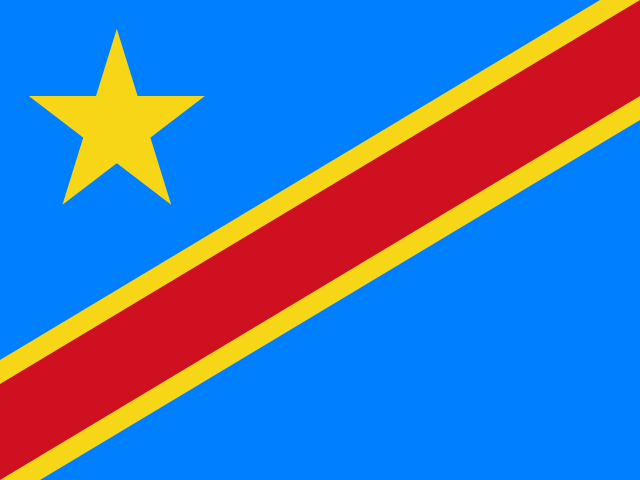
The current system is the Third Republic, declared by Laurent-Désiré Kabila in May 1997. A transitional constitution was adopted in April 2003 and replaced by the current constitution, in force since February 2006, which also brought a new flag. A referendum approved the constitution in December 2005, and the first free election in over four decades took place in July 2006. More than 600 parties registered after democratization began in 1990, and four (UDPS, PPRD, UNC and MLC) operate nationwide.
Joseph Kabila governed from 2001 to 2019 and stayed beyond his mandate, which ended in 2016. Tshisekedi succeeded him and was reelected in late 2023. In 2024 he appointed Judith Suminwa as prime minister, the first woman in the post.
In foreign relations, the DRC holds about 80% of the world's cobalt reserves according to the source, which suggests increasing geopolitical interest because of battery and grid needs. Chinese investment and exports to China have grown quickly, and in 2021 Tshisekedi called for a review of the Sicomines deal. The DRC belongs to the Central African UN subregion but is also affiliated with the Southern African Development Community.
The armed forces (FARDC) comprise Land Forces, Air Force and Navy, plus a separate Republican Guard answerable to the president. In 2023 they numbered about 134,250 personnel. The source cites low professionalism, pay, morale and equipment, and corruption. Tshisekedi announced military reforms in 2022. The FARDC has fought over 100 armed groups in the east and Kasaï, including M23.
Economy
Nominal GDP grew from about US$9.02 billion in 2003 to US$72.48 billion in 2024, and PPP GDP from about $29.23 billion to $190.13 billion. Minerals and metals, chiefly cobalt and copper, made up 80% of exports in 2023. China took 41% of exports in 2024, followed by Zambia, South Africa, Singapore and the United Arab Emirates.
Growth has not reduced poverty. About 65% of people work in subsistence agriculture, most jobs are informal, and youth unemployment is very high. An estimated 73.5% lived below US$2.15 a day in 2024, and food-price inflation reached 173% in 2023. Agricultural output has declined for decades, leaving the country dependent on food imports.
At independence in 1960 the DRC was the second-most-industrialised country in Africa after South Africa. Its economy fell sharply after the mid-1980s because of falling commodity prices, corruption and hyperinflation, and by the early 1990s the formal economy had almost ceased to exist. The wars of 1996 to 2003 deepened the damage, and stability improved from 2003 with donor help. Untapped mineral deposits are estimated at over US$24 trillion.
In the 2020s the DRC has moved from a state-dominated model toward a market economy, with partial privatization in mining and telecoms, trade agreements with over 50 countries, and membership of the African Continental Free Trade Area from 2022. Corruption, patronage networks and weak enforcement have slowed these efforts.
Mining drives growth. The DRC produced 70% of the world's cobalt ore in 2023 and is a major copper and diamond producer. It holds about 70% of global coltan, a third of cobalt, over 30% of diamond reserves and a tenth of copper reserves. The largest mechanised mines are in Katanga; diamonds come from Kasaï. Artisanal miners account for most diamond output, and a third of diamonds are believed smuggled. Conflict minerals such as coltan and cassiterite helped fuel the eastern wars.
The Sicomines deal (2007 to 2008) traded mining rights for US$3 billion of infrastructure investment, with China Railway Engineering Corporation as majority owner. Criticised as lopsided, it was renegotiated under Tshisekedi, with infrastructure investment raised to US$7 billion in 2024. Katanga Mining's Luilu plant is described as the largest cobalt refinery in the world. In 2013 the DRC gained full EITI membership after improving transparency.
Transport is poor: 152,373 km of roads, of which only 3,047 km are paved, and 4,007 km of mostly narrow-gauge railway. Air and river transport matter greatly. All DRC-certified airlines are banned from EU airspace over safety standards.
Demographics and urbanization
The population rose from 51.9 million in 2000 to 105 million in 2021 (other source figures: 96 million UN estimate for 2021), and is about 124 million in the lead figures. Growth is high; it nearly quadrupled between 1950 and 2000.
The source gives no urbanization rate. From general knowledge, roughly 47 to 48% of people live in urban areas (approx.). Kinshasa is the biggest city at approx. 15 million in its metro area. Lubumbashi (approx. 2.5 to 3 million) and Mbuji-Mayi (approx. 3 million) are mining cities, and Goma, Kisangani and Kananga are other notable centres (approx. 1 to 2 million each for Goma and Kisangani).
Over 250 ethnic groups and 450 subgroups live in the DRC, so no group dominates. The Luba-Kasaï, Kongo, Mongo, Lubakat, Lulua, Tetela, Nande, Ngbandi, Ngombe, Yaka and Ngbaka together account for 51.5%. About 600,000 Pygmies live in the country.
About 242 languages are spoken. French is official; in 2021, 74% could speak it and in 2018 51% could read and write it. In Kinshasa in 2014, 67% could read and write French. The four national languages are Kituba, Lingala, Tshiluba and Swahili, mostly spoken as second languages. Lingala is dominant in the army, and Swahili in the east.
Christianity is predominant: in 2013, 93.7% were Christian (Catholics 29.7%, Protestants 26.8%, other Christians 37.2%), Kimbanguists 2.8% and Muslims 1%, though Muslim estimates range from 1% to 12%. The Catholic Church educates over 60% of primary students and runs many hospitals and clinics, and the Church of Christ in the Congo federates 62 Protestant denominations.
About 6.9 million people are displaced within the country, over five million of them in North Kivu, South Kivu and Ituri, the most severe internal displacement crisis in Africa. Over 990,000 Congolese refugees and asylum seekers live elsewhere in Africa. Immigrants fell from just over one million in 1960 to about 445,000 in 2010, and three to six million Congolese live abroad.
In 2026, 52% had access to water services (29% rural) and 31% to sanitation (21% rural). Only 12% of formal workers are enrolled in the National Social Security Fund.
Capital city
Kinshasa is the capital, the largest city and the economic centre, so the political and main economic city are the same. It stands on the south bank of the Congo River at Pool Malebo, directly opposite Brazzaville, the capital of the Republic of the Congo. It is also its own city-province.
Its metro population is approx. 15 million (general knowledge). The climate is tropical wet-and-dry, hot and humid, with rain from about October to May and a drier season from June to September (approx.).
Kinshasa serves as the seat of government, parliament and the presidency, and it is also the main commercial hub and the cultural centre. French is widely used in the city. In 2014, 67% of residents could read and write it, and 68.5% could speak and understand it. According to the source, many regions of the country have no road access to the capital, which makes air and river connections important. Other big cities, including Lubumbashi and Mbuji-Mayi, are centres of mining.
About this summary
Metro populations, city climates and capital-city details (Kinshasa, Lubumbashi, Mbuji-Mayi, Goma) come from general knowledge and are approximate.