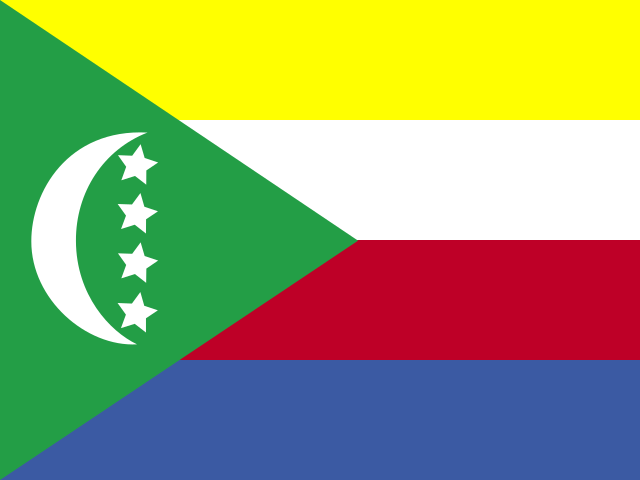
Overview
The Union of the Comoros is a small island nation at the northern entrance of the Mozambique Channel in the Indian Ocean, between the African coast (closest to Mozambique and Tanzania) and Madagascar. It has no land borders. It consists of three main islands, Ngazidja (Grande Comore), Ndzwani (Anjouan) and Mwali (Mohéli), plus several small islets, all of volcanic origin.
With about 1,659 square kilometres of land, it is among the smallest countries in Africa and the world. Its population is under one million (estimated at about 944,000 in 2026), which makes it very densely populated, at roughly 457 people per square kilometre.
Independence from France was proclaimed on 6 July 1975. The country has three official languages: Comorian (Shikomori), French and Arabic. Islam, mainly Sunni, is the state religion and is followed by almost the whole population. The country belongs to the African Union, the Arab League, the Organisation internationale de la Francophonie, the Organisation of Islamic Cooperation and the Indian Ocean Commission, and it is the only Arab League member lying entirely in the Southern Hemisphere.
Mayotte, geographically part of the same archipelago, voted to stay with France and is now a French overseas department. Comoros still claims it, a position backed by the African Union and by UN General Assembly resolutions.
Politically the country has been unstable, with more than 20 coups or attempted coups since independence. Poverty is widespread, especially in rural areas, though it has fallen in recent years, and remittances from the diaspora are a major source of income.
History
Legend says a jinni dropped a jewel that became the Karthala volcano. Archaeology indicates the first inhabitants were Austronesian-speaking seafarers from Southeast Asia, who arrived no later than the 8th century AD (the oldest known site is on Mayotte). Bantu speakers from East Africa, Malagasy groups and Arab traders followed, producing the mixed Comorian population.
Tradition says that in 632 an islander named Mtswa-Mwindza travelled to Mecca after hearing of Islam, then built a mosque at Ntsaweni and began the gradual conversion of the islands. In 933 Omani sailors called the archipelago the Perfume Islands. From about 1500 the Sultanate of Anjouan was the dominant power, while Grande Comore was split among several sultans.
From the end of the 18th century Malagasy raiders, mostly Betsimisaraka and Sakalava, attacked the islands for slaves. Crops were destroyed and many people were killed, enslaved or fled; Mwali was said to be nearly empty by the 1810s. The islands were repopulated with slaves from the mainland, and by 1865 as much as 40% of the population was enslaved.
France took Mayotte in 1841 through a treaty with Sultan Andriantsoly and tried to make it a sugar colony. Anjouan served as a supply stop for British merchants and American whalers until its importance faded after Mauritius passed to Britain (1814) and the Suez Canal opened (1869). Plantations producing ylang-ylang, vanilla, cloves, coffee, cocoa and sisal were developed. Mwali and Ngazidja came under French protection in 1886, the four islands were administered together from 1908, Anjouan's sultan abdicated in 1909, and from 1914 the islands formed a province of the colony of Madagascar.
An agreement in 1973 set independence for 1978. A referendum in December 1974 produced large majorities for independence on three islands, while Mayotte voted against. On 6 July 1975 the Comorian parliament unilaterally declared independence, and Ahmed Abdallah became first president. France recognised the new state on 31 December 1975 but kept Mayotte. Further referendums in Mayotte in 1976 confirmed its wish to remain French.
Abdallah was overthrown in a coup within a month, and Ali Soilihi took power in January 1976 with socialist and isolationist policies. In May 1978 the mercenary Bob Denard overthrew Soilihi and restored Abdallah, who ruled in an authoritarian way as head of the Federal Islamic Republic of the Comoros until he was killed in 1989. Said Mohamed Djohar then became president. Denard attempted another coup in 1995 and French paratroopers forced him to surrender. Mohamed Taki Abdoulkarim was elected in 1996 and died in office in 1998.
In 1997 Anjouan and Mohéli declared independence, which led to clashes. In April 1999 Colonel Azali Assoumani took power in a bloodless coup. Under African Union mediation, the Fomboni Accords of December 2001 renamed the country the Union of the Comoros and set up a decentralised system with a rotating Union presidency. Assoumani won the 2002 election, and in 2006 Ahmed Abdallah Mohamed Sambi won the presidency, the first peaceful transfer of power in the country's history.
In 2007 Anjouan's leader Mohammed Bacar refused to leave office after his term. In March 2008 African Union and Comorian troops took the island, and Bacar fled to Mayotte and was later granted asylum in Benin. Ikililou Dhoinine, the first president from Mohéli, took office in May 2011. Assoumani returned to the presidency after the 2016 election. A 2018 referendum, contested and boycotted by the opposition, ended the strict rotation of the presidency and allowed two consecutive terms. He was re-elected in 2019 and again in January 2024 with about 63% of the vote in a disputed election. His party won 28 of 33 seats in the January 2025 parliamentary elections, and opposition parties rejected the results.
In 2021 Comoros ratified the Treaty on the Prohibition of Nuclear Weapons. In 2023 it was a guest at the G7 summit in Hiroshima and, from 18 February 2023, held the presidency of the African Union. In 2026 the Historic Sultanates of the Comoro Islands were inscribed on the UNESCO World Heritage List, the country's first Islamic sites to be listed.
Climate
The climate is tropical and mild, with two seasons separated by rainfall. The hot, rainy season (kashkazi, the north monsoon) runs from November to April, and March is the hottest month, with average highs around 29–30 °C. The cooler, dry season (kusi, the south monsoon) runs from May to October, with average lows around 19 °C. Cyclones are rare.
Moroni, on the west coast of Grande Comore, has a warm, humid tropical climate typical of the archipelago, with hot wet months in the northern summer-to-autumn monsoon and a drier, slightly cooler winter; temperatures are approx. 24–30 °C through the year and the coast is humid. Mutsamudu on Anjouan and Fomboni on Mohéli share the same pattern, with highland areas cooler and wetter, especially on the slopes of Mount Ntingui and Karthala.
Terrain ranges from steep mountains to low hills. Mount Karthala, an active shield volcano on Ngazidja, is the highest point at 2,361 metres. It erupted in 2005 (about 40,000 people were evacuated) and had a minor eruption in 2006, so volcanic hazard is a real concern for residents of Grande Comore. Ndzwani's highest point is Mount Ntingui at 1,575 metres.
The Comoros forms its own ecoregion (Comoros forests). The coelacanth, a fish thought to be extinct, was rediscovered off the coast in 1952. There are six national parks: Karthala, Coelacanth and Mitsamiouli Ndroudi on Grande Comore, Mount Ntringui and Shisiwani on Anjouan, and Mohéli National Park.
Government and politics
The Comoros is a federal presidential republic with a multi-party system. The president is both head of state and head of government. The current constitution was ratified by referendum on 23 December 2001 and amended by referendums in 2009 and 2018. Its preamble states that governance is inspired by Islam and commits to human rights and democracy.
Power is shared between the Union and the three islands. Under the 2001 constitution each island has its own fundamental law, president and parliament, with considerable autonomy, while the Union has its own presidency and Assembly. A 2005 law on competences set out which responsibilities belong to which level. About 80% of the central budget once went to this costly administrative structure, so a 2009 referendum (about 94% in favour) reduced it: island presidents became governors and island ministers became councillors. The 2018 referendum (92.34% in favour according to the government) ended the rotation of the Union presidency among the islands; the vote was boycotted by the opposition.
The legal system combines Islamic law, French civil law inherited from the Napoleonic Code, and customary law known as mila na ntsi. Most local disputes are resolved by village elders, kadis or civil courts. The judiciary is described as independent. The Supreme Court also serves as the Constitutional Council, supervises presidential elections and acts as a High Court of Justice for allegations against the government.
The armed forces are small: a modest standing army, a police force of about 500 and a defence force of about 600. A defence treaty with France covers maritime protection, training and air surveillance. Same-sex sexual acts are illegal for both men and women, punishable by up to five years in prison.
In foreign affairs, Comoros joined the UN in November 1975 and also belongs to the African Union, the Arab League, the IMF, the World Bank, the Indian Ocean Commission and the African Development Bank. It joined the WTO in 2024. It continues to press its claim to Mayotte at the UN, while France administers the island as an overseas department (effective 2011) and an outermost region of the EU (since 2014). Comoros also claims the Glorioso Islands, a French territory in the Scattered Islands. In 2013 it referred the 2010 Gaza flotilla raid to the ICC Prosecutor.
The next elections are not covered by this summary; the January 2024 presidential and January 2025 legislative results are described in the history section.
Economy
The economy is small, agricultural and heavily dependent on aid and remittances. Remittances from the large diaspora, including 200,000–350,000 Comorians in France, were about 20% of GDP in 2023 according to the French Development Agency. About one fifth of the population lived below the international poverty line in 2009–2014. Poverty fell by about 10% between 2014 and 2018, but nearly 80% of poor people live in rural areas.
In 2019 over half of the workforce (56%) was in agriculture, with about 29% in industry and 14% in services. Agriculture contributed about 36.6% of GDP in 2024 and provides most exports; cloves alone were around 65% of exports in 2023. Vanilla, cinnamon and cloves make export earnings exposed to world price swings. The Comoros is the world's leading producer of ylang-ylang, supplying about 80% of global output for perfume.
Weaknesses include an inadequate transport system, few natural resources, a low education level in the workforce, a large civil service wage bill, erratic revenues and external debt above the HIPC threshold. Real GDP growth was weak in the 2000s, with falling per-capita output at the time. Unemployment estimates vary widely, from around 4% in ILO series to a registered 14.3% in a 2005 government paper, with higher rates in urban areas.
Membership of the franc zone anchors price stability, and the country is a member of OHADA, the African business-law organisation. Government priorities include improving education and technical training, privatisation, health services, export diversification, tourism and slowing population growth. Very high rural densities, up to about 1,000 per km² in the densest farming areas, create environmental pressure.
Demographics and urbanization
The population is about 940,000, with an average density of about 457 per square kilometre. In 2001, 34% of people were urban, and the share has risen since (approx. around 30–40% today); rural population growth has turned negative while overall growth remains relatively high. Nearly half of the population was under 15 in 2009.
Moroni on Grande Comore is the largest city (approx. 60,000–110,000 in the city, depending on definition; the wider urban area is larger). Other main centres are Mitsamihuli, Foumbouni, Mutsamudu (Anjouan's capital), Domoni and Fomboni (Mohéli's capital). Anjouan is noted as the most densely populated island.
About 97% of people are ethnically Comorian, a blend of Bantu, Malagasy-Bantu Austronesian and Arab ancestry. Minorities include Makua, Indians (mostly Ismaili), a small Creole community descended from French, Malagasy and Réunionnais settlers, and recent Chinese migrants, especially in Moroni.
Comorian languages (Shikomori, related to Swahili) are spoken by over 95%, with island variants Shingazidja, Shimwali, Shindzwani and Shimaore. Arabic script is more widely used than Latin for writing Comorian. Arabic is widely known through Quranic teaching and French is the administrative language and used in most non-Quranic education; English is taught in later grades. A 2025 Afrobarometer survey found about 90% speak Shikomori at home and about 10% French.
Sunni Islam is followed by up to 99% of the population. Small Christian communities (Catholic and Protestant) include most Malagasy residents and French immigrants.
Health indicators are modest: about 15 physicians per 100,000 people, average life expectancy about 63 years in 2021 (67 for women, 62 for men), and a fertility rate down from 7.14 in 1973 to 3.98 in 2021. Infant mortality fell from 152 to 47 per 1,000 live births between 1970 and 2020. The 2024 Global Hunger Index score of 18.8 indicates moderate hunger. About 21% of skilled workers had emigrated as of 2000.
Capital city
Moroni is the capital and largest city, on the west coast of Ngazidja (Grande Comore), at the foot of the Karthala volcano. Its population is approx. 60,000–110,000 in the city proper, depending on the definition, with a larger urban area around it. It is the seat of the Union government and presidency.
Climate is hot and humid tropical, with warm temperatures throughout the year (approx. 24–30 °C), a wetter season from November to April and a somewhat drier, cooler season from May to October. The nearby volcano is a hazard, as shown by the 2005 eruption.
Moroni is the political, commercial and port centre of the country and also hosts most foreign missions, so it is also the main economic city; there is no separate economic capital. The islands' own capitals are Mutsamudu (Anjouan) and Fomboni (Mohéli). Harbour facilities on Grande Comore are limited. The city has a historic old town, Friday Mosque and a mostly Chinese and Comorian business community. It has an international airport nearby (Prince Said Ibrahim, Hahaya).
About this summary
Some details on Moroni (approx. population, climate, role), recent political context and the approx. urban share of the population come from general knowledge and are marked approx.