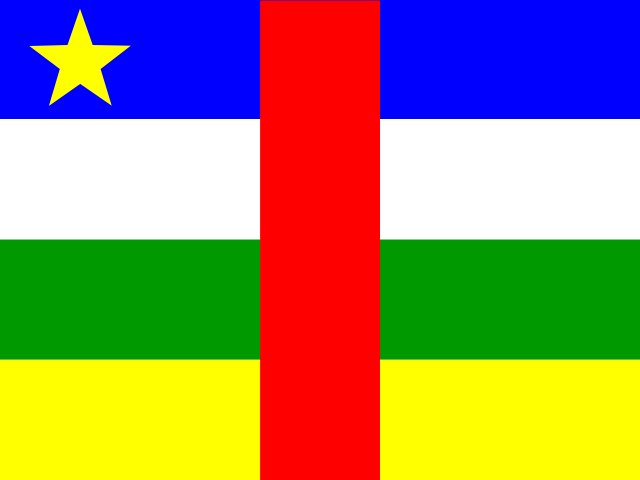
Overview
The Central African Republic (CAR) is a landlocked country in the middle of the African continent. Its neighbours are Chad to the north, Sudan to the northeast, South Sudan to the east, the Democratic Republic of the Congo to the south, the Republic of the Congo to the southwest and Cameroon to the west.
The land area is roughly 620,000 km2 (the source gives 622,984 km2, or about 240,500 sq mi). The source gives a 2024 population of about 5.36 million people, drawn from some 80 ethnic groups. Sango is the national language and French is the other official language. Bangui, the capital and largest city, lies on the southern border with the Democratic Republic of the Congo.
Most of the country is Sudano-Guinean savanna. The north has a transitional Sahel-Sudan belt, while the south has equatorial forest. About two-thirds of the territory drains into the Ubangi River, a Congo tributary, and the remaining third drains via the Chari River toward Lake Chad.
The country holds large natural resources, including uranium, crude oil, gold, diamonds, cobalt, timber, hydropower and sizeable arable land. Even so, it is among the poorest countries in the world. Per the source, it had the lowest GDP per capita at purchasing power parity in 2017, and in 2023 it ranked 191 of 193 on the Human Development Index. It was second-lowest on the inequality-adjusted index (164th of 165). It is a member of the UN, the African Union, the Economic Community of Central African States, the Organisation internationale de la Francophonie and the Non-Aligned Movement.
History
People have lived in the region since at least 8000 BCE. Around 10,000 years ago, desertification pushed hunter-gatherers south into the Sahel zones of northern Central Africa. Farming followed, starting with white yam and moving on to millet and sorghum. Before 3000 BCE the domestication of the African oil palm improved nutrition and supported population growth. Fishing and boat use also grew, allowing goods to be transported.
In the 16th and 17th centuries, slave raiders working the Saharan and Nile routes preyed on the region, and captives were sent to the Mediterranean coast, Europe, Arabia and the Americas, or along the Ubangi and Congo rivers. In the 18th century the Bandia-Nzakara and Azande peoples founded the Bangassou Kingdom along the Ubangi. In the mid 19th century the Bobangi became major slave traders, sending captives toward the Americas by river.
European expansion began in the late 19th-century Scramble for Africa. French, German and Belgian agents arrived around 1885, and France seized and colonised Ubangi-Shari in 1894. In 1911, under the Treaty of Fez, France ceded roughly 300,000 km2 of the Sangha and Lobaye basins to Germany in exchange for a smaller area in present-day Chad. France took the land back after World War I. Concessions were handed to private companies, in a pattern modelled on King Leopold's Congo Free State. In 1903 France created the separate colony of Ubangi-Shari, part of French Equatorial Africa.
In the 1957 territorial assembly election, MESAN under Barthélemy Boganda won 347,000 of 356,000 votes and every seat. Boganda declared the Central African Republic within a year and served as its first prime minister. The territory received autonomy on 1 December 1958 and became fully independent from France in 1960.
On 31 December 1965 Colonel Jean-Bédel Bokassa overthrew David Dacko in the Saint-Sylvestre coup, suspending the constitution and dissolving the National Assembly. He declared himself President for Life in 1972 and on 4 December 1976 proclaimed himself Emperor Bokassa I of the Central African Empire, then crowned himself a year later in an expensive ceremony. In April 1979 students protested a decree requiring school uniforms to be bought from a company owned by one of his wives, and the government violently suppressed the protests. Bokassa's rule ended in 1979.
André Kolingba suspended the constitution and governed with a military junta until 1985. A new constitution passed by referendum in 1986, and his party, the Rassemblement Démocratique Centrafricain, had voluntary membership. Semi-free parliamentary elections took place in 1987 and 1988, but his main opponents, Abel Goumba and Ange-Félix Patassé, were barred. By 1990 a pro-democracy movement had formed, and pressure from the United States, France and local groups pushed toward political opening.
Patassé governed from 1993 to 2003. He purged Kolingba loyalists, and Kolingba supporters called this a witch hunt against the Yakoma. In 1996–1997 three mutinies against his administration brought widespread property destruction and ethnic tension, and the Peace Corps evacuated its volunteers to Cameroon in 1996 and has not returned.
François Bozizé took power in 2003, suspended the constitution, formed a cabinet including most opposition parties, named Abel Goumba vice-president and set up a National Transition Council to draft a new constitution. The Central African Bush War began in 2004. Bozizé won the May 2005 presidential election, which excluded Patassé. A new constitution had been approved by referendum on 5 December 2004. In November 2006 his government asked France for military help against rebels holding northern towns, and French assistance by December included Mirage 2000 airstrikes.
The Syrte Agreement (February 2007) and the Birao Peace Agreement (April 2007) provided for a ceasefire, integration of fighters into the army and government, release of political prisoners and amnesty for the UFDR. Some groups kept fighting, and the CPJP, the only major group that had not signed, made peace in 2012. Bozizé was reelected in 2011 in a vote widely regarded as fraudulent.
Séléka, a coalition of rebel groups, captured towns across the north and centre in November 2012. The power-sharing agreement reached in January 2013 fell apart, and in March 2013 the rebels took Bangui, forcing Bozizé to flee, after which Michel Djotodia assumed the presidency. On 31 May 2013, Bozizé was indicted on charges of crimes against humanity and incitement to genocide. Over 200,000 people had been internally displaced by August 2013. Toward the close of 2013, the international community was warning of genocide, as Séléka's mostly Muslim fighters and Christian militias known as anti-balaka carried out reprisal attacks on civilians.
Djotodia formally disbanded Séléka in September 2013, but many fighters refused to disarm and became known as ex-Séléka. It has been argued that focusing early disarmament only on Séléka gave anti-balaka the upper hand and contributed to the forced displacement of Muslims in Bangui and the west. In December 2013 the African Union force MISCA (about 6,000 personnel) was authorised alongside French Operation Sangaris. In February 2014 UN Secretary-General Ban Ki-moon asked the Security Council to deploy 3,000 more troops, on top of the 6,000 AU soldiers and 2,000 French troops already present. In January 2014 Djotodia and Prime Minister Nicolas Tiangaye resigned under a deal negotiated at a regional summit in Chad, and Catherine Samba-Panza was elected interim president, the country's first woman in the role.
Faustin-Archange Touadéra has been president since 2016, following the interim government. In August 2025, per the source, Russia demanded that the CAR pay its Africa Corps for armed protection instead of relying on the private Wagner Group.
Climate
The climate is broadly tropical. The rainy season runs from about June to September in the north and May to October in the south. During it, rainstorms are nearly daily and early-morning fog is common. Annual rainfall peaks near 1,800 mm in the upper Ubangi region.
The north is hot and humid from February to May and can be hit by the Harmattan, a hot, dry, dusty wind. The south is more equatorial but faces desertification risk, and the far northeast is steppe.
Bangui, the capital and largest city in the south, has a tropical wet-and-dry climate (approx.): warm to hot all year, with average highs around 30–33°C, a drier season from roughly December to February and heavy rain mainly between May and October. Cities in the drier north, such as Birao, are hotter and drier with a shorter rainy season, while forest towns in the southwest, such as Berbérati and Nola, are wetter and more humid (approx.).
Geographically, much of the country is a flat or rolling savanna plateau about 500 m above sea level. The Fertit Hills lie in the northeast, scattered hills in the southwest and the granite Yade Massif in the northwest. The Mbomou meets the Uele to form the Ubangi, which forms part of the southern border, and the Sangha River drains parts of the west. About 36% of the land is forest (22.3 million ha in 2020), densest in the south, with commercial species such as Ayous, Sapelli and Sipo. Deforestation runs around 0.4% a year and illegal logging is common. The source says deforestation increased 71% in 2021.
Wildlife is notable. Dzanga-Sangha National Park in the southwest protects rainforest elephants and western lowland gorillas, while Manovo-Gounda St. Floris and Bamingui-Bangoran parks in the north hold leopards, lions, cheetahs and rhinos. Poaching, especially by raiders from Sudan, has seriously harmed these parks. In 2008 the country was the least light-polluted in the world, and the Bangui magnetic anomaly, one of the largest on Earth, is centred in the capital.
Government and politics
The CAR is formally a presidential republic. The president is head of state and is elected by popular vote for a six-year term. The prime minister is head of government and is appointed by the president, who also appoints and chairs the Council of Ministers, which initiates laws and oversees government operations. A new constitution was approved by referendum on 5 December 2004. Faustin-Archange Touadéra has led the country since April 2016, after the interim government of Catherine Samba-Panza and Prime Minister André Nzapayeké.
The National Assembly has 140 members elected for five-year terms by a two-round system. The legal system is based on French law. The Supreme Court and a Constitutional Court both have judges appointed by the president. The constitution addresses freedom of speech, but there have been incidents of government intimidation of the media, and an IREX media sustainability report said the country only minimally met its objectives. Freedom ratings were 'Partly Free' for 1991–2001 and 2004–2013, and V-Dem described the country as autocratizing in 2024. Governments have changed through violence, negotiation and elections. The source says that as of 2018 the official government did not control large parts of the country, which were held by rebel groups.
Power is centralised. The country is divided into 7 administrative regions, 20 prefectures and 85 sub-prefectures. The source does not describe regional powers over taxation, health, law or education, so these sub-national units should be understood mainly as administrative divisions of a unitary state, not as autonomous governments. The source mentions no special jurisdictions.
The country depends heavily on foreign aid, and many NGOs provide services the state does not. In 2019 over US$100 million in aid was spent, mostly humanitarian. The UN Peacebuilding Fund declared the country eligible on 8 January 2008, with priorities of security-sector reform, good governance and rule of law, and community revitalisation. It also requested Peacebuilding Commission help in June 2008. In 2017 it signed the UN Treaty on the Prohibition of Nuclear Weapons.
On human rights, a 2009 US State Department report described poor conditions, alleging extrajudicial executions, torture, beatings and rape by security forces with impunity, harsh prison conditions, arbitrary arrest, prolonged pretrial detention, corruption, restrictions on movement and workers' rights, mob violence, female genital mutilation, discrimination against women and pygmies, trafficking, forced labour and child labour. Accusations of witchcraft, a criminal offence, have led to violence against women and children. About 68% of girls are married before 18. Freedom of movement is limited in the north because of security forces, armed bandits and other armed groups, and many people are internally displaced.
The source does not cover any scheduled elections, and no election outcomes after the retrieval date are stated.
Economy
Income per person is frequently put at roughly US$400 annually, which places it near the bottom globally. That estimate, however, relies chiefly on documented export sales and leaves out informal trade in food, homemade alcohol, diamonds, ivory, bushmeat and traditional medicine. Real GDP expands by a little over 3% each year. The country uses the CFA franc, which is tied at a fixed rate to the euro. It is a member of OHADA, the Organization for the Harmonization of Business Law in Africa, and the World Bank's 2009 Doing Business report placed it 183rd out of 183 economies.
Diamonds lead exports, accounting for 40–55% of export revenue, though an estimated 30–50% of production is smuggled out of the country. Farming is built around cassava, peanuts, maize, sorghum, millet, sesame and plantain, among other food crops. Cassava, the staple, is grown at a rate of 200,000–300,000 tonnes annually, compared with 25,000–45,000 tonnes of cotton, the principal cash crop sold abroad. Incomes derive more from the occasional sale of surplus food than from exports of cotton or coffee. Most of the country feeds itself, yet the tsetse fly holds back livestock raising.
Trade partners: France is the main import source (17.1%), followed by the United States (12.3%), India (11.5%) and China (8.2%). France is also the largest export partner (31.2%), followed by Burundi (16.2%), China (12.5%), Cameroon (9.6%) and Austria (7.8%). Untapped resources include uranium, crude oil, gold, cobalt, timber and hydropower.
Demographics and urbanization
The population has roughly quadrupled since independence, from about 1.23 million in 1960 to roughly 5.4 million in recent estimates (a 2021 UN estimate of about 5.46 million and a 2024 figure of about 5.36 million). There are over 80 ethnic groups, each with its own language. The two most common are the Gbaya (28.8%) and Banda (22.9%), together slightly over half of the 2003 population. Others include the Baggara Arabs, Baka, Bayaka, Fula, Kara, Kresh, Mbaka, Mandja, Ngbandi, Sara, Vidiri, Wodaabe, Yakoma, Yulu and Zande, plus some Europeans, mostly of French descent.
The source gives no urbanization rate. From general knowledge, roughly 40% of people live in towns and cities (approx.), with Bangui the dominant urban centre at roughly 900,000 or more people (approx.). Other towns such as Bimbo, Berbérati, Bambari, Bouar and Bossangoa are far smaller, at tens to a few hundred thousand people (approx.).
French and Sango are the official languages. Sango is a creole that developed as an inter-ethnic lingua franca from the local Ngbandi language.
The 2003 census found 80.3% Christian (51.4% Protestant, 28.9% Catholic), 10% Muslim, 4.5% other religions and 5.5% no religion. Pew estimated in 2010 that Christians were 89.8% (60.7% Protestant, 28.5% Catholic) and Muslims 8.9%. The Catholic Church claims over 1.5 million adherents. Animist beliefs persist and blend into Christian and Islamic practice. A UN director described Muslim-Christian tensions as high. Many missionary groups work in the country, including Lutherans, Baptists, Catholics, Grace Brethren and Jehovah's Witnesses, from the US, France, Italy, Spain, Nigeria, the DRC and elsewhere. Since 2012, religious leaders have mediated between communities and armed groups and given refuge to displaced people.
Public education is free and compulsory from age 6 to 14, but about half of adults are illiterate. Higher education has two institutions: the public University of Bangui, which has a medical school, and Euclid University, an international university.
Health indicators are very poor. In 2007, women could expect to live 48.2 years and men 45.1 years. By 2010, only three other nations had a higher maternal mortality rate than this one. The total fertility rate in 2014 was roughly 4.46 children for each woman, and around 25% of women have undergone female genital mutilation. Traditional birth attendants with little formal training oversee many deliveries. Malaria is endemic and ranks among the main causes of death. In 2009, about 4.7% of adults aged 15–49 were HIV-positive, and just 3% of them received antiretroviral therapy. Per-person health spending was US$20 (PPP) in 2006, and in 2009 there was roughly one physician for every 20,000 people. The biggest hospitals are located in the Bangui district. The country scored 31.5 on the 2024 Global Hunger Index, placing 119th among the 127 countries ranked.
Capital city
Bangui is the capital and largest city. It sits on the Ubangi River at the country's southern border with the Democratic Republic of the Congo. Its population is roughly 900,000 to over 1 million people (approx.).
Its climate is tropical wet-and-dry (approx.), with warm to hot temperatures year-round, heavy rain in the May–October wet season and a drier period around December to February. The Bangui magnetic anomaly, one of the largest on Earth, is centred here.
Bangui is the political centre, home to the national government. It is also the main economic and cultural city, and the University of Bangui, including its medical school, is located here. The largest hospitals are in the Bangui district. Euclid University, an international institution, also operates in the country. The capital was seized by Séléka rebels in March 2013, and Bangui saw reprisal violence and displacement of Muslim civilians by anti-balaka groups. The country has a single capital, and it is also the main economic city, so there is no separate economic capital.
About this summary
Capital-city details (Bangui's approximate population, climate and role), city populations and some recent political context come from general knowledge and are approximate.