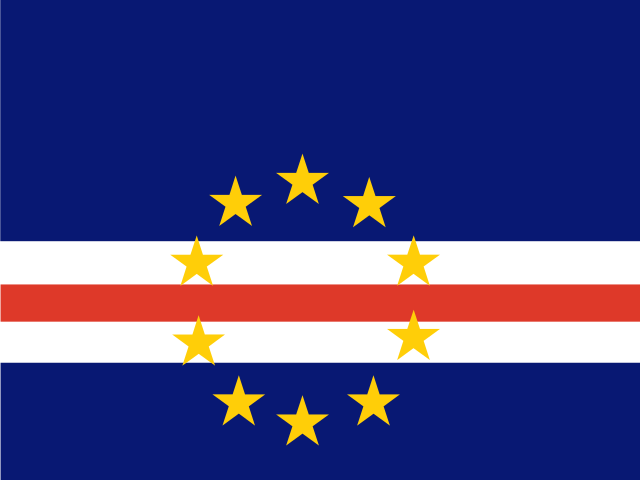
Overview
Cape Verde (Portuguese: Cabo Verde, officially the Republic of Cabo Verde) is an island country in the eastern Atlantic Ocean, off the coast of West Africa. It has ten volcanic islands (nine inhabited) plus several islets, with a combined land area of about 4,033 square kilometres. The islands lie roughly 600 to 850 kilometres west of Cap-Vert near Dakar, the westernmost point of mainland Africa, from which the country takes its name. It belongs to the Macaronesia ecoregion, together with the Azores, the Canary Islands, Madeira and the Savage Islands.
The islands had no permanent population until Portuguese explorers arrived in the 15th century. Cape Verde became independent in 1975 and since the early 1990s has been a stable multiparty democracy, regarded as one of the more developed and democratic countries in Africa. With few natural resources, its economy is mostly based on services, with a growing emphasis on tourism and foreign investment.
The population is around 530,000 (2026 estimate), which makes it one of the smallest countries in Africa by population. Most Cape Verdeans trace their ancestry mainly to West Africa, with additional Portuguese and other roots. The diaspora, found especially in the United States and Portugal, is larger than the resident population. The country is a member of the African Union.
Portuguese is the official language and Cape Verdean Creole (Kriolu/Crioulo) is the recognised national language, spoken by nearly everyone. In the 2021 census the most populous islands were Santiago (about 269,000), São Vicente (about 74,000), Santo Antão (about 37,000), Fogo (about 33,500) and Sal (about 33,300). The main urban centres are Praia (about 138,000), Mindelo (about 69,000), Espargos (about 24,500) and Assomada (about 21,300).
History
The archipelago formed through volcanic activity, with the islands dating from roughly 8 to 20 million years old in their exposed form. No people lived there before Europeans arrived. Genoese and Portuguese navigators reached the islands around 1456. Portuguese records credit the Genoa-born António de Noli, later made governor by King Afonso V, with the first discoveries, and also name Diogo Dias, Diogo Afonso, Alvise Cadamosto and Diogo Gomes among those involved.
In 1462 Portuguese settlers landed on Santiago and founded Ribeira Grande, today called Cidade Velha (Old City). It became the earliest lasting European town in the tropics. During the 16th century the islands grew wealthy from the Atlantic slave trade. Pirates sometimes raided the settlements, and the English privateer Francis Drake sacked Ribeira Grande twice in 1585, when Portugal was within the Iberian Union. After a French attack in 1712 the town lost importance to nearby Praia, which became the capital in 1770.
In the 19th century the decline of the slave trade brought an economic crisis, drought and emigration. The islands' position on mid-Atlantic shipping routes nevertheless made them a useful resupply point, and the fine harbour of Mindelo on São Vicente turned it into a commercial hub. Charles Darwin's voyage on HMS Beagle made its first stop in Cape Verde in 1832.
Discontent with Portuguese rule grew because of weak investment and refusal to grant local autonomy. In 1951 Portugal redesignated the colony as an overseas province, partly to dampen nationalism. In 1956 Amílcar Cabral and fellow Cape Verdeans and Guineans founded the PAIGC (African Party for the Independence of Guinea and Cape Verde) in secret. It first sought independence by peaceful protest, but after repression and mass arrests in 1959 it turned to armed struggle, moving its headquarters to Conakry in 1960 and starting the rebellion in 1961. The fighting took place mainly in Portuguese Guinea, where about 10,000 PAIGC soldiers faced about 35,000 Portuguese and African troops. The PAIGC did not try to disrupt Portuguese control in Cape Verde itself.
Portuguese Guinea declared independence in 1973 and was recognised in 1974. Cabral was assassinated in 1973, and leadership passed to his half-brother Luís Cabral. After Portugal's revolution of April 1974, the PAIGC became active in Cape Verde, and in December 1974 it agreed with Portugal on a transitional government. Cape Verdeans elected a National Assembly on 30 June 1975, which received the instruments of independence on 5 July 1975.
Since the early 1990s the country has been a multiparty democracy. In 2007 it moved out of the UN's least developed country category, and in 2008 it joined the WTO. On 2 February 2024 it was certified malaria-free, the third African country to reach that status.
Climate
Cape Verde has a mild, dry, largely arid climate, moderated by the surrounding ocean. The air is cooler than on the nearby mainland, such as Senegal, while the sea is warmer because the islands lack the cold upwelling found off the West African coast. Average temperatures range from about 22 °C in February to about 27 °C in September.
The islands sit in the Sahelian semi-arid belt. Rain is irregular and falls mostly between August and October, in brief heavy downpours, with September usually the wettest month. Sal receives only about 145 mm a year, which is desert-level rainfall, and Sal Rei on Boa Vista about 67 mm. Humid mountain areas can exceed 1,000 mm, largely from condensation of ocean mist. Less than two percent of the land is arable.
Climate varies by island. Sal, Boa Vista and Maio are flat, sandy and dry, with extensive salt flats on Sal and Maio. Higher and rockier islands such as Santiago, Santo Antão, Fogo and São Nicolau catch more moisture, allowing greener slopes, sugarcane and banana plantations. On Santiago the interior and east coast are wetter than the dry south and southwest coast, where Praia lies. Mindelo on São Vicente is a dry, windy coastal city (approx.), and Espargos on Sal is among the driest and sunniest places (approx.).
Many strong Atlantic hurricanes, known as Cape Verde-type hurricanes, begin near the islands, though the islands themselves have been struck by hurricanes only twice since 1851: in 1892 and in 2015 (Hurricane Fred). The country is exposed to climate change, including sea-level and drought risks. About 20% of energy came from renewables in 2023, with a goal of 50% by 2030. In 2023 Portugal agreed to forgive €140 million of debt in exchange for environmental investment, one of Africa's first debt-for-nature swaps.
The volcano Pico do Fogo on Fogo island is the largest active volcano in the region, rising to 2,829 metres, and erupted in 2014. Forest covers about 11% of the land. The isolation of the islands has produced endemic species, especially birds and reptiles, such as the Raso lark and the Cape Verde giant gecko.
Government and politics
Cape Verde is a unitary semi-presidential representative democratic republic. The constitution, adopted in 1980 and revised in 1992, 1995 and 1999, defines the basic framework. The president is head of state and is elected by popular vote for five years. The prime minister is head of government, is nominated by the National Assembly and appointed by the president, and proposes the ministers and secretaries of state. National Assembly members are elected for five-year terms. The two main parties are the MpD and the PAICV; a third party, the UCID, has also held seats. In 2016 the seat split was MpD 36, PAICV 25, UCID 3. The country is rated highly for democracy in Africa, ranking 40th worldwide on the V-Dem electoral democracy score in 2026. Later elections and their results are not covered here.
The court system is topped by a Supreme Court of Justice, with regional courts beneath it. The president, the National Assembly and the Board of the Judiciary each appoint some of the Supreme Court's members. Civil, constitutional and criminal cases are handled by separate courts, and appeals from them are brought before the Supreme Court.
As a unitary state, power is concentrated at the national level, which holds the main responsibility for taxation, law, health and education policy. Sub-national government consists of 22 municipalities (concelhos), subdivided into 32 parishes (freguesias) that derive from colonial-era religious parishes. Municipalities handle local services and administration under national law. There are no federal states or autonomous regions with separate legislative powers.
Foreign policy is nonaligned and cooperative, with an active role in Africa. Cape Verde is a founding member of the Community of Portuguese Language Countries and has had a special partnership with the EU since 2007. Its currency, the escudo, is pegged to the euro. It ratified the Rome Statute in 2011, signed the UN treaty on the prohibition of nuclear weapons in 2017, and opened an embassy in Nigeria in 2021.
The armed forces consist of the National Guard and the Coast Guard. Their efforts have focused on combating drug trafficking, including Operation Flying Launch, which ended in 2010. In 2016 the Monte Tchota incident, in which soldiers killed 11 people, took place.
Economy
Cape Verde has few natural resources: salt, pozzolana (a volcanic rock used in cement) and limestone. Only five islands (Santiago, Santo Antão, São Nicolau, Fogo and Brava) normally support significant farming, and over 90% of food is imported. The UN has classed it as a developing country rather than a least developed one since 2007, and it has been recognised for strong growth and improved living conditions despite its limits.
The economy is dominated by services. Commerce, transport and public services make up more than 70% of GDP, while agriculture and fishing provide about 9% even though roughly 35% of people live in rural areas. Light manufacturing accounts for most of the rest. Fish and shellfish are exported in small quantities, with processing plants in Mindelo, Praia and on Sal. Remittances from emigrants are estimated at about 20% of GDP.
Since 1991 the government has followed market-oriented policies, with privatisation and openness to foreign investment, prioritising tourism, light industry, fisheries, transport, communications and energy. Between 1994 and 2000 about $407 million of investment was made or planned, 58% of it in tourism. Real GDP grew by more than 7% a year on average from 2000 to 2009, helped by one of the fastest-growing tourism sectors in the world. Cape Verde joined the WTO in 2008 and moved to middle-income status in the same year.
The currency, the Cape Verdean escudo (CVE), was first tied to the Portuguese escudo and, from 1999, to the euro, reflecting close economic ties with Portugal. The minimum wage was raised to 13,000 CVE (about €118) a month in January 2018. The country attracts immigrants because of its comparatively high living standards for the region.
Infrastructure supports its position on Atlantic air and sea routes. The main ports are Mindelo (Porto Grande) and Praia. Sal has the international airport, and Praia's Nelson Mandela-era successor, Cesária Évora Airport, opened in 2009, while Aristides Pereira International Airport on Boa Vista opened in 2007. Airports exist on all inhabited islands, though Brava and Santo Antão have no scheduled flights. The road network is about 3,050 km, of which 1,010 km is paved, mostly with cobblestone.
On energy, a wind farm built in 2011 supplies about 30% of electricity at the time. The country hosts the ECOWAS Regional Centre for Renewable Energy and Energy Efficiency (2010), and has postponed its goal of full renewables, now aiming for 50% by 2030 and 100% by 2050. TechPark Cabo Verde, a technology park funded by the African Development Bank and the government, began operations in 2023 and was inaugurated in 2025. Internet penetration is high and the mobile market is growing. Research spending is very low, about 0.07% of GDP in 2011.
Demographics and urbanization
The population was 491,233 at the 2021 census and is around 530,000 by a 2026 estimate. About 236,000 people lived on Santiago at the time cited, and the 2021 island count for Santiago is about 269,000. Roughly 35% of people live in rural areas, so the country is about two-thirds urban (approx.). Cape Verdeans descend from Africans (free and enslaved) and Europeans of various origins, with some Jewish ancestry from North Africa.
Largest cities in 2021: Praia (about 137,900), Mindelo (about 69,000), Espargos (about 24,500) and Assomada (about 21,300). Praia on Santiago is the principal urban agglomeration, and Mindelo is the main city of the northern islands.
Portuguese is the official language and is used in education, government and the media. Kriolu is the mother tongue of virtually everyone, and the constitution calls for measures to give it parity with Portuguese. Differences between island varieties, mainly the northern (Barlavento, São Vicente) and southern (Sotavento, Santiago) forms, have complicated standardisation.
Roughly 80% of the population was Roman Catholic as of 2010, with two dioceses (Mindelo and Santiago de Cabo Verde). The Church of the Nazarene is the second-largest community, with other Protestant groups present, and Islam is the largest minority religion. Atheists are under 1%.
Almost one million Cape Verdeans live abroad, nearly twice the resident population. The United States hosts about 500,000, mostly in New England (Boston, New Bedford, Providence, Brockton). Portugal has about 150,000, with other sizeable groups in Angola, Spain, France, Senegal, Italy, the UK and the Netherlands. Cape Verde now receives more migrants than it sends, mostly from West Africa and China, plus a few thousand professionals, entrepreneurs and retirees from Europe and the Americas. Over 22,000 foreign-born residents have been naturalised.
Health indicators are among the best in Africa: life expectancy at birth was 76.2 years in 2017 (72.2 male, 80.2 female), under-five mortality 15 per 1,000 live births, and HIV prevalence 0.8%. There are two central hospitals (Praia and Mindelo), four regional hospitals and numerous health centres. Education is free and compulsory for ages 6 to 14, adult literacy is about 91%, and the country has around ten universities. Theft and burglary are common in crowded places, and murders are concentrated in Praia and Mindelo.
Capital city
Praia is the capital and largest city, on the southern coast of Santiago island, the largest island of the Sotavento (leeward) group. It had about 138,000 inhabitants in 2021 (the urban area is somewhat larger, approx.). It became the capital in 1770, after the older settlement of Ribeira Grande (Cidade Velha) declined.
Praia has a hot, dry, semi-arid climate (approx.), with a short rainy season from August to October and a long dry season, and warm temperatures year-round, usually in the mid-20s °C. It is on the drier south coast of Santiago, in contrast to the wetter interior and east.
Praia is the political and administrative centre, with the seat of government, and hosts the embassies of many countries. It is also a major economic city, with one of the country's two main ports and Cesária Évora Airport, plus fish processing plants. It is the commercial and services hub, though tourism is concentrated more on Sal and Boa Vista (approx.).
The country has a single capital. Culturally, Mindelo on São Vicente (about 69,000 people) is the second major city and is known for its harbour and as a centre of music and the arts (approx.). Cidade Velha, the original colonial settlement near Praia, is a historic site.
About this summary
Includes approximate general-knowledge facts on Praia's climate and role, city-level climates, recent population and economic context, and the status of upcoming political events.