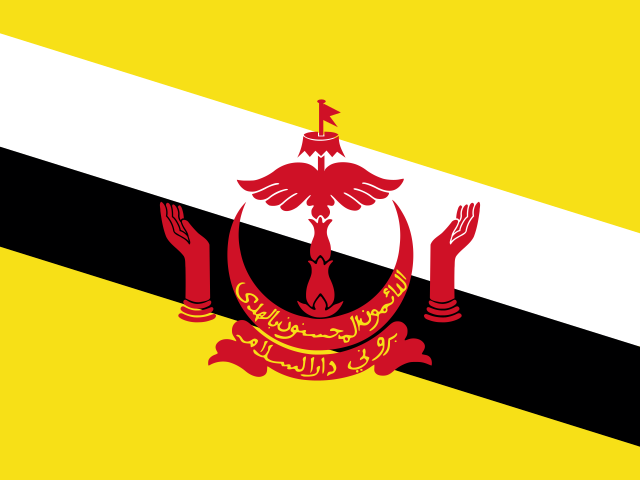
Overview
Brunei, formally Brunei Darussalam, is a small Southeast Asian country on the northern coast of Borneo. Apart from its shore on the South China Sea, it is enclosed by the Malaysian state of Sarawak, and the Sarawak district of Limbang splits its territory into two separate parts. It is the only sovereign state located entirely on Borneo; the rest of the island belongs to Malaysia and Indonesia.
As of 2025 the population was about 466,330, which the source describes as the smallest in Asia. The capital and largest city is Bandar Seri Begawan. Malay is the official language, Sunni Islam is the state religion, and other faiths are nominally tolerated.
Brunei is an absolute monarchy headed by Sultan Hassanal Bolkiah, who has ruled since 1967. Its legal system blends English common law with Islamic-inspired law, including sharia. Wealth comes mostly from oil and natural gas, and the state provides free or heavily subsidised housing, healthcare and education. It ranks 'very high' on the Human Development Index, second in Southeast Asia after Singapore, with which it has close ties including a Currency Interchangeability Agreement. The IMF ranks it seventh in the world for GDP per capita at purchasing power parity.
Brunei belongs to the United Nations, the WTO, the East Asia Summit, the Organisation of Islamic Cooperation, the Non-Aligned Movement, the Commonwealth and ASEAN.
History
Archaeology shows the area took part in the Maritime Jade Road, a trading network that lasted roughly 3,000 years, from about 2000 BC to 1000 AD. A settlement called Vijayapura, thought to have lain in northwest Borneo and to have flourished in the 7th century, is described as a vassal of the Buddhist Srivijaya empire.
At the height of the Sultanate under Sultan Bolkiah (1485–1528), Brunei is claimed to have controlled most of Borneo, including present-day Sarawak and Sabah, the Sulu archipelago and islands off the northwest tip of Borneo. Claims also exist over a place called Seludong, which scholars link either to Mount Selurong in Indonesia or to the Serudong River in eastern Sabah.
The Portuguese capture of Malacca pushed wealthy Muslim refugees toward nearby sultanates such as Brunei, helping its rise. Brunei intervened in a dispute between Hindu Tondo and Muslim Manila in the Philippines, naming Rajah Ache of Manila, a man of Bruneian descent, as admiral of its navy. The surviving crew of the Magellan Expedition visited in 1521, and in 1578 Brunei fought Spain in the Castilian War.
The empire declined through the 19th century. Britain attacked Brunei in July 1846 amid a dispute over who was the rightful Sultan. In return for help in putting down a rebellion, the Sultan gave James Brooke land that became Sarawak and let him set up the Raj of Sarawak. Brooke and his nephews, known as the White Rajahs, later leased or annexed more territory. The Sultanate also gave up Sabah to the British North Borneo Chartered Company. Brunei became a British protectorate in 1888, and in 1906 a British Resident was assigned as colonial manager.
Oil was struck at Seria on 5 April 1929 after the first well was drilled on 12 July 1928; Seria Well Number 2, drilled in August 1929, was still producing as of 2009. Production grew in the 1930s with more fields.
Japan invaded on 16 December 1941, landing about 10,000 troops of the Kawaguchi Detachment at Kuala Belait and taking the whole country after six days of fighting. Before their defeat the Japanese set fire to the Seria oil wells. A British Military Administration, made up mainly of Australian personnel, took over, and civil administration followed on 6 July 1945. It had to rebuild an economy badly damaged during the occupation.
In July 1953 Sultan Omar Ali Saifuddien III formed the seven-member Tujuh Serangkai committee to gauge public views on a written constitution. In March 1959 he led a delegation to London, and the constitution was adopted that year. The first National Development Plan began in 1953 with B$100 million, funding a gas plant and public education; by 1956 oil output reached 114,700 barrels per day.
In 1962 a small armed rebellion against the monarchy, indirectly tied to the Indonesia–Malaysia confrontation, was put down with British help. The pro-independence Brunei People's Party was banned, and the revolt influenced the Sultan's decision not to join the Malaysian Federation.
A November 1971 agreement gave full internal self-government, with the UK still handling external affairs and defence, and Gurkha units were deployed, remaining to this day. A treaty on 7 January 1979 gave Brunei responsibility for its international affairs. Full independence came on 1 January 1984, when Sultan Hassanal Bolkiah read the Proclamation of Independence and took the style 'His Majesty'. Brunei joined the United Nations on 22 September 1984 as its 159th member.
In October 2013 the Sultan announced a phased introduction of a Sharia-based penal code for Muslims, starting in April 2014, which drew international criticism including 'deep concern' from the UN. In 2019 Brunei extended its moratorium on the death penalty to the Sharia code and said the second phase would not proceed as planned; the first phase remains in force.
Climate
Brunei has a tropical equatorial rainforest climate, influenced more by the Intertropical Convergence Zone than by trade winds, with few or no cyclones. It is hot and humid all year with high rainfall.
The capital Bandar Seri Begawan has typical daytime highs around 31–32°C (approx.), warm nights and heavy rain throughout the year, with somewhat wetter periods from roughly November to January (approx.). Coastal towns such as Muara, Seria and Kuala Belait share this climate, as does the mountainous Temburong District, which is somewhat cooler inland.
About 72% of the land is forested, mostly lowland rain forest with mountain rain forest inland. Brunei shares with other ASEAN states exposure to climate change risks.
Government and politics
Brunei is governed under its 1959 constitution and the national tradition of the Malay Islamic Monarchy (Melayu Islam Beraja, MIB), which combines Malay culture, Islamic religion and monarchy. The Sultan, Hassanal Bolkiah, is head of state with full executive authority and also serves as prime minister, finance minister and defence minister. Since the 1962 revolt he has held emergency powers renewed every two years, so Brunei has technically been under martial law since then.
The Legislative Council has a single chamber and serves only in a consultative role, with the Sultan choosing its membership. Its most recent election took place in 1962. English common law forms the basis of the legal system, although sharia takes precedence in certain cases. The highest court is the Supreme Court, which comprises the Court of Appeal and the High Court, but civil cases may be appealed further to the Judicial Committee of the Privy Council.
Power is highly centralised; there are no elected sub-national governments. Brunei has four districts: Brunei-Muara, Belait, Tutong and Temburong. Brunei-Muara is the smallest but most populous and contains the capital. Belait is the centre of the oil and gas industry, Temburong is an exclave, and Tutong has the largest natural lake, Tasek Merimbun. The districts hold 39 mukims, which in turn contain villages (kampung). District Offices and Municipal Departments, both departments of the Ministry of Home Affairs, run districts and towns. Bandar Seri Begawan and most towns, except Muara and Bangar, are Municipal Board areas. Health, education, tax and law are all set nationally.
Foreign affairs were managed by the UK until 1979, and now by the Ministry of Foreign Affairs. Brunei joined the Commonwealth on 1 January 1984 and ASEAN on 7 January 1984, and chaired ASEAN in 2013. It joined the OIC in 1984, APEC in 1989, and was a WTO founding member in 1995. It hosted APEC in 2000, is a major player in BIMP-EAGA, and has close ties with Singapore and the Philippines. Brunei claims some of the Spratly Islands and has disputed Limbang's status as part of Sarawak; reports of a 2009 settlement are denied by the Brunei government.
The military has three infantry battalions and a navy with patrol boats. A British Gurkha battalion of about 1,500 is stationed at Seria under a defence agreement. The 2016–17 defence budget was about B$564 million, roughly 2.5% of GDP.
The 1959 constitution guarantees non-Muslims the right to practise their faith, but celebrations and prayers must remain in places of worship and private homes. After the Sharia Penal Code was adopted, public Christmas decorations were banned. Male and female homosexuality is illegal. The 2019 moratorium covers the death penalty under the Sharia code. Criticism by the UN and others of the penal code and of discrimination against women has been noted; Brunei was the first Asian country to ban shark finning nationwide.
Economy
Roughly 90% of GDP comes from crude oil and natural gas. Brunei produces around 167,000 barrels of oil daily, along with approximately 25.3 million cubic metres of liquefied natural gas each day; according to the source, this places the country ninth worldwide among gas exporters. Brunei belongs to OPEC+. Forbes placed it fifth among 182 nations in wealth, a position driven by its hydrocarbon resources. In the 2025 Global Innovation Index it came in at 88th. Between 1999 and 2008, GDP expanded by 56%.
Income from overseas investment, mostly managed by the Brunei Investment Agency under the Ministry of Finance, supplements domestic production. The government provides all medical services and subsidises rice and housing. Unemployment was 6.9% in 2014. Leaders aim to upgrade the labour force and broaden the economy through banking, tourism and a long-term diversification plan. A national halal brand, Brunei Halal, was launched in 2009.
Brunei imports 60% of its food, about 75% of it from ASEAN countries, plus vehicles and electrical goods. It promotes rice self-sufficiency through Laila Rice. In 2020 renewable energy produced under 1% of electricity.
Royal Brunei Airlines aims to make Brunei a hub between Europe and Australia/New Zealand, holding a daily Heathrow slot via Dubai and flying to Hong Kong, Bangkok, Singapore and Manila. Brunei International Airport is being upgraded with Changi Airport International as consultant, planned at $150 million, to double capacity from 1.5 to 3 million passengers a year. There is one main sea port, at Muara, with a ferry to Labuan in Malaysia.
The road network was about 3,714 km in 2019, 86.8% paved, with a 135 km dual carriageway from Muara to Kuala Belait. A bridge linking Muara and the Temburong district across Brunei Bay opened on 17 March 2020 at a cost of about $1.6 billion. Car ownership is among the highest in the world, one car per 2.09 people, due to limited public transport, low import tax and fuel at B$0.53 per litre.
Banks operating include Maybank, RHB, Standard Chartered, UOB and Bank of China (permitted from April 2016). Citibank left in 2014 and HSBC in November 2017.
Demographics and urbanization
The population was 445,373 in 2021 and about 466,330 in 2025, with roughly 76% living in urban areas. Life expectancy is about 77.7 years. About 97% live in the larger western part (Belait, Tutong, Brunei-Muara), while only about 10,000 live in Temburong.
In 2014, 65.7% of the population were Malay, 10.3% Chinese, 3.4% indigenous and 20.6% other groups. Indigenous groups include the Belait, Brunei Bisaya, Brunei Malay, Dusun, Kedayan, Lun Bawang, Murut and Tutong. There is a relatively large expatriate community, mostly from non-Muslim countries such as Australia, the UK, South Korea, Japan, the Philippines, Thailand, Cambodia, Vietnam and India. The Panaga area in Belait District hosts many European expatriates because of Shell and British Army housing.
Main urban centres are Bandar Seri Begawan, the port town of Muara, and the oil towns of Seria and Kuala Belait. The official 2025 figure of about 64,000 refers to the capital's core municipal area; the wider Bandar Seri Begawan urban area is considerably larger (approx. 150,000–250,000).
Over 82% are Muslim (Sunni, Shafi'i school), 6.7% Christian and 6.3% Buddhist, with about 2% freethinkers and about 2% followers of indigenous religions.
Standard Malay is official, written in Latin (Rumi) and Arabic (Jawi) scripts. Brunei Malay is the principal spoken language, about 84% cognate with standard Malay. English is widely spoken and is the language of instruction from primary to tertiary level. Chinese varieties are widely spoken, Arabic is used for religious education, and Kedayan, Tutong, Murut and Dusun are also spoken.
Capital city
Bandar Seri Begawan is the capital and largest city, in Brunei-Muara District in the northeast of the main western part of the country, near Brunei Bay. Its core municipal population is about 64,000 (2025), while the wider urban area is larger (approx. 150,000 or more).
It has the same tropical rainforest climate as the rest of the country: hot, humid and rainy year-round, with highs around 31–32°C (approx.).
It is the political, administrative and cultural centre, seat of the Sultan's government and home to major mosques and the royal institutions, and also the capital of Brunei-Muara District. Brunei International Airport lies nearby, and the port at Muara is a short distance away.
It is the main urban centre but not the sole economic centre: the oil and gas industry is based in Belait District, around Seria and Kuala Belait. Brunei has a single capital.
About this summary
Approximate capital-city details, city climates, recent population and economic context, and some historical background (early history, 1984 independence context, sultan's succession and wealth management) come from general knowledge.