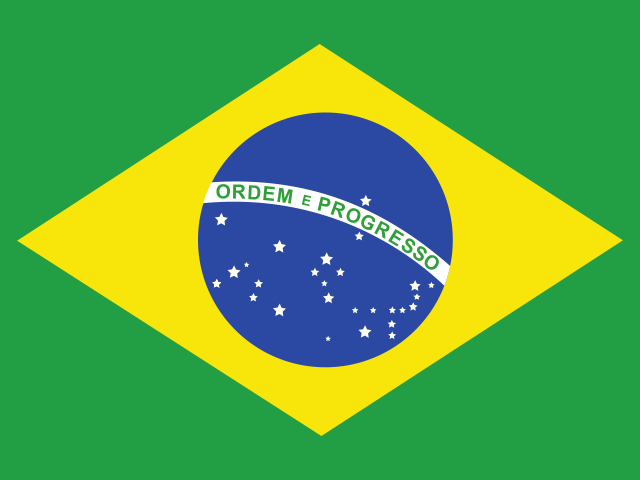
Overview
Brazil, officially the Federative Republic of Brazil, is the largest country in South America. It covers about 8.5 million km2 and holds roughly half of the continent's land. It has a population of about 214 million, which makes it one of the most populous countries in the world. The capital is Brasília, while São Paulo is the largest city, followed by Rio de Janeiro.
It is the only country in the Americas where Portuguese is the official language, and it has the largest Portuguese-speaking population anywhere. The country is a federation of 26 states and one Federal District, divided further into 5,571 municipalities.
The Atlantic coast runs for about 7,491 km. Brazil borders every South American country except Ecuador and Chile. The landscape ranges from tropical and subtropical zones to wetlands, savannas, plateaus and low mountains. The country holds most of the Amazon basin, with the world's largest river system and the most extensive tropical forest. It is described as the most biodiverse country on Earth.
Brazil is an upper-middle income, newly industrialized economy. It has the largest economy in Latin America and one of the ten largest in the world, by both nominal GDP and purchasing power. It is a major exporter of farm goods, minerals and manufactured products. It belongs to the UN (as a founding member), G20, BRICS, G4, Mercosur and the Community of Portuguese Language Countries, and is a major non-NATO ally of the United States. It ranks thirteenth worldwide by number of UNESCO World Heritage Sites.
History
Humans lived in the area at least 11,000 years ago; the Luzia Woman remains were found in Minas Gerais. Some of the oldest pottery in the Americas, dated to over 8,000 years ago, comes from near Santarém in the Amazon basin. The Marajoara culture on Marajó island thrived from about AD 400 to 1400. When the Portuguese arrived, many coastal peoples spoke Tupi–Guarani languages.
Portugal claimed the land on 22 April 1500 when Pedro Álvares Cabral's fleet arrived, following the 1494 Treaty of Tordesillas. São Vicente, the first settlement, was founded in 1532. In 1534 the Crown split the territory into fifteen private captaincies, and plantations worked by enslaved Africans became the base of the colonial economy.
In 1807–08, with Napoleonic forces threatening Portugal, Prince Regent John moved the royal court to Rio de Janeiro. There he opened Brazilian ports to other nations, ended the Portuguese trade monopoly and set up early financial institutions including a National Bank. Brazil was raised to a united kingdom with Portugal in 1815.
As Portuguese authorities tried to restore colonial status, Prince Pedro sided with the Brazilians and declared independence on 7 September 1822. He was proclaimed Emperor Pedro I, founding the Empire of Brazil, and a war of independence followed. The 1824 constitution created a two-chamber legislature and protected freedom of religion and the press. Slavery was phased out gradually and finally abolished in 1888.
A military coup in 1889 turned Brazil into a presidential republic. The early republic was a military dictatorship; civilians took power in 1894 and held it until the revolution of October 1930, which brought Getúlio Vargas to power. His self-coup in 1937 began the authoritarian Estado Novo, during which Brazil took part in World War II. Vargas was ousted in 1945 and democracy was restored.
A military dictatorship took power in 1964 with US support and became a full dictatorship with the Fifth Institutional Act in 1968. It repressed guerrillas, institutional opponents, artists and journalists, and was boosted in popularity by the early-1970s 'economic miracle'. Economic crises and public pressure led to gradual opening, including the 1979 Amnesty Law, and civilian rule returned in 1985 under José Sarney.
Hyperinflation persisted through the late 1980s. Fernando Collor was elected in 1989 and impeached in 1992. Fernando Henrique Cardoso, as finance minister, designed the 1994 Plano Real, which stabilized the economy, and he won the presidency in 1994 and 1998. The 1988 constitution remains in force.
Luiz Inácio Lula da Silva won in 2002 and 2006 after a peaceful handover from Cardoso. Dilma Rousseff won in 2010 and 2014, faced mass protests over corruption and public services, and was impeached in 2016; her vice-president Michel Temer took over. The Petrobras corruption scandal implicated many politicians.
Jair Bolsonaro won the 2018 election with about 55% in the runoff. Brazil suffered one of the highest COVID-19 death tolls in the world. Lula beat Bolsonaro in the October 2022 election (about 50.9% in the second round). On 8 January 2023, a week after his inauguration, supporters of Bolsonaro attacked federal government buildings in Brasília.
Climate
Most of Brazil is tropical, but the country spans six Köppen subtypes: desert, equatorial, tropical, semiarid, oceanic and subtropical. Settings range from equatorial rainforest in the north and semiarid land in the northeast to savanna in the centre and subtropical conditions with cool winters in the south.
The north is equatorial, with no real dry season, average temperatures near 25 °C and larger day-night than seasonal swings. Central Brazil has a more seasonal savanna climate. The interior northeast gets the most extreme seasonal rainfall, with semiarid areas getting under 800 mm a year, mostly in three to five months, which brings long droughts. The south has average annual temperatures under 18 °C, and frost or snow can occur in the highest areas.
Major cities (approx.): Manaus has a hot, humid equatorial climate with heavy rain most of the year. Brasília has a tropical savanna climate with a clear dry season from about May to September. São Paulo is warm and humid-subtropical to highland, with wet summers and mild, drier winters. Rio de Janeiro is tropical, hot and humid in summer with milder winters. Salvador and Recife are hot and humid coastal cities. Porto Alegre is humid subtropical, with hot summers and cool winters.
Forest covers about 59% of the land. Drought hit the 1877–78 Grande Seca, which killed around half a million people. In 2024 a drought reached from the north to the southeast and covered almost 60% of the country, and is linked to deforestation and climate change.
Climate change brings higher temperatures, longer heatwaves, more intense wildfires and shifting rainfall, threatening hydropower, farming and urban water supply. Extreme weather costs about R$13 billion a year. Brazil's emissions are over 4% of the world total. A national climate plan launched in 2026 aims to cut emissions by 59–67% by 2035 and reach carbon neutrality by 2050. Brazil hosted the 2025 UN climate conference.
Government and politics
Brazil is a democratic federal republic with a presidential system, a choice confirmed by voters in a 1993 plebiscite. The president serves as both head of state and head of government, for a four-year term with one consecutive re-election allowed, and appoints the cabinet. The current president is Luiz Inácio Lula da Silva.
The National Congress has two chambers. The Federal Senate has three senators for each of the 26 states and the Federal District, elected for eight years. The Chamber of Deputies is elected for four years by proportional representation. The Supreme Federal Court is the highest court, and there are also military, labor and electoral courts. All executive and legislative officeholders are directly elected.
Government is divided into spheres: the Union, the Federal District, the states and the municipalities. All three levels have executive and legislative branches, whereas a judiciary is found only at the federal level and in the states and the Federal District. Each state has a governor, a unicameral legislature, its own constitution, courts and taxes, and it also receives part of federal revenue. Only Congress sets criminal and civil law, which applies the same way across the whole country. Municipalities are run by mayors and councils, levy their own taxes and are given portions of federal and state taxes, yet they lack separate courts; instead, state courts serve groups of municipalities within a district known as a comarca.
The Federal District, which hosts the capital, has its own organic law. Municipalities also have organic laws. No federal territories exist: the 1988 constitution abolished the last three. Education, health and other services are shared among levels of government; public health is run by all levels, and the constitution requires set shares of tax revenue for education.
Brazil's law is civil-law based and largely codified, with the 1988 constitution (124 amendments by July 2022) at the top. Voting is compulsory for literate citizens aged 18–70. There are about 30 parties, around twenty in Congress, and politicians often switch parties. Democracy indices rate it mid-to-high; the Economist Intelligence Unit labeled it a flawed democracy in 2021, and Freedom House classes it as free.
Foreign policy stresses multilateralism, non-intervention and peaceful dispute settlement, with the president holding final authority. Brazil's armed forces are the largest in Latin America, with an army of about 236,000 active personnel. Police is divided among federal, state and military forces. Homicides fell to about 34,000 in 2025 (about 16 per 100,000), the lowest in over a decade, but rates vary strongly, from about 5 per 100,000 in São Paulo to about 33 in Ceará. The prison population is about 909,000.
Economy
Brazil has a diversified, upper-middle income mixed economy with a labor force of roughly 100 million. It is the largest in Latin America, tenth in the world by nominal GDP and eighth by purchasing power. After a recession starting in 2014, growth picked up from 2024. Services make up about 72.7% of GDP, industry 20.7% and agriculture 6.6%. About one-fifth of people live in poverty, and corruption and inequality are persistent problems. The currency is the real, and the B3 exchange in São Paulo is the largest in Latin America by market value.
Agriculture is a global leader: Brazil is the top producer of sugarcane, soy, coffee and oranges, and among the top producers of maize, cotton, beef, chicken and pork. Mining covers iron ore, copper, gold, bauxite, manganese, tin, niobium and nickel, as well as gemstones. Main exports include soy, iron ore, pulp, maize, beef, sugar, coffee, aircraft, cars and ethanol.
China is the largest trading partner at about 32% of trade, followed by the United States, Argentina, the Netherlands and Canada. Industry includes the eighth-largest auto sector, large food processing, steel, chemicals and footwear. Embraer makes Brazil one of the biggest aircraft producers. Micro and small businesses produce about 30% of GDP.
Energy: about 49.5% of the energy mix and 86.8% of electricity are renewable, mainly hydropower (Itaipu, Belo Monte, Tucuruí), plus biomass, wind and solar, and ethanol is widely used. Brazil became oil self-sufficient in 2006–07 and produces nearly three million barrels a day, much of it from deep water.
Transport relies on roads (about 2 million km), with rail of about 30,600 km, over 4,900 airports and airfields, inland waterways and major ports led by Santos. São Paulo–Guarulhos is the busiest airport, with about 43 million passengers a year. The country had roughly 6.6 million international visitors in 2018 and a strong domestic tourism market, with draws such as the Amazon, Pantanal, Rio's beaches and the Northeast coast. Brazil ranked 52nd in the 2025 Global Innovation Index.
Demographics and urbanization
Brazil's population was about 203 million in the 2022 census, with an official projection of about 214 million for mid-2026. Growth has slowed sharply from about 3% a year in the 1950s, and is expected to turn slightly negative by 2050. Life expectancy was about 72.6 years in 2007 and has since risen further.
About 84% of people live in urban areas. The Southeast (roughly 89 million people) and Northeast (about 55 million) hold most of the population, while the vast North and Center-West together have only about 34 million. The largest urban agglomerations are São Paulo (about 21 million), Rio de Janeiro (about 12 million) and Belo Horizonte (about 5 million), all in the Southeast. Most state capitals are also their state's biggest city.
In the 2022 census 45.3% identified as pardo (brown or mixed), 43.5% as white, 10.2% as Black, 0.6% as Indigenous and 0.4% as East Asian. Genetic mixing of Indigenous, European and African ancestry is widespread. About five million immigrants from over 60 countries arrived between 1808 and 1972, including Portuguese, Italians, Spaniards, Germans, Japanese and Arabs. Brazil has the largest population of Arab ancestry outside the Arab world and large Lebanese diaspora. It is thought to have the most uncontacted peoples worldwide.
Portuguese is the official and near-universal language. About 180 Indigenous languages are spoken, some co-official locally (for example in São Gabriel da Cachoeira), as are German dialects and Talian in the South. The sign language LIBRAS has legal recognition.
In 2022, about 56.75% were Catholic, 26.85% Protestant (largely Pentecostal and Evangelical), 1.84% Kardecist spiritist and 9.28% non-religious. Brazil has the world's largest Catholic population.
Literacy was about 95.1% in 2025, higher in the Southeast than the Northeast. Education is run by all levels of government, with a divide between mostly stronger private schools and public ones; the University of São Paulo is often rated the top university in Latin America. The Unified Health System gives free universal care, with spending near 9% of GDP, and about 2.4 doctors per 1,000 people in 2023.
Capital city
Brasília is the capital and sits in the Federal District in the central highlands. It is a planned city built in the late 1950s and inaugurated in 1960 (approx.), and its modernist design is a UNESCO World Heritage Site (approx.). The city has about 2.8 million residents, and the wider metro area is somewhat larger (approx.).
Its climate is tropical savanna with a pronounced dry season from roughly May to September and a wet season from about October to April, with mild temperatures thanks to the altitude of about 1,100 m (approx.).
Brasília is the seat of all three branches of national government: the presidency, the National Congress and the Supreme Federal Court. Its role is political and administrative rather than economic or cultural. The main economic city is São Paulo, and Rio de Janeiro is the best-known cultural and tourist center and was the capital until 1960 (approx.). On 8 January 2023, Brasília's government buildings were attacked by a mob.
About this summary
Approximate general-knowledge facts: metro populations, city climates, capital-city details (Brasília population, planning, role) and a few recent political and economic context points.