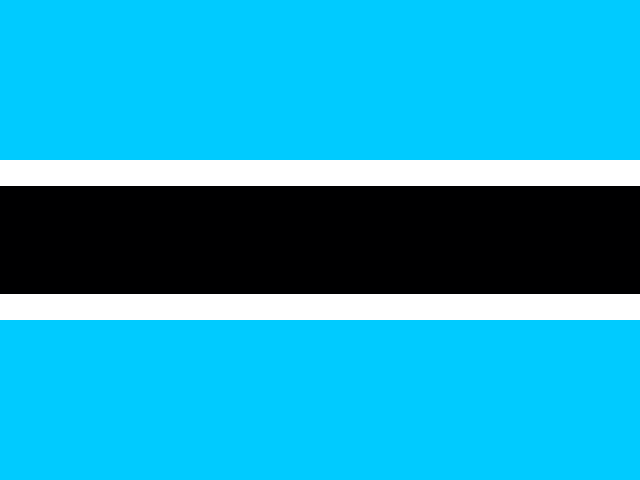
Overview
Botswana, officially the Republic of Botswana, is a landlocked country in Southern Africa. It covers about 581,730 square kilometres (approx. 224,600 sq mi). Its land is mostly flat, and roughly 70% of it lies within the Kalahari Desert.
Its neighbours are South Africa (south and southeast), Namibia (west and north), Zambia (a short border in the far north) and Zimbabwe (northeast). The capital and largest city is Gaborone, in the South-East District, in the southeast corner of the country.
Botswana has one of the lowest population densities in the world, with a population of approx. 2.4 million. The Batswana (Tswana) make up nearly 80% of people, and the Kalanga, about 11%, are the largest minority.
It became independent from Britain on 30 September 1966 and is a parliamentary republic. The Botswana Democratic Party (BDP) governed from independence until 2024, when the Umbrella for Democratic Change (UDC) won the general election and Duma Boko became president.
The economy rests mainly on diamond mining and tourism. By production, Botswana is the world's second diamond producer after Russia. Gross national income per capita (PPP) was about US$20,158 in 2024, and Botswana has the second-highest Human Development Index in continental sub-Saharan Africa after South Africa. Unemployment, inequality and HIV/AIDS remain serious problems.
Botswana belongs to the Southern African Customs Union, the Southern African Development Community, the Commonwealth and the United Nations.
History
Stone tools in what is now Botswana are around two million years old, and Homo erectus lived in the region in the Early Stone Age. Early modern humans were in the Kalahari area well over 186,000 years ago. Lake Makgadikgadi began shrinking about 50,000 years ago. The ancestors of the Khoe and San lived here some 30,000–40,000 years ago, moving with changing water and climate. Rock art is about 30,000 years old, and permanent water sources were widely settled by 20,000 years ago.
About 2,000 years ago cattle, sheep, pottery and farming (millet, sorghum, cowpeas and others) arrived. Bantu-speaking peoples moved in between roughly 2,000 and 1,500 years ago: the Kalanga around 200 CE and Tswana ancestors around 400 CE, who brought iron and copper tools and permanent settlements. From the 7th century trade grew, linking the area to wider southern Africa and eventually Indian Ocean trade. The Toutswe, the Kingdom of Mapungubwe and later Great Zimbabwe were regional powers, with cattle and gold central to their wealth.
Between the 15th and 18th centuries Tswana and Kalanga groups formed new political communities. Tswana society was organised into merafe (singular morafe), ruled by chiefs called dikgosi (singular kgosi), and cattle were the main store of wealth. The Difaqane of the late 18th and early 19th centuries brought wars and migrations that in the end strengthened Tswana settlement. By the 1840s many states had been re-established, governed through the kgotla, a community council.
Missionaries arrived in 1816, followed by British traders and explorers. David Livingstone founded a mission in 1845. Tensions with Boer forces continued. A coalition of Tswana chiefdoms under Sechele I defeated Afrikaner forces at the Battle of Dimawe in 1852, and a peace was agreed at Potchefstroom in 1860. The Tati Goldfields discovery in 1868 caused a gold rush and the rise of Francistown. In 1884 Batawana cavalry under Moremi II defeated an Ndebele invasion at Khutiyabasadi, which helped start the decline of the Ndebele kingdom in Zimbabwe.
In 1885 Britain declared the Bechuanaland Protectorate, aiming to block German and Afrikaner expansion and keep a route between southern and central Africa. Tswana dikgosi welcomed British protection because they feared German settlers, incorporation into South Africa and Cecil Rhodes. The territory was split into tribal reserves and crown land, eight Tswana groups were recognised, chiefs kept much authority, and the economy depended on South Africa.
In 1895 Khama III, Sebele I and Bathoen I travelled to Britain and persuaded the government not to hand the protectorate to Rhodes's British South Africa Company. The 1890s rinderpest epidemic devastated livestock and wildlife. Britain introduced hut and poll taxes, and the territory joined the South African Customs Union in 1910. All Tswana groups had become Christian by then.
Hundreds of Batswana served with British forces in the First World War. In the 1930s Britain became more involved, promoting the cattle economy and tightening control of the chiefs, after a severe drought killed much cattle. About 11,000 men served in the Second World War, mostly in the African Auxiliary Pioneer Corps. After the war, education, wage work and civic groups produced a new political class that challenged chiefly authority.
The marriage of Seretse Khama, heir to the Ngwato chieftainship, to the white British woman Ruth Williams caused a major crisis. In 1950 Britain banished the couple under South African pressure linked to apartheid. Seretse was allowed back in 1956. The affair weakened the chiefs and boosted the push for representative government. Parties formed: the Bechuanaland People's Party (1960) and Seretse Khama's Bechuanaland Democratic Party (1962). A new system limited chiefs' political power while keeping them in a House of Chiefs (Ntlo ya Dikgosi). Gaborone became the capital in 1965 and self-government began. The BDP won the first election, and on 30 September 1966 Botswana became independent with Seretse Khama as first president.
At independence Botswana was very poor, with low literacy, little infrastructure and dependence on cattle and South Africa. It adopted a Westminster-style liberal democracy, keeping chiefs and the kgotla under the national legal system. The government invested in roads, schools and services. Diamonds were found in 1967, and the partnership with De Beers through Debswana gave the state large revenues, making Botswana one of Africa's fastest-growing economies.
Seretse Khama died in 1980 and Vice-President Quett Masire succeeded him, continuing the same policies. Opposition grew in the 1980s, winning local elections, and the Botswana National Front was a competitive party by the 1984 election. HIV/AIDS cut life expectancy from 67 to 50 years within a decade.
Festus Mogae became president in 1998 and made HIV/AIDS treatment a priority. A 1999 dispute with Namibia over Sedudu Island went to the International Court of Justice, which ruled it belonged to Botswana. In 2002 a legal challenge by the San against their removal from the Central Kalahari Game Reserve was dismissed. Ian Khama, son of Seretse, took office on 1 April 2008, promoting the 'four Ds' (democracy, development, dignity, discipline) and centralising power around the presidency. The 2008 financial crisis hit the diamond-dependent economy; diamonds stabilised at about 39% of GDP in 2009. In 2014 the BDP kept its majority but with only a plurality of votes for the first time.
Mokgweetsi Masisi, appointed vice-president by Ian Khama, won the presidency after the 2019 election, reversed several Khama-era policies and pursued anti-corruption measures. In the 2024 general election the opposition Umbrella for Democratic Change defeated the BDP after 58 years in power, and Duma Boko became president. His government stresses diversification, including solar energy and technology, while facing a healthcare crisis from shortages of medicines and supplies.
Climate
Botswana has a mostly semi-arid climate. Rain falls in a strong season (summer, roughly November to March) and varies a lot from place to place. The north and east are wetter, and the southwest is driest. Summers can be extremely hot, and winter nights can be quite cold.
Gaborone (southeast) has a hot semi-arid climate (approx.): hot, rainy summers with highs often around 32–35°C, a dry and mild winter with warm days and cool nights that can approach freezing, and annual rainfall of approx. 450–500 mm, mostly in summer thunderstorms.
Francistown (northeast) is similar but a little wetter and hotter in summer (approx.). Maun, the gateway to the Okavango Delta in the northwest, has a hot semi-arid climate with a summer rainy season and dry, warm winters (approx.). Kasane, near the Chobe River in the far north, is wetter and humid in summer (approx.). The Kalahari southwest, around Tsabong, is very dry with large temperature swings (approx.).
Drought is a recurring hazard affecting farming, livestock, water supplies and wildlife. Heavy rain can cause local floods, especially around the Okavango and Chobe areas and seasonal waterways. Veldfires occur mostly in the winter dry season, started naturally by lightning or by people.
The Okavango Delta in the northwest is a vast inland delta where the Okavango River spreads over the Kalahari instead of reaching the sea; it has channels, lagoons, islands and seasonal wetlands. The Chobe River forms part of the border with Namibia. Surface water is scarce: under 5% of agriculture is rain-fed sustainable, and about three-quarters of people and animals depend on groundwater, with boreholes easing drought. About 71% of land is communal grazing, a major cause of desertification and erosion. Livestock grew from 1.7 million in 1966 to 5.5 million in 1991, and environmentalists report the Delta is drying because of grazing. Botswana scored 9.13/10 on the 2018 Forest Landscape Integrity Index, 8th of 172 countries.
Government and politics
Botswana is a parliamentary republic under its Constitution, described as Africa's longest uninterrupted democracy. Its institutions date from independence in 1966 and blend the British Westminster system with Tswana tribal government.
The Parliament consists of the President and the National Assembly, the sole legislature. The Ntlo ya Dikgosi, made up of tribal chiefs and appointed members, is only advisory. The President is both head of state and head of government, chosen by members of parliament, and appoints the vice-president and cabinet. The president is powerful and the legislature has little ability to check him once he is in office. Courts include the High Court, the Court of Appeal and Magistrates' Courts, and many cases are handled by customary courts presided over by chiefs.
Government is centralised and national law overrides local law. Local and district councils make local rules, strongly influenced by tribal authorities led by chiefs. The country has ten administrative districts: Southern, South-East, Kweneng, Kgatleng, Central, North-East, Chobe, North-West, Ghanzi and Kgalagadi. Seven urban districts exist as special jurisdictions: Gaborone, Francistown, Lobatse, Selebi-Phikwe, Orapa, Jwaneng and Sowa. There are 22 sub-districts, and each district is run by a district administration led by a district commissioner. In general, the key policy areas (taxation, health, education, law) are set nationally rather than by the districts. In 1966 Ngamiland and Chobe were merged as the North-West District, and Chobe was separated again as its own district in 2006.
Every five years, the Independent Electoral Commission supervises the country's elections. Although the system allows multiple parties, the BDP governed on its own from 1966 until 2024. Observers have regarded the elections as free and fair, even though the ruling party enjoyed institutional advantages. Factionalism is widespread, and splinter groups frequently break away to create new parties. Since 2019, the Umbrella for Democratic Change has served as an opposition coalition. In 2024, the BDP lost its majority for the first time, bringing 58 years of rule to an end, and Duma Boko became president.
Since the 1991 Kgabo Commission, factional rivalries (Barata-Phathi, led by Peter Mmusi, Daniel Kwelagobe and Ponatshego Kedikilwe, and the A Team, led by Mompati Merafhe and Jacob Nkate) shaped politics. Ian Khama effectively expelled the A Team in 2010. After Mokgweetsi Masisi became president in 2018 he fell out with Khama, and this rivalry has shaped politics into the 2020s.
The Economist's 2023 Democracy Index rated Botswana a 'flawed democracy', 33rd of 167 countries, the highest in continental Africa (behind only island Mauritius). The 2024 V-Dem indices, however, describe a decade of democratic backsliding with its lowest-ever scores. The 2025 Corruption Perceptions Index placed it third-least corrupt in Africa, just below Cape Verde and the Seychelles.
Botswana had no army at independence. The Botswana Defence Force was formed in 1977 after Rhodesian and South African forces attacked guerrilla bases. The president is commander-in-chief. Its work now focuses on anti-poaching, disaster preparation and peacekeeping. The United States is the largest foreign contributor to its development, and many officers have US training. Botswana signed the UN Treaty on the Prohibition of Nuclear Weapons in 2019 and ranked 50th in the 2024 Global Peace Index.
On human rights, the San have been relocated from ancestral lands to reservations, with reports that water access was cut and hunting punished. The government denies a link to diamond mining and says relocation protects wildlife. In 2018 UN Special Rapporteur Fernand de Varennes urged stronger recognition of minority rights in public services, land use and minority-language education.
Economy
Botswana was among the world's poorest countries at independence, with GDP per capita around US$70 in the late 1960s. It became an upper-middle-income country, with GDP per capita rising from $439 in 1950 to $15,842 in 2018. The IMF says growth averaged over 9% a year from 1966 to 1999. Sound institutions let the state reinvest resource income. By one estimate gross national income at PPP is the fourth-highest in Africa, around the level of Mexico.
Unemployment was 25.4% in 2022 and youth unemployment 45.41% in 2023. In 2015/16, 17.2% of people were multidimensionally poor and another 19.7% at risk. Botswana has relatively high economic freedom for Africa, a prudent fiscal record, negligible foreign debt, and Africa's highest sovereign credit rating (as reported); reserves topped $7 billion in 2005/06, almost two and a half years of imports. The courts are sound for commercial dealings, though a case backlog slows trials. It ranked second to South Africa in sub-Saharan Africa in the 2014 International Property Rights Index.
Mining is central. Debswana, the main diamond miner, is a 50% government joint venture with De Beers. Minerals supply about 40% of government revenue. The Letlhakane uranium project is large but undeveloped. Diversification has been official policy since 2009. Diamond demand weakness in recent years (approx.) has strained public finances.
Livestock raising is the main rural income. Tourism is built on wildlife and the Okavango Delta, which became the 1,000th World Heritage Site in 2014. Other attractions include Mokolodi Nature Reserve and Gaborone Dam. The Botswana Tourism Organisation promotes the sector.
Infrastructure: 971 km of railway, 18,443.8 km of roads (7,383.2 km paved), and 92 airports, 12 with paved runways. Air Botswana is the national airline, and Botswana Railways carries mining freight and some passengers. Power comes from domestic coal and imported oil: Morupule B (600 MW), Morupule A (132 MW), Orapa (90 MW), Phakalane (1.3 MW), with Mmamabula (300 MW) planned. A 200 MW solar plant is in planning, and the government is courting wind, solar and biomass investment.
Demographics and urbanization
Population is approx. 2.4 million. Tswana are about 79%, Kalanga 11%, San (Basarwa) 3%, and the remaining 7% includes white Batswana, Indians and smaller southern African groups (2024). Other native groups include Bayei, Bambukushu, Basubia, Baherero and Bakgalagadi. The Indian minority includes recent migrants and descendants of migrants from Mozambique, Kenya, Tanzania, Mauritius and South Africa. Since 2000, economic collapse in Zimbabwe has brought tens of thousands of Zimbabweans. Fewer than 10,000 San still live as hunter-gatherers.
Urbanisation is roughly 70–75% (approx.). Much of the population lives in the southeast, where the main towns are. Gaborone with approx. 250,000 people (metro approx. 400,000 or more), Francistown approx. 100,000–120,000, Maun approx. 60,000–80,000, and Molepolole, Serowe, Selebi-Phikwe, Kanye and Mahalapye are other significant towns (all approx.). Large areas of the Kalahari are almost empty.
English is the official language and Setswana is widely spoken. Setswana uses noun-class prefixes: Bo- (country), Ba- (people), Mo- (one person), Se- (language), so Botswana, Batswana, Motswana, Setswana. Other languages include Kalanga, Sarwa, Ndebele, Kgalagadi, Tswapong, !Xóõ, Yeyi and, in places, Afrikaans.
About 77% are Christian, mostly Anglican, Methodist and United Congregational Church of Southern Africa, with Lutheran, Baptist, Catholic, Latter-day Saints, Dutch Reformed, Mennonite, Adventist, Jehovah's Witness and Serbian Orthodox congregations. The 2001 census counted about 5,000 Muslims, 3,000 Hindus and 700 Baháʼí; roughly 20% have no religion.
Health services are improving: infant and maternal mortality are falling, 85% live within 5 km of a health facility, 73% of pregnant women have at least four antenatal visits, and nearly all births occur in hospitals. Life expectancy fell from a peak of 64.1 in 1990 to a low of 49 in 2002, and was 66.4 in 2024. The 2024 Global Hunger Index score was 20.7.
HIV/AIDS hit Botswana very hard. A national programme began in 2002–2003 with free or cheap generic antiretrovirals and public education, and Botswana was the first country to offer ARVs. Mother-to-child transmission fell from about 40% in 2003 to 4% in 2010, and new infections in children fell over 50% from 2009 to 2013. About 75% of adults and 98% of children with HIV were on treatment, among the highest in UN Global Plan countries. Partners included the Gates and Merck foundations (ACHAP), the Botswana–Harvard AIDS Institute and Botswana–UPenn Partnership. The number of people with AIDS rose from 290,000 (2005) to 320,000 (2013). The epidemic cut development spending by 10% in 2002–2003. Health is now strained by shortages of medicines and supplies.
Capital city
Gaborone is in the South-East District, in the southeast near the South African border. Its population is approx. 250,000 in the city, with a larger metro area of 400,000 or more. It became the capital in 1965 ahead of independence, replacing Mafeking (outside the protectorate).
It is the seat of government, the National Assembly and the main ministries, and also the largest city and main commercial and financial centre, home to the central bank, the Botswana Stock Exchange and the University of Botswana (approx.). It is both the political and the main economic city. Botswana has a single capital. Diamond mining sites such as Orapa and Jwaneng are elsewhere, and Francistown is the main northern commercial hub.
Gaborone has a hot semi-arid climate (approx.): hot, rainy summers (November–March) with highs of 30–35°C, mild dry winters with cool nights, and annual rainfall of approx. 450–500 mm. Nearby sites include the Gaborone Dam and Mokolodi Nature Reserve. It is a common base for expats working in government, diplomacy, finance and development work (approx.).
About this summary
Approximate general-knowledge facts: area/population rounding, city populations, city climates, capital-city details and some recent economic context.