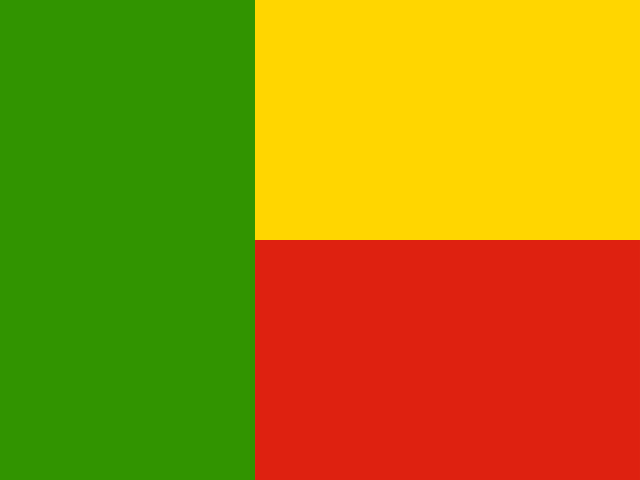
Overview
Benin, officially the Republic of Benin and formerly called Dahomey, is a country in West Africa. It borders Togo to the west, Nigeria to the east, Burkina Faso to the northwest and Niger to the northeast, and has a short coast on the Bight of Benin (Gulf of Guinea). Most people live in the south, near that coast.
The official capital is Porto-Novo, but the seat of government is in Cotonou, which is the most populous city and the economic capital. The country covers about 112,622 km2 and had roughly 15 million people in 2026 (estimate).
Benin is tropical, and its economy depends heavily on agriculture, especially cotton and palm oil exports. French is the official language, and Fon, Bariba, Yoruba and Dendi are among the many local languages.
It belongs to the UN, the African Union, ECOWAS, the Organisation of Islamic Cooperation, La Francophonie, the Community of Sahel–Saharan States and the Niger Basin Authority, among other bodies.
History
Before 1600 the area now called Benin held a mix of political systems and peoples. Coastal city-states were mainly Aja, with Yoruba and other Gbe groups, while inland regions were home to Bariba, Mahi, Gedevi and Kabye peoples. The Oyo Empire, based mostly to the east, raided the area and collected tribute from coastal kingdoms and inland groups. In the 17th and 18th centuries the Kingdom of Dahomey, mostly Fon people, rose to prominence, alongside the city-state of Porto-Novo and states in the north.
By the mid-19th century Dahomey was losing its regional power. France took control in the 1890s (1892 to 1894 depending on the account) and in 1899 placed French Dahomey inside French West Africa. France saw little agricultural or mineral wealth worth large-scale investment and treated the colony as a reserve in case resources were found later. Dahomey became fully independent in 1960.
After independence there were repeated coups and changes of regime. Hubert Maga, Sourou Migan Apithy, Justin Ahomadégbé and Émile Derlin Zinsou dominated politics, and the first three each represented a different region and ethnic group. After violence disrupted the 1970 elections, those three agreed to a Presidential Council. Maga handed power to Ahomadégbé in May 1972.
In October 1972 Lt. Col. Mathieu Kérékou seized power. In November 1974 he declared the state Marxist, run by a Military Council of the Revolution that nationalized oil and the banks. In November 1975 the country was renamed the People's Republic of Benin. The regime moved through three stages: a nationalist phase from 1972 to 1974, a socialist phase from 1974 to 1982, and then a period of opening to Western countries and economic liberalism until 1990.
From 1974 the government nationalized strategic sectors, reformed education, set up farming cooperatives and new local government, and campaigned against so-called feudal forces, including tribalism. Opposition activity was banned. Kérékou was chosen as president by the National Revolutionary Assembly in 1980 and again in 1984. He built ties with China, North Korea and Libya and put almost all business under state control, which drove away foreign investment. The regime also raised money by accepting nuclear waste, first from the Soviet Union and later from France.
Growth was relatively strong in the early 1980s (15.6% in 1982, 4.6% in 1983, 8.2% in 1984) until Nigeria closed its border with Benin, cutting customs and tax revenue. Civil servants went unpaid, riots broke out in 1989 when the army could not be paid, and the banking system collapsed. Kérékou renounced Marxism, released political prisoners and agreed to hold elections. The country took the name Republic of Benin on 1 March 1990.
In 1991 Kérékou lost to Nicéphore Soglo, becoming the first president on the African mainland to lose power at the ballot box. He returned by winning in 1996 and won again in 2001, though opponents alleged irregularities. In 1999 he issued a national apology for the role Africans played in the Atlantic slave trade.
Neither Kérékou nor Soglo could run in 2006, since both were excluded by age and term limits. Thomas Boni Yayi beat Adrien Houngbédji in the runoff and was sworn in on 6 April 2006. In 2011 he secured re-election with 53.18% in the first round, which was the first victory without a runoff since 1991. Boni Yayi could not seek a third term in 2016, so the businessman Patrice Talon took the second round against Lionel Zinsou with 65.37% and entered office on 6 April 2016. Talon pledged to reform the constitution, introduce one five-year presidential term, and shrink the cabinet from 28 members to 16. He won re-election in April 2021 with more than 86.3% of the vote, and amended election laws gave his supporters complete control of parliament.
In February 2022 the W National Park massacre was the largest terrorist attack in the country's history. Later that month Talon opened an exhibition of 26 sacred artworks that France had returned, 129 years after colonial forces looted them. In March 2025 a law recognized 16 kingdoms, 80 senior chiefs and 10 traditional chiefs, using the pre-colonial situation (1894 in the south, 1897 in the north) as a reference. In July 2025 the My Afro Origins law came into force, offering provisional citizenship to members of the African diaspora whose ancestry was affected by the transatlantic slave trade.
On 7 December 2025 a faction of the army led by Pascal Tigri announced on state television that it had removed Talon. The government said it had put down the attempt and regained control of all institutions. A constitutional reform adopted on 18 November 2025 (90 votes to 19 in the National Assembly) created a Senate, making parliament bicameral. The Senate was sworn in on 30 July 2026, and Talon was chosen as its president on 6 August 2026 with 24 of 25 votes.
Climate
Benin is tropical and the climate changes from humid in the south to drier toward the Sahel in the north. The south has two rainy seasons and two dry seasons. The main rains run from April to late July, with a shorter, lighter wet period from September to November. The main dry season is December to April, with a cooler dry spell from July to September. Coastal rainfall averages about 1,300 mm a year.
Cotonou, the largest city, is hot and humid, with average highs near 31 °C and lows near 24 °C. Porto-Novo, the capital, has a similar hot, humid coastal climate (approx.). Inland cities such as Parakou in the center-north (approx.) have a savanna climate with one main wet season and larger temperature swings, and the far north is hotter and drier.
From December to March the harmattan, a dry dust-laden wind from the Sahara, dries the grass, turns vegetation reddish-brown and leaves a haze that makes skies overcast. This is also when farmers burn brush in the fields.
The land has four zones from south to north: a sandy, marshy coastal plain (up to about 10 m high and at most 10 km wide) with lakes and lagoons; plateaus of forest-savanna mosaic (20 to 200 m) cut by the Couffo, Zou and Ouémé river valleys; flatter land with rocky hills up to about 400 m around Nikki and Save; and the Atacora mountains in the northwest, where Mont Sokbaro (658 m) is the highest point. Four ecoregions occur: Eastern Guinean forests, Nigerian lowland forests, Guinean forest-savanna mosaic and West Sudanian savanna.
Forest covers about 28% of the land (around 3.1 million ha in 2020), down from about 4.8 million ha in 1990. Most people live on the low coast, so sea level rise is a risk, and northern areas may become more desert-like. In the north, Pendjari National Park and the W reserve, together with neighboring parks in Burkina Faso and Niger, hold the largest remaining lion population in West Africa (an estimated 246 to 466 lions), as well as elephants, hippopotamus, antelopes and monkeys.
Government and politics
Benin is a presidential republic with a multi-party system. The president is both head of state and head of government. The political system comes from the 1990 constitution and the transition to democracy in 1991, most recently amended in 2025. A constitutional reform adopted in November 2025 created a Senate, so parliament is now bicameral (National Assembly and Senate).
The judiciary is officially independent, but critics say its independence has been gradually weakened under former president Talon. Press freedom rankings from Reporters Without Borders fell from 53rd of 169 in 2007 to 78th in 2016 and later to 113th.
The country has twelve departments, which are divided into 77 communes. The twelve departments were created in 1999 by splitting each of six earlier departments in two. Benin is a unitary state: departments are mainly administrative and communes are the local government level, with communes handling local services while tax, law, health and education policy are set nationally (approx.). A 2025 law also recognized traditional kingdoms and chiefs, giving traditional authority a formal, institutional place.
Talon's two terms were the most the constitution permits. Parliamentary elections took place on 11 January 2026, and a presidential election followed on 12 April 2026. International observers said the vote was neither free nor fair. Finance Minister Romuald Wadagni was officially declared the winner, taking over 94% of ballots. The ballot excluded any credible opposition candidate, and the Democrats, the leading opposition party, put forward no one.
On 7 December 2025 soldiers calling themselves the Military Committee for Refoundation claimed on state television to have deposed Talon. The interior minister said loyal forces had foiled the attempt. At Talon's request, ECOWAS called for standby troops to be deployed, and Nigeria sent fighter jets over Cotonou and land forces into Benin.
Economy
The economy relies on subsistence farming, cotton and regional trade. Cotton accounts for about 40% of GDP and roughly 80% of official export earnings. Services still make up the largest share of GDP, thanks to Benin's position for trade, transit, transport and tourism with its neighbors. Growth was about 5.1% in 2008, 5.7% in 2009 and around 5.6% in 2017, driven by cotton and other cash crops, the Port of Cotonou and telecommunications.
In 2017 Benin imported about $2.8 billion of goods such as rice, meat and poultry, alcoholic drinks, fuel, plastics, mining and excavating machinery, telecommunications equipment, passenger cars and cosmetics. Main exports are ginned cotton, cotton cake and seed, cashew, shea butter, cooking oil and lumber. The Port of Cotonou, the country's only seaport, is a key revenue source, and the government wants to broaden its revenue base.
Plans to raise growth include attracting foreign investment, expanding tourism, developing food processing and new agricultural products, and promoting information technology. A US$307 million Millennium Challenge Account grant signed in February 2006 funded reforms to land tenure, commercial justice and the financial sector. External debt was eased by Paris Club and bilateral creditors and a G8 debt reduction announced in July 2005. An insufficient electricity supply holds back growth.
Despite steady growth of 4% to 5% over two decades, poverty rose: the share under the poverty line went from 36.2% in 2011 to 40.1% in 2015. Trade unions cover up to 75% of the formal workforce, while the informal economy has problems including unequal pay for women, child labor and forced labor. Benin belongs to OHADA, the African business-law harmonization organization. In 2016 it used about 1.4 global hectares of biocapacity per person against 0.9 available, a deficit.
Cotonou has the only international airport (Cadjehoun), with direct flights to African cities such as Accra, Niamey, Lagos, Lomé and Ouagadougou, and to Paris, Brussels and Istanbul. There are 6,787 km of roads, of which 1,357 km are paved, and two-lane paved roads link Benin to Togo, Burkina Faso, Niger and Nigeria. The Trans-West African Coastal Highway crosses the country. The rail network is 578 km of metre-gauge single track, with lines to Niger and Nigeria under construction. Mobile phone service covers the country, and Internet access came by satellite from 1998 and the SAT-3/WASC submarine cable from 2001.
In science, the Ministry of Higher Education and Scientific Research sets policy. Benin ranked 119th in the 2024 Global Innovation Index and 118th in 2025. Research output tripled between 2005 and 2014 (86 to 270 articles), and the University of Abomey-Calavi joined a World Bank Centres of Excellence project in 2014 with an $8 million loan. Public health spending was 2.5% of GDP in 2013.
Demographics and urbanization
The population is about 15 million (2026 estimate), with most people living in the south. Life expectancy is about 62 years. The country has about 42 African ethnic groups, including the Fon around Abomey, the Yoruba in the southeast, the Aja, Mina and Xueda on the coast, the Dendi in the north-central area, the Bariba and Fula in the northeast, and the Betammaribe and Somba in the Atakora mountains. Non-Africans, including Europeans, Lebanese and South Asians, number a few thousand (about 5,500 Europeans in the source, many of them embassy, aid, NGO and missionary staff).
About half of the population is urban (approx. 50 to 55%), with growth concentrated in the southern coastal belt. Cotonou has roughly 700,000 people in the city proper and well over 1 million in its wider urban area (approx.), including neighboring Abomey-Calavi, which is itself a large city of several hundred thousand (approx.). Porto-Novo has roughly 300,000 to 350,000 people (approx.). Parakou, the main northern city, has roughly 250,000 to 300,000 (approx.).
French is the official language, and local languages are used in the first years of primary school before French takes over. French is the only language of instruction at secondary level. Beninese languages are generally written with one letter per sound, using symbols like ɛ, ɔ, ŋ and digraphs for kp and gb, with tone marks.
In the 2013 census, 48.5% were Christian (25.5% Roman Catholic), 27.7% Muslim, 11.6% practiced Vodun, 2.6% other traditional religions, and 5.8% had no affiliation. A 2026 Pew publication estimated 53% Christian, 31% Muslim, 11% other religions (including traditional faiths) and 5% unaffiliated in 2020, and said Muslims grew from 23.5% to 31.4% between 2010 and 2020. Christianity is stronger in the south and center, Islam in the north. Ouidah is the spiritual center of Vodun.
Adult literacy was about 51% in 2022 (63% for men, 42% for women), up from 16% in 1979. Universal primary education has been achieved, and 54% of children were in secondary school in 2013. School fees have been abolished, and education spending has exceeded 4% of GDP since 2009 (4.4% in 2015). University enrollment more than doubled between 2006 and 2011, from 50,225 to 110,181 students.
HIV prevalence among adults aged 15 to 49 was about 0.1% in 2024, down from a peak of 2.6% in 1995. Malaria remains a major problem, especially for children under five, with around 5 million cases recorded in 2024. The Bamako Initiative's community-based reforms greatly widened access to primary healthcare. In 2015 Benin had the 26th highest maternal mortality rate in the world, and in 2013 UNICEF reported that 13% of women had undergone female genital mutilation. In the 2024 Global Hunger Index Benin ranked 99th of 127.
Capital city
Benin has two centers of government. Porto-Novo, in the southeast near the Nigerian border on a coastal lagoon, is the official capital. Cotonou, on the Atlantic coast, is where the government sits and is the largest city and the economic capital.
Porto-Novo has roughly 300,000 to 350,000 people (approx.). It was the center of the historic city-state of Porto-Novo and is the formal seat of the constitutional capital functions, including the National Assembly (approx.). It has a hot, humid tropical climate like the rest of the coast, with two rainy seasons, high humidity and temperatures typically in the high 20s to low 30s °C (approx.). It also has a cultural role through museums and its colonial and Afro-Brazilian heritage (approx.).
Cotonou has about 700,000 residents in the city proper and more than 1 million in its wider urban area (approx.). It is the country's economic engine: it holds the only seaport and the only international airport, and its port also serves trade with neighboring landlocked countries such as Niger. Average highs are about 31 °C and lows about 24 °C, with rain mainly from April to July and September to November.
So the capital differs from the main economic city. Porto-Novo is the official capital, while Cotonou is the seat of government, the commercial hub and the largest city. Anyone planning to live or work in Benin, such as expats and embassy staff, will mostly be based in Cotonou (approx.).
About this summary
Approx. general-knowledge facts: city populations and metro sizes, city climates, capital-city details, and some recent economic and political context. Figures are rounded and approximate.