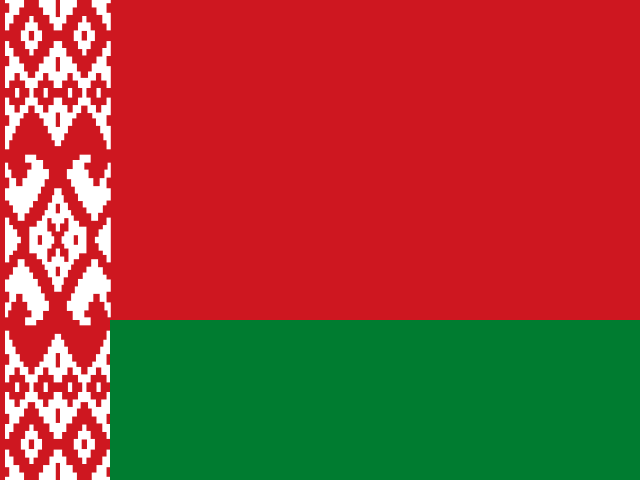
Overview
Belarus, officially the Republic of Belarus, is a landlocked country in Eastern Europe. Russia lies along its eastern and northeastern edges, Ukraine lies below it, Poland sits on its western side, and Lithuania and Latvia touch its northwest. It covers about 207,600 square kilometres and has roughly 9.1 million people. The climate is hemiboreal and the country is split into six regions. Minsk is the capital and largest city and is run as a separate city with special status.
Belarus became independent from the Soviet Union on 25 August 1991. Alexander Lukashenko has been president since 1994, after the country's first and only free post-independence election. His government is highly centralised and has been described as authoritarian, and the country scores low in international measures of press freedom and civil liberties. Many Soviet-era policies continue, including state ownership of large parts of the economy.
Belarus and Russia signed a treaty in 2000 creating the Union State, a framework for deeper cooperation. Belarus is a UN member from its founding and belongs to the CIS, the CSTO, the Eurasian Economic Union, the OSCE and the Non-Aligned Movement. It has not sought EU membership but keeps a bilateral relationship with the bloc, and it takes part in the Baku Initiative.
Belarus is not a member of the Council of Europe. Its 1993 application was refused over electoral malpractice and human rights concerns, and it is the only European country that still applies the death penalty. Its limited ties with the council were suspended in April 2022 after the Russian invasion of Ukraine, which was partly launched from Belarusian territory.
History
Farmers of the Bandkeramik tradition lived in the area between about 5000 and 2000 BC. Cimmerians and other herding peoples moved through by about 1000 BC, and the Zarubintsy culture spread at the start of the 1st millennium. Baltic tribes settled permanently from the 3rd century, and Slavs took over the area around the 5th century, gradually assimilating the Balts.
In the 9th century the territory became part of Kievan Rus', an East Slavic state ruled by the Rurikids. After Yaroslav the Wise died in 1054 the state broke into separate principalities. The Battle on the Nemiga River in 1067 gives the conventional founding date of Minsk. The Mongol invasion of the 13th century hit many early principalities hard, but the Belarusian lands escaped its worst effects and eventually joined the Grand Duchy of Lithuania. Independent city-states such as the Principality of Polotsk were important in the medieval period.
On 2 February 1386 the Grand Duchy of Lithuania and the Kingdom of Poland entered a personal union through a royal marriage. The Union of Lublin in 1569 created the Polish–Lithuanian Commonwealth. Over time Polish language and Catholicism became dominant in culture and social life, and in 1696 Polish replaced Ruthenian as the official language. This period lasted about 500 years in total.
The Commonwealth was partitioned in the late 18th century, and the third partition in 1795 ended the Polish–Lithuanian union. The Belarusian lands taken by the Russian Empire under Catherine II formed a governorate in 1796, which lasted until German occupation in World War I. Under Nicholas I and Alexander III local cultures were suppressed, Polonization gave way to Russification, and Belarusian Uniates were returned to Orthodoxy.
The Belarusian People's Republic, proclaimed in 1918 and lasting only to 1919, was the first attempt at an independent state called Belarus. It fell mainly because German and Russian armies and then the Bolshevik Red Army kept dominating the land. After the Russian Revolution several rival states competed during the Civil War, and the Byelorussian SSR emerged and became a founding republic of the Soviet Union in 1922. After the Polish-Soviet War (1918–1921), Belarus lost almost half of its territory to Poland.
Two weeks after Germany attacked Poland in September 1939, the Soviet Union invaded the country's east and incorporated Western Belorussia into the Byelorussian SSR. On 28 October 1939, a People's Council under Soviet control assumed authority in Białystok, where the inhabitants included Poles, Ukrainians, Belarusians and Jews. When Nazi Germany attacked the USSR in 1941, the defence of Brest Fortress counted among the earliest major engagements. Over the course of the war, Belarus suffered the loss of roughly 25 percent of its people and 50 percent of its economic resources. A widespread partisan movement against the Nazis subsequently shaped the republic's politics well into the 1970s. The Byelorussian SSR joined the USSR as a founding member of the UN in 1945, and after the war its borders were settled along the Curzon Line, which added the former Polish Kresy.
Under Stalin, Sovietisation was pursued to separate the republic from Western influence, with Russians placed in key government posts. Khrushchev continued the cultural policy after 1953. The republic shifted from an agrarian to an industrial economy.
In March 1990 elections to the republic's Supreme Soviet gave the pro-independence Belarusian Popular Front only about 10% of seats, but the parliament declared sovereignty on 27 July 1990. Large strikes broke out in April 1991. The country was renamed the Republic of Belarus and gained independence on 25 August 1991. On 8 December 1991 Stanislav Shushkevich met Boris Yeltsin and Leonid Kravchuk in Białowieża Forest to declare the Soviet Union dissolved and the CIS formed.
A new constitution in March 1994 gave the president the functions of the prime minister. In the June and July 1994 two-round vote, Alexander Lukashenko won about 45% in round one and about 80% in round two, defeating Vyacheslav Kebich (about 14% in round one). It remains the only free national election since independence.
Economic disputes with Russia marked the 2000s: the 2004 gas dispute with Gazprom, the 2007 dispute over alleged oil siphoning from the Druzhba pipeline, and the 2009 'Milk War', in which Russia banned Belarusian dairy imports after a disagreement that included recognition of Abkhazia and South Ossetia. In 2011 a severe economic crisis hit, with inflation of 108.7%, and a Minsk Metro bombing killed 15 people and injured 204. Two suspects were executed in 2012, and the official account was questioned in wording used by a UN Security Council statement.
The disputed August 2020 presidential election, in which Lukashenko sought a sixth term, set off mass protests. Poland and Lithuania do not recognise him as legitimate president, and Lithuania provided a residence in Vilnius for opposition candidate Sviatlana Tsikhanouskaya and others. The EU, Canada, the UK and the US also do not recognise him as legitimate and imposed sanctions. More sanctions followed in 2022 after Belarus allowed Russian troops to stage part of the invasion of Ukraine from its territory. Norway and Japan joined the sanctions, which are aimed at isolating Belarus from international supply chains, and most major Belarusian banks face restrictions.
Climate
Belarus lies between roughly 51° and 57° N. It is flat with many marshes, about 40 to 43% forest, and has around 11,000 lakes. It sits in a transition zone between maritime and continental climates, with mild to cold winters and cool, moist summers averaging about 18 °C. Annual rainfall is about 550 to 700 mm. January minimums range from about −4 °C in the southwest (Brest) to about −8 °C in the northeast (Vitebsk).
Minsk (approx.) has a humid continental climate: cold, snowy winters with January averages around −5 °C and warm summers with July highs of about 23 °C. Brest in the southwest is somewhat milder, as given above. Vitebsk in the northeast is colder in winter. Gomel in the southeast (approx.) has warmer summers, and Grodno in the west (approx.) has a climate similar to Brest, with a modest maritime influence.
The highest point is Dzyarzhynskaya Hara at 345 m, the lowest is on the Neman River at 90 m, and the average elevation is about 160 m. The main rivers are the Neman (flowing west to the Baltic), the Pripyat (flowing east into the Dnieper) and the Dnieper (flowing south to the Black Sea). Natural resources include peat, small amounts of oil and gas, granite, dolomite, marl, chalk, sand, gravel and clay.
About 70% of the radiation from the 1986 Chernobyl disaster in Ukraine fell on Belarusian territory, affecting about a fifth of the land, mainly farmland and forest in the southeast. International efforts have used caesium binders and rapeseed cultivation to lower caesium-137 levels in soil.
Government and politics
By its constitution Belarus is a semi-presidential republic with separation of powers, led by a president and a National Assembly. In practice power is concentrated in the president. Media, politicians and authors have often called it 'Europe's last dictatorship', and it has been described as an autocracy with unfree elections and weak judicial independence. Lukashenko has been president since 1994. The presidential term is five years. The 1994 constitution limited presidents to two terms, but a 2004 change removed the limit. A 1996 referendum, denounced by the chief electoral officer Viktar Hanchar, extended the term and pushed the next election from 1999 to 2001.
The National Assembly has two chambers: the 110-member House of Representatives and the 64-member Council of the Republic. The lower house appoints the prime minister, makes constitutional amendments, can call a confidence vote on the prime minister and can suggest foreign and domestic policy. The upper house selects various officials, holds an impeachment trial of the president, and approves or rejects the lower house's bills. Each chamber can veto local-government decisions that contradict the constitution.
The Council of Ministers is led by the prime minister and five deputy prime ministers. Members are appointed by the president and need not be legislators. The courts include the Supreme Court and specialised courts such as the Constitutional Court. The president appoints national judges and the Council of the Republic confirms them. The Supreme Court is the highest appeal court in criminal cases, and extrajudicial special courts are forbidden by the constitution.
Elections: Lukashenko was officially re-elected in 2001, 2006, 2010, 2015, 2020 and 2025, though none were regarded as free, fair or democratic. In 2004 neither pro-Lukashenko nor opposition parties won seats, and the OSCE judged the vote unfair. In 2006 he took about 80% against Alaksandar Milinkievič and Alyaksandr Kazulin; Russia and the CIS called the vote open and fair, while the OSCE and others disagreed. In 2010 he took nearly 80% and runner-up Andrei Sannikov under 3%, followed by street protests, arrests and prison terms. In the 2012 parliamentary vote, 105 of 110 members were non-party. In 2020 official results gave him about 80%, followed by mass protests, with the EU and UK not recognising the result.
Local government has a basic level (118 raion councils and 10 cities of oblast subordination) and a primary level (14 cities of raion subordination, 8 urban-type settlement councils and 1,151 village councils). Councils are elected, but executive committee chairs are appointed through the higher level, and councils can accept or reject nominees. Raion administrations are appointed by oblast executive authorities, and region administration chairs are appointed by the president. A 1995 decree stripped local government from certain raion-centre towns and settlements. As of 2019 there were 115 cities, 85 urban-type settlements and 23,075 rural settlements.
Belarus is divided into six oblasts named after their centres (Brest, Gomel, Grodno, Mogilev, Minsk, Vitebsk), with 118 raions below them. Each oblast has an elected council and an executive committee led by a presidentially appointed chairman. Regional powers are limited because key appointments come from the centre. Tax, health, law and education policy are largely set nationally (approx.). Minsk city is split into nine districts and has special status at the same administrative level as the oblasts, with an executive committee and a charter of self-rule.
Foreign policy: Russia is Belarus's closest partner and ally, and the country relies on it both for imported raw materials and for export markets. Under the Union State treaties signed between 1996 and 1999, the two countries were meant to pursue a shared currency, equal rights, one citizenship, and joint foreign and defence policies. Doubts about the project have grown, however, owing to the postponed monetary union, the lack of any referendum date for a draft constitution, and a dispute over oil trade. Belarus's relations with the US are strained: neither side has had an ambassador since 2007/2008, and the Belarus Democracy Act dates from 2004. Belarus has close ties with China and counts Syria as a partner. On 28 June 2021, it suspended its participation in the Eastern Partnership.
Military: the Ministry of Defence is headed by Lieutenant General Viktor Khrenin and the president is commander-in-chief. The armed forces were formed in 1992 from former Soviet forces and restructured by 1997. Most personnel are conscripts serving 12 months (with higher education) or 18 months. It cooperates with NATO through Partnership for Peace (1995) and the Individual Partnership Program (1997), but cannot join NATO as a CSTO member.
Human rights: Amnesty International and Human Rights Watch have criticised the government. Freedom House labels the country 'not free', and Reporters Without Borders ranked it 153rd of 180 in 2022. A 2014 law restricted kolkhoz workers from leaving jobs freely. The UN human rights office reported 450 documented cases of torture and ill-treatment of detainees during the 2020–2021 protests. In May 2021 authorities diverted Ryanair Flight 4978 to detain journalist Roman Protasevich, leading to stricter EU sanctions. From mid-2021 the EU and neighbours accused Belarus of pushing migrants towards EU borders. Corruption concerns include bribery in tenders and lack of whistleblower protection.
Economy
Belarus is a developing country with 'very high' human development, ranked 60th in the UN index. In 2019 manufacturing made up 31% of GDP and employed 35% of the workforce. Manufacturing growth in 2021 was about 2.2%. Key farm products are potatoes and cattle products including meat. It ranked 85th in the Global Innovation Index in 2024 and 2025.
At the Soviet breakup Belarus was among the most industrially developed states and the richest CIS member. Early exports included heavy machinery (especially tractors), farm products and energy products. Industrial output fell in the 1990s, but GDP rose from 1996, making it a fast-recovering post-Soviet economy. In 2006 GDP was about US$83.1 billion (PPP), roughly $8,100 per head. Under Lukashenko the state has kept control of key industries and avoided large-scale privatisation. In 2015, 39.3% of workers were in state-controlled companies, 57.2% in private firms (with a government stake of 21.1%) and 3.5% in foreign firms.
Trade: Belarus trades with over 180 countries. In 2024 Russia accounted for about 66% of its trade and EU countries about 11%. The EU imposed trade sanctions in April 2022, extended in August 2023, on top of earlier ones. Belarus applied to join the WTO in 1993. It lost EU Generalized System of Preferences status in June 2007 over labour-rights concerns.
Labour: the labour force exceeds 4 million. Official unemployment was 1.5% in 2005 (679,000 unemployed, two-thirds women). Jobs are common in industry, agriculture, trade and education.
Currency: the Belarusian ruble was introduced in May 1992. The peg to the Russian ruble ended in 2007. The ruble fell 56% against the dollar on 23 May 2011 and the country requested IMF help on 1 June 2011. The new ruble (BYN) replaced the old at 10,000 to 1 in July 2016. In October 2022 Lukashenko banned price increases to fight food inflation, and in January 2023 the country legalised copyright infringement of media and IP from 'unfriendly' countries. The banking system has a central bank and 25 commercial banks.
Six free economic zones encourage investment: Brest (1996), Gomel-Raton (1998), Grodnoinvest (2002), Minsk (1998), Mogilev (2002) and Vitebsk (1999). Telecoms: the state monopoly Beltelecom holds exclusive links to foreign internet providers and is the only licensed commercial VoIP operator. The country domain is .by.
Demographics and urbanization
The 2019 census counted 9.41 million people; ethnic Belarusians were 84.9%, Russians 7.5%, Poles 3.1% and Ukrainians 1.7%. Density is about 50 people per km². About 70% of people live in urban areas.
Minsk had about 1.94 million residents in 2015 (approx. 2 million today). Gomel has about 481,000 people, Mogilev 365,100, Vitebsk 342,400, Grodno 314,800 and Brest 298,300 (source figures, mixed years).
Population is shrinking, with negative natural growth. In 2007 the population fell 0.41% and the fertility rate was 1.22. Net migration was slightly positive (0.38 per 1,000). In 2015, 69.9% were aged 14 to 64, 15.5% were under 14 and 14.6% were 65 or older. The population is ageing. There are about 0.87 males per female. Life expectancy is about 72 years (66.5 for men, 78.1 for women) and literacy is over 99%.
Belarusian and Russian are the official languages. In the 2019 census 54.1% named Belarusian as their mother tongue and 42.3% Russian, while 71.4% said they mainly speak Russian at home and 26% Belarusian. Polish, Ukrainian and Yiddish are spoken by minorities. Schools mainly teach in Russian, and publication of Belarusian-language literature fell between 1990 and 2020.
Religion: in the 2011 census 58.9% followed a religion, with about 82% of them Eastern Orthodox. Overall 48.3% are Orthodox, 41.1% non-religious, 7.1% Roman Catholic and 3.3% other. Catholics are concentrated in the west around Grodno. Protestants, Greek Catholics, Jews, Muslims and neo-pagans are minorities. The Lipka Tatars, over 15,000, are mostly Muslim. Jews were once about 10% of the population but are now under 1%. There is no official religion, though groups deemed harmful can be banned.
Capital city
Minsk is the capital and largest city, in the centre of the country (approx.), and has about 2 million residents (approx.). Its founding date is conventionally tied to the 1067 Battle on the Nemiga River. It is administered separately as a city with special status, at the same level as the oblasts, with nine districts and a charter of self-rule. It also serves as the seat of the Minsk Region's administration (approx.).
Climate (approx.): humid continental, with cold snowy winters, mild to warm summers and rain spread through the year. Winters are slightly colder than in Brest and milder than in Vitebsk.
Role: Minsk is the political centre, hosting the president, the National Assembly and the central government. It is also the main economic and cultural city (approx.), with major industry, universities, theatres and museums, and one of the six free economic zones, FEZ Minsk (1998). It has a metro system, which was the site of the 2011 bombing. Belarus has a single capital, and it is also the main economic city.
About this summary
Approx. general-knowledge facts: recent population estimate, Minsk metro and city climate and capital-city details, city climates, and 2025 election context.