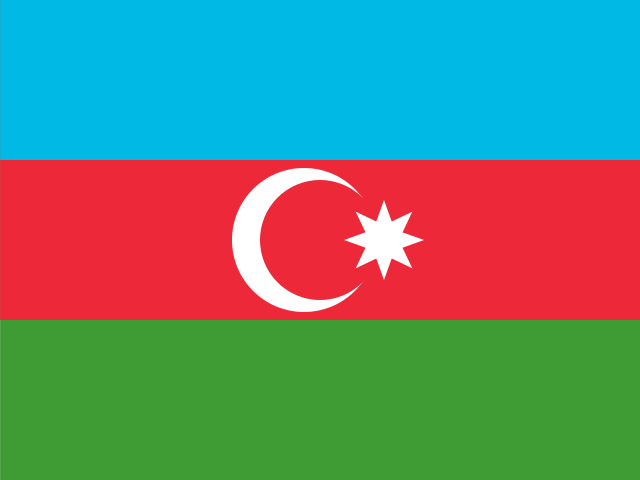
Overview
Azerbaijan, officially the Republic of Azerbaijan, is a landlocked country in the South Caucasus, where Western Asia meets Eastern Europe. Its neighbours are Russia (Dagestan) in the north, Georgia in the northwest, Armenia and a short Turkish frontier (via the Nakhchivan exclave) in the west, and Iran in the south, while the Caspian Sea forms its eastern edge. Baku is both the capital and the largest city.
The land borders total about 2,648 km (Armenia about 1,007 km, Iran about 756 km, Georgia about 480 km, Russia about 390 km, Turkey about 15 km). The Caspian coastline runs for about 800 km. The Nakhchivan Autonomous Republic is a separate exclave cut off from the main territory.
Azerbaijan is a unitary republic with a strong presidency. It is described as one of six independent Turkic states and takes part in the Organization of Turkic States. It reports diplomatic relations with around 180 countries and membership in 38 international organizations, including the UN, the Council of Europe, the OSCE, and the Non-Aligned Movement. It takes part in NATO's Partnership for Peace programme, is a founding member of GUAM and the Commonwealth of Independent States, and is a World Trade Organization observer.
About 97% of people are Muslim, yet the constitution names no official religion and all major political forces are secular. The country ranks 81st on the Human Development Index. The New Azerbaijan Party has governed since 1993 under Heydar Aliyev and then his son Ilham Aliyev, and it has been accused by critics of authoritarian rule.
History
The oldest signs of settlement date to the late Stone Age and are linked to the Guruchay culture of Azykh Cave. Scythians were present around the 9th century BC. The Medes then dominated the land south of the Aras river, and the area was absorbed into the Achaemenid Empire around 550 BC, which helped spread Zoroastrianism.
In 252 the Sasanian Empire made Caucasian Albania a vassal state. King Urnayr adopted Christianity as the state religion in the 4th century. Albania kept its monarchy and survived as an entity until the 9th century, but real civil, religious and military power rested with the Sasanian governor (marzban). In later centuries the region was shaped by Arab, Turkic and Persian rule, including the Safavid period (approx.).
After the Safavids came the Iranian Afsharid dynasty. Following Nader Shah's death in 1747, many khanates with varying autonomy emerged, ruled by families tied to Iran's dynasties and subject to the Iranian shah. They profited from trade routes between Central Asia and the West. The Zands and Qajars then ruled in turn.
The Russo-Persian wars of 1804–1813 and 1826–1828 forced Qajar Iran to give up its Caucasian lands. The treaties of Gulistan (1813) and Turkmenchay (1828) set the Russia–Iran border along the Aras, and the northern region joined the Russian Empire under the Caucasus Viceroyalty.
By the late 19th century an Azerbaijani national identity had emerged. In 1918, a year after the Russian Empire collapsed, the Azerbaijan Democratic Republic declared independence, becoming the first secular democratic Muslim-majority state in the world. Soviet forces took the country in 1920 and it became the Azerbaijan SSR. During the Soviet era literacy rose sharply and the alphabet changed twice (to Latin in the 1920s, then Cyrillic in the 1930s).
Under Gorbachev's glasnost, unrest and ethnic tension grew, including over Nagorno-Karabakh, an autonomous region within the Azerbaijan SSR. Anger at Moscow's indifference led to calls for independence and to the Black January events in Baku. In 1990 the Supreme Council dropped 'Soviet Socialist' from the republic's name and restored the Democratic Republic's flag. After the failed Moscow coup of 1991, it adopted a Declaration of Independence on 18 October 1991, confirmed by referendum in December. Independence is also marked on 30 August in some accounts. The Soviet Union ended on 26 December 1991.
The First Nagorno-Karabakh War followed. By the 1994 ceasefire, Armenian forces controlled roughly 14–16% of Azerbaijani territory, including Nagorno-Karabakh. An estimated 30,000 people died and over a million were displaced (more than 800,000 Azerbaijanis and 300,000 Armenians). Atrocities by both sides were recorded, including the Khojaly massacre and the Baku and Kirovabad pogroms. UN Security Council resolutions 822, 853, 874 and 884 demanded withdrawal of Armenian forces from occupied areas. The 1970 census counted about 510,000 Russians and 484,000 Armenians in Azerbaijan, and many of both groups fled in the 1990s.
In 1993 President Abulfaz Elchibey was ousted by a military revolt led by Surat Huseynov, bringing Heydar Aliyev to power. Further coup attempts in 1994 and 1995 failed. Aliyev was re-elected in 1998. His son Ilham Aliyev became president when his father died in 2003, and was re-elected in 2013 and again in April 2018 in a vote boycotted by the main opposition, which called it fraudulent.
Fighting resumed on 27 September 2020 and ended after six weeks with a ceasefire in which Azerbaijan made significant territorial gains, including the seven surrounding districts and parts of Nagorno-Karabakh. In September 2023 Azerbaijan launched an offensive that led to the dissolution of the self-declared Republic of Artsakh on 1 January 2024 and the departure of nearly all ethnic Armenians from the region.
At the White House on 8 August 2025, President Aliyev and Armenian Prime Minister Nikol Pashinyan put their signatures on a shared declaration pledging to pursue a peace agreement, which was portrayed as bringing an end to almost four decades of conflict. Events occurring after the retrieval date are not addressed.
Climate
Azerbaijan lies between about 38° and 42° N. Nine of the eleven recognised climate zones are present. The Greater Caucasus shields the country from cold northern air, so most plains and foothills have a subtropical climate with strong solar radiation. Cold arctic, Siberian and Central Asian air masses also influence the weather.
Precipitation varies widely: the wettest area is Lankaran in the south (about 1,600–1,800 mm a year) and the driest is the Absheron Peninsula (about 200–350 mm). Recorded extremes are about −33 °C and 46 °C, both in Nakhchivan (Julfa and Ordubad).
Baku, on the Absheron Peninsula by the Caspian, has a dry, semi-arid climate (approx.): hot dry summers around 30 °C, mild damp winters averaging a few degrees above freezing, and notably strong winds. Ganja, in the west, has a hotter, more continental semi-arid climate with colder winters (approx.). Lankaran in the south is humid subtropical with heavy rain (approx.). Sumqayit, just north of Baku, shares Absheron's dry coastal climate (approx.). Mountain areas such as Shahdag have cold snowy winters and support skiing.
Geography: the Caspian Sea forms the eastern boundary, with the Greater Caucasus in the north, the Lesser Caucasus in the west, the Talysh Mountains in the south, and broad lowlands in the centre (the Kura–Aras lowland). Mountains cover about 40% of the country. The highest peak is Bazardüzü (4,466 m) and the lowest point is the Caspian shore (about −28 m). The Kur (1,515 km) is the longest river and Sarysu (67 km²) the largest lake. Nearly half of the world's mud volcanoes are found here, and Yanar Dag near Baku is a natural gas fire burning continuously on a hillside.
Environment: protected areas now cover about 8% of the country. Forest is around 14% of land. The flora has more than 4,500 higher plant species, and records list 106 mammal, 363 bird, 97 fish and 52 reptile species. The Karabakh horse is the national animal.
Government and politics
Formally, Azerbaijan is a republic with a strong president and three branches of power. In practice, Freedom House rates it 'not free' (7/100 in 2024) and calls the regime authoritarian. Elections are held regularly but are criticised for fraud and unfair practices. The New Azerbaijan Party (YAP), with the Aliyev family, has governed continuously since 1993.
The constitution dates from 12 November 1995. Legislative power lies with the unicameral National Assembly (Milli Majlis) of 125 members elected by majority vote for five-year terms, plus a Supreme National Assembly in Nakhchivan. Parliament approves the cabinet but does not form the government. YAP and loyal independents hold almost all seats. International observers have reported irregularities in elections, for example in 2010 when the opposition won no seat.
The president is directly elected for a seven-year term, appoints the Cabinet of Ministers (prime minister, deputies and ministers) and can veto parliament's decisions, which parliament can override with 95 votes. The president cannot dissolve parliament. Judicial power belongs to the Constitutional Court, Supreme Court and Economic Court, whose judges the president nominates. A Security Council advises the president.
Power is highly centralised. Local government is mostly a continuation of the executive: the president appoints the heads of regional units, and a 2012 regulation added powers to local executive authorities, reinforcing their dominance in local affairs. The country is divided into 14 economic regions, 66 rayons and 11 cities directly under the republic. Sub-national units do not hold independent tax, health, law or education powers; these are set nationally.
Special jurisdiction: the Nakhchivan Autonomous Republic is an exclave with its own parliament, which elects and approves its government.
Foreign policy stresses restoring territorial integrity, relations with Turkey (described as a special relationship), integration with European structures, energy and transport security, and cooperation with international organizations. The country joined the Council of Europe in 2001, serves in NATO's Partnership for Peace and has contributed peacekeepers to Kosovo, Afghanistan and Iraq. It sat on the UN Security Council as a non-permanent member (elected 2011).
Armed forces: about 126,000 active personnel (2021), with the Land Forces, Air Forces and Navy, plus paramilitary and border forces. Defence spending was about $2.24 billion in 2020 (about 5.4% of GDP).
Rights and corruption: the constitution guarantees free speech but the media environment is tightly restricted, foreign broadcasts are banned and many journalists have been prosecuted. A figure of 375 political prisoners was cited for 2025. Amnesty International has reported severe deterioration in human rights. Discrimination against LGBT people is widespread. The Azerbaijani laundromat scheme, reported in 2017, involved about $2.9 billion used for covert payments to influence foreign figures, a practice called 'caviar diplomacy' by critics.
Economy
The economy is built on oil and gas. About two-thirds of the country is rich in hydrocarbons, and the industry dates back to antiquity on the Absheron Peninsula. A 1994 contract between SOCAR and 13 foreign oil companies opened deepwater fields, notably Azeri–Chirag–Guneshli (extended to 2050 under an amended agreement signed on 14 September 2017) and the Shah Deniz gas field. The State Oil Fund manages oil revenue for macroeconomic stability and future generations.
Export routes include the Baku–Tbilisi–Ceyhan oil pipeline (operating since May 2006, about 1,774 km, up to 50 million tonnes a year), the South Caucasus Pipeline, and the Southern Gas Corridor via the Trans-Anatolian and Trans Adriatic pipelines to Turkey and Europe, intended to cut EU dependence on Russian gas. The Baku–Tbilisi–Kars railway links the Caspian region to Turkey.
Macroeconomics: GDP grew about twentyfold between 1995 and 2012. Chronic high inflation was tamed in the early 2000s, and a new manat was introduced on 1 January 2006. Inflation reached 16.6% in early 2007, and the country shows signs of 'Dutch disease'. The Central Bank, created in 1992, issues the manat and supervises commercial banks. The country belongs to the IMF, World Bank, EBRD, Islamic Development Bank and Asian Development Bank. GDP per person is upper-middle income (approx.).
Minerals: the Lesser Caucasus holds gold, silver, iron, copper, titanium, chromium, manganese, cobalt, molybdenum and antimony.
Agriculture: about 54.9% of land is agricultural. Crops include grain, potatoes, sugar beets, cotton, tobacco, vegetables and grapes for wine, plus livestock and dairy. Caspian sturgeon and beluga stocks are dwindling. Some formerly imported goods are now produced locally.
Tourism: the sector was popular in the 1980s, suffered in the 1990s, and recovered from the 2000s, with religious, spa and health tourism and skiing at Shahdag. The government wants tourism to become a major economic contributor. 63 countries have visa-free access and an e-visa is available. It ranked 84th in the 2015 WEF Travel and Tourism Competitiveness Report.
Transport and technology: Azerbaijan sits at the crossroads of the Silk Road and the north–south corridor. In 2010 it had about 2,918 km of broad-gauge railways (1,278 km electrified) and 35 airports. The government promotes ICT and innovation; the country ranked 94th in the 2025 Global Innovation Index. It launched its first satellite, AzerSat 1, on 7 February 2013. Mobile operators include Azercell, Bakcell and Azerfon (Nar).
Ecological note: biocapacity is about 0.8 global hectares per person against a footprint of 2.1 (2016), a deficit.
Demographics and urbanization
The population was about 10.16 million in March 2022, of whom 52.9% were urban and 47.1% rural. About 50.1% were female in 2019. Population growth was about 0.85% in 2011, restrained by net emigration. The diaspora is found in 42 countries.
The country has 78 cities, 63 city districts, one special-status city, 261 urban-type settlements and 4,248 villages. Baku and its Absheron surroundings are home to the largest concentration of people, roughly 2.3 million in the city and about 2.5 million or more in the wider area (approx.). Ganja (roughly 330,000, approx.) and Sumqayit (roughly 350,000, approx.) are the next largest cities.
Ethnicity (2019 census): 94.8% Azerbaijani, 1.7% Lezgin, 0.9% Talysh, 0.7% Russian, 0.5% Avar, 0.4% Turk, 0.3% Tat, 0.2% Tatar, and small Ukrainian, Tsakhur, Georgian and Jewish shares.
Languages: Azerbaijani, a Turkic language, is the official language and mother tongue of about 96%. Russian is still spoken (mother tongue of 0.8%) and is useful in business in Baku. A dozen minority languages are spoken, including Avar, Lezgin, Talysh, Tat, Udi and Juhuri.
Religion: about 97% are Muslim, roughly 55–65% Shia and 45–55% Sunni by estimate. The country is regarded as very secular and the constitution (article 48) ensures religious freedom, but religious communities must register and registration is often denied. Christians number about 280,000 (3.1%), and about 12,000 Jews remain, with a 2,000-year presence.
Education: literacy is about 99.5% (UNDP 2009). Education is compulsory through ninth grade. A modified Latin alphabet replaced Cyrillic after independence, and religious education returned. A large share of people hold higher education, especially in scientific and technical fields.
Capital city
Baku is the capital and largest city, on the southern shore of the Absheron Peninsula on the western Caspian coast. It is sometimes called the 'land of fire'. The city proper has roughly 2.3 million people and the metro area about 2.5–3 million (approx.).
Climate: semi-arid with hot dry summers, mild winters with some rain, and frequent strong winds (approx.). Annual precipitation on Absheron is only about 200–350 mm.
Role: Baku is the political centre, with the presidency, parliament and ministries, and also the main economic city. It is the hub of the oil and gas sector, with SOCAR and international energy companies headquartered or active there, as well as banks and the main international airport (approx.). It is also the cultural centre, with its walled Old City, Caspian waterfront and modern architecture (approx.). Nearby Yanar Dag, the burning hillside, is a tourist attraction.
The country has a single capital and the capital is also the main economic city. Baku is where most foreign residents and businesses are based, and Russian and English are widely used there alongside Azerbaijani (approx.).
About this summary
Some history gaps (medieval to 19th century, Soviet era), city populations and climates, Baku capital details, and recent economic figures come from general knowledge and are approximate.