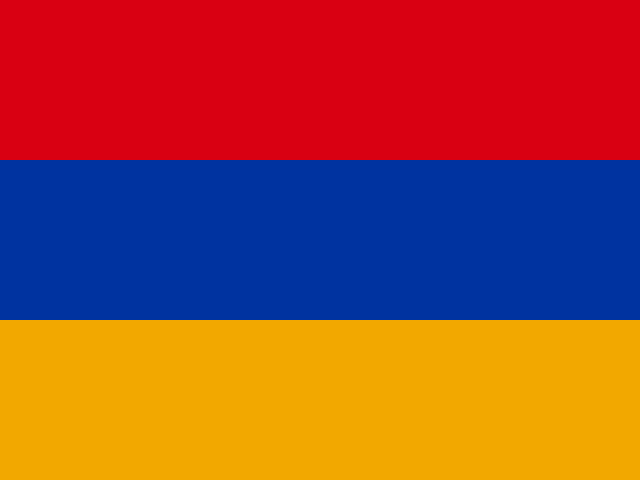
Overview
Armenia is a landlocked country in the Armenian highlands of West Asia, in the South Caucasus. Turkey lies on its western side, Georgia on the north, Azerbaijan on the east, and Iran plus Azerbaijan's Nakhchivan exclave on the south. Yerevan is the capital, the largest city and the financial centre.
The country is mountainous and covers about 29,743 square kilometres. It has a population of roughly 3.08 million (2025). Armenian is the only official language, and the Armenian Apostolic Church is recognised as the primary religious establishment.
Armenia is a unitary, multi-party parliamentary democracy. It ranks 69th on the Human Development Index (2023). The economy rests largely on industry and mining, with growing IT, tourism and jewellery sectors. Although geographically in the South Caucasus, Armenia sees itself as part of Europe and belongs to several European bodies (Council of Europe, OSCE, Eastern Partnership) as well as Eurasian ones (Eurasian Economic Union, CSTO).
History
Humans have lived in the area for a very long time: Acheulean tools near obsidian outcrops are over a million years old, and the Nor Geghi 1 site in the Hrazdan valley has artifacts about 325,000 years old. Bronze Age settlements appeared in places such as the Ararat valley, and the Areni-1 cave complex yielded the earliest known leather shoe, skirt and wine-producing facility. Cultures and peoples of the region included Trialeti-Vanadzor, Hayasa-Azzi, Shupria, Nairi and Mitanni. An archaic form of Proto-Armenian had spread into the highlands by at least 600 BC.
The state of Urartu arose in 860 BC and was replaced by the Satrapy of Armenia by the 6th century BC. The Kingdom of Armenia peaked under Tigranes the Great in the 1st century BC and in AD 301 became the first state to adopt Christianity officially. In the early 5th century the kingdom was divided between the Byzantine and Sasanian empires.
After the mid-7th century Arab conquest of the Sasanians, Armenia became Arminiya, an autonomous principality under the Umayyad Caliphate, centred on Dvin. The Bagratid Kingdom of Armenia was restored in the 9th century and fell in 1045. Cilician Armenia, a principality and later kingdom on the Mediterranean coast, existed between the 11th and 14th centuries.
The Mongols took Armenia in the 1230s, followed by Turkic and Central Asian dynasties through the 15th century. In the 16th century the Ottoman and Safavid empires divided the Armenian lands. By the 19th century Eastern Armenia was under the Russian Empire, while most of Western Armenia stayed Ottoman.
During World War I, Armenians in the Ottoman Empire were arrested and deported starting on 24 April 1915; up to 1.5 million were killed in the Armenian genocide. After the Russian Revolution, a brief Transcaucasian federation collapsed in May 1918 and the First Republic of Armenia declared independence. By 1920 it was absorbed into the Soviet Union as the Armenian SSR. The treaties of Moscow and Kars left territory including the medieval capital Ani and Mount Ararat in Turkey.
In World War II about 500,000 Armenians served in the Red Army and roughly 175,000 died. Under Gorbachev's glasnost, the Karabakh movement grew, with nearly a million people joining demonstrations centred on Yerevan by early 1988. The Spitak earthquake of 1988 killed over 25,000 people.
Armenia declared statehood on 21 September 1991, and Levon Ter-Petrosyan became the first president. The country fought the First Nagorno-Karabakh War with Azerbaijan, ending in a 1994 ceasefire. In 2018 protests led by Nikol Pashinyan forced Serzh Sargsyan to resign, and Pashinyan became prime minister. A six-week war over Nagorno-Karabakh began on 27 September 2020 and ended with a ceasefire seen by many as a defeat for Armenia. Civil Contract won an early election on 20 June 2021. President Armen Sarkissian resigned in January 2022 and Vahagn Khachaturyan was elected president in March 2022.
After a long blockade, Azerbaijan attacked the breakaway Republic of Artsakh on 19-20 September 2023, and by 1 October 2023 nearly all of the region's Armenian population had fled to Armenia. Then, on 8 August 2025, Pashinyan and Azerbaijan's President Ilham Aliyev put their signatures to a joint declaration at the White House, in which both pledged to pursue a peace deal.
Climate
Armenia has a highland continental climate. Summers (June to mid-September) are hot, dry and sunny, with temperatures roughly 22-36 °C, softened by low humidity and cooling evening mountain breezes. Springs are short and autumns long and colourful. Winters are cold and snowy, with temperatures around -10 to -5 °C.
Yerevan (approx. 990 m elevation) has hot, dry summers where daytime highs often exceed 35 °C in July and August, and cold winters with January averages a few degrees below freezing. Gyumri in the northwest is higher and noticeably colder in winter, with heavy snow. Vanadzor in the north is cooler and wetter than the capital. Tsaghkadzor, about 30 minutes from Yerevan, is a ski area, and Lake Sevan sits at about 1,900 m, so its surroundings are cool even in summer (all city climate details approx.).
The land rises to 4,090 m at Mount Aragats, and no point lies below 390 m. About 85.9% of the area is mountainous. Forest covers around 12% of the land. Armenia ranked 63rd of 180 on the 2018 Environmental Performance Index, with air quality a particular weakness. Waste management is underdeveloped, with around 60 landfills and no sorting or recycling. The country's seismic risk is notable, as shown by the 1988 Spitak earthquake.
Government and politics
Armenia is a parliamentary democratic republic. It was semi-presidential until April 2018. The president is head of state with largely ceremonial functions, while the prime minister is head of government and holds executive power. The Commander-in-Chief role rests with the prime minister, currently Nikol Pashinyan. Legislative power lies with the unicameral National Assembly (Azgayin Zhoghov) of 105 members. Suffrage is universal from age 18.
The state is unitary. There are ten provinces (marzer), each led by a governor (marzpet) appointed by the national government, so regional authority is limited and centralised. Yerevan has special status as the capital and as a community; it has a mayor who has been elected since 2009 and is split into twelve semi-autonomous districts. Below the provinces are communities (hamaynkner), which are self-governing; as of 2007 there were 915, of which 49 were urban and 866 rural. Communities consist of towns or villages. Taxation, health, law and education are primarily set at national level.
In foreign policy, Armenia joined the UN on 2 March 1992 and belongs to the Council of Europe, OSCE, IMF, WTO, EBRD, the Commonwealth of Independent States, the Eurasian Economic Union and La Francophonie, and works with NATO through the Partnership for Peace. Relations with Turkey and Azerbaijan have been difficult; Turkey has kept its border closed since 1993 and the two have no formal diplomatic relations, though protocols were signed in 2009 and never ratified. Ties with Iran are important economically. Russia long served as the main security partner and kept a base in Gyumri. After 2023 relations with Russia worsened; in February 2024 Pashinyan said Armenia had effectively frozen its participation in the CSTO. The EU-Armenia Comprehensive and Enhanced Partnership Agreement was finalised in November 2017, and on 12 February 2025 parliament approved a bill endorsing EU accession.
The armed forces have about 81,000 active personnel and 32,000 reserves. On rights, the Economist Democracy Index gave Armenia 5.63 for 2022 (classified a hybrid regime), Freedom House rated it partly free (51/100 in the 2019 report), and Armenia ratified the Rome Statute of the ICC in October 2023.
Economy
Under the Soviet Union Armenia built an industrial economy (chemicals, electronics, machinery, processed food, synthetic rubber, textiles) heavily reliant on outside resources. After independence, the loss of Soviet trade links, the 1988 earthquake, the Karabakh conflict and the energy crisis after the nuclear plant closed in 1989 led GDP to fall nearly 60% between 1989 and 1993. Growth resumed strongly after the plant reopened in 1995. The dram was introduced in 1993 and suffered early hyperinflation, but reforms later brought low inflation.
Armenian mines produce copper, zinc, gold and lead. Energy relies on imported Russian gas and nuclear fuel for the Metsamor nuclear plant, with hydropower the main domestic source. Agriculture's share of GDP rose above 30% in the 1990s and fell to just over 20% by 2006, while remaining over 40% of employment then. Newer sectors include precious-stone processing and jewellery, information technology and tourism.
The economy grew 7.5% in 2017 on higher copper prices. GDP was about $39.4 billion in 2022, helped by an inflow of Russian citizens, and the Heritage economic freedom score was 65.3. Unemployment was 18.5% in 2015. Armenia joined the WTO on 5 February 2003. International lenders have provided over $1.1 billion since 1993, and the diaspora is a main source of foreign investment. A liberal foreign investment law was passed in 1994 and a privatisation law in 1997.
Research spending is low, averaging 0.25% of GDP in 2010-2013, though IT is active with university-industry partnerships such as Synopsys and the Enterprise Incubator Foundation. Armenia ranked 59th in the Global Innovation Index in 2025. The country runs an ecological deficit, using about twice the biocapacity it has.
Demographics and urbanization
Armenia has about 3,081,100 people (2025), down from a peak of 3.6 million in 1991 due to emigration, which has slowed since 2012. The diaspora is estimated at up to 8 million, with big communities in Russia, the United States and France. Roughly 139,000 Armenians lived in Artsakh before almost all fled in 2023.
Urbanization is approx. 63% of the population. About a third of the country lives in the Yerevan area (approx.). Other main cities are Gyumri (approx. 110,000) and Vanadzor (approx. 75,000), followed by Vagharshapat (Etchmiadzin), Abovyan and Kapan (approx.).
Ethnic Armenians make up about 98.1%, with Yazidis (about 1.1%; 31,077 in 2022) and Russians (0.5%) the main minorities, plus Assyrians, Ukrainians, Greeks, Kurds and others. Nearly all Azerbaijanis left during the Karabakh conflict, while refugees from Azerbaijan arrived.
Armenian is the only official language and has its own 39-letter alphabet created by Mesrop Mashtots. Russian is widely known (95% had some knowledge in a 2013 survey), and about 40% reported some English.
Christianity predominates, with over 93% of Christians belonging to the Armenian Apostolic Church. Others include Catholics (Latin and Armenian), Evangelicals, Baptists, Molokans, Yazidis (the world's largest Yazidi temple, Quba Mêrê Dîwanê, opened in 2019 at Aknalich) and a small Jewish community of about 750.
Education is free and secondary school is compulsory, with 12 years of schooling. Higher education follows the Bologna process, and tertiary enrollment was 44% in 2015. Primary care has been free since 2006, and healthcare became free for people under 18 in 2019, though out-of-pocket costs remain high. Life expectancy was 74.8 years in 2014.
Capital city
Yerevan is the capital, the largest city and the financial centre, so political and economic functions are concentrated in one place. It has special administrative status, an elected mayor and twelve semi-autonomous districts. Its population is approx. 1.1 million in the city and a bit more in the wider area.
Yerevan lies in the Ararat valley with Mount Ararat visible across the Turkish border. Its climate is continental, with hot dry summers and cold winters with some snow (approx.). Zvartnots International Airport serves the capital. The city hosts the main universities, including Yerevan State University, the government, the National Assembly and most corporate and cultural institutions. It is also the centre of Armenia's IT sector and tourism.
About this summary
Approximate general-knowledge facts: city populations and metro size, Yerevan's climate and city details, recent economic figures, and details of recent events and the border situation with neighbours.