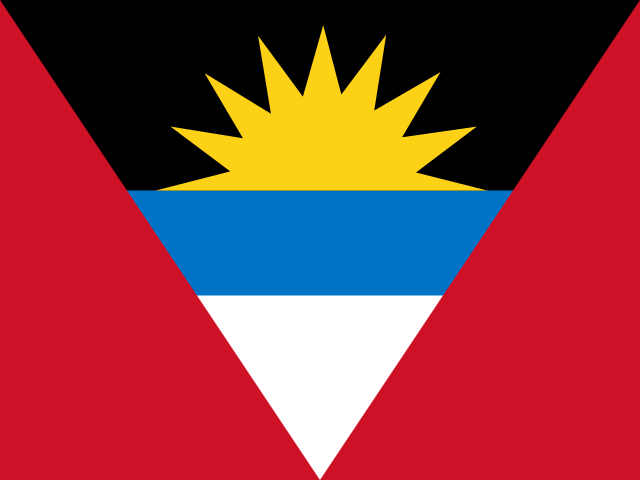
Overview
Antigua and Barbuda is a small island country in the eastern Caribbean. It consists of two main islands, Antigua and Barbuda, plus many smaller islets, including Guiana Island, Long Island and the uninhabited rock of Redonda. Total land area is about 440 km2, which makes it one of the smallest countries in the region.
The Atlantic Ocean lies to the east and the Caribbean Sea to the west. At sea, its neighbours include Anguilla, Saint Barthélemy and Saint Kitts and Nevis in one direction, Montserrat to the southwest and Guadeloupe further south. The terrain is mostly low and flat. The highest point is Boggy Peak (about 402 m) in southwest Antigua, a remnant of a volcanic crater. Limestone, not volcanism, shaped most of the landscape. Coastlines are irregular, with beaches, lagoons and natural harbours, and reefs and shoals surround the islands.
Fresh groundwater and streams are scarce because rainfall is low. Forest covers about 18% of the land (about 8,120 ha in 2020, down from about 10,110 ha in 1990). Codrington Lagoon on Barbuda is one of the largest inland bodies of water in the Lesser Antilles. The country faces environmental pressure from climate change and hurricanes.
It is a constitutional monarchy and Commonwealth realm with Charles III as head of state, and a unitary state in which Barbuda has its own council. It is a high-income country and is described in the source as the most developed in the Caribbean by Human Development Index. The economy is mainly services, led by tourism. It belongs to the UN, CARICOM, the OECS, the Regional Security System and the WTO, and is one of the few Caribbean states with an air force.
History
Hunter-gatherers (called the Ciboney) were the first inhabitants, with settlement dated to about 3700 BC. They were followed by ceramic-age, Arawak-speaking Saladoid people from the lower Orinoco, who brought farming: the Antigua black pineapple, corn, sweet potatoes, chillies, guava, tobacco and cotton. Caribs settled later.
Christopher Columbus sighted the islands in 1493. A Spanish settlement attempt around 1520 did not succeed, and disease, malnutrition and enslavement had greatly reduced the native population. England founded the first lasting colony on Antigua in 1632 under Edward Warner. Christopher Codrington settled Barbuda in 1685, and the Codrington family controlled it until the 1860s.
Tobacco and then sugar were grown by a large enslaved population from West Africa, who came to far outnumber the Europeans. England repelled a French attack in 1666. Revolts took place in 1701 and 1729, and a planned revolt in 1736 led by Prince Klaas was discovered and its leaders executed. Slavery ended across the British Empire in 1833 (emancipation in 1834), hurting the economy, which was further hit by an earthquake in 1843 and a hurricane in 1847. Mining on Redonda stopped in 1929.
Antigua and Barbuda was part of the Leeward Islands colony and the short-lived West Indies Federation (1958–1962). It became an associated state of the UK with full internal self-government on 27 February 1967. The 1970s were shaped by the rivalry between Vere Bird of the Antigua and Barbuda Labour Party (Premier 1967–1971 and 1976–1981) and George Walter of the Progressive Labour Movement (Premier 1971–1976). Full independence came on 1 November 1981, with Vere Bird as prime minister and the monarch as head of state.
The Bird family and the ABLP dominated politics after independence: Vere Bird until 1994, then his son Lester Bird until 2004. This brought stability and tourism growth, but also accusations of corruption and cronyism, including a 1990 arms-smuggling scandal that forced Vere Bird Jr. from the cabinet. Hurricane Luis badly damaged Barbuda in 1995.
Baldwin Spencer's United Progressive Party won in 2004 and governed until 2014. The ABLP under Gaston Browne then returned to power and won 15 of 17 seats in the 2018 snap election; it has dominated national politics since 2014. A marine protection framework (the MEPA Trust and the Environmental Protection and Management Act) was set up in 2015, and Nelson's Dockyard became a UNESCO World Heritage Site in 2016.
In September 2017 Hurricane Irma, with winds near 295 km/h, damaged or destroyed about 95% of Barbuda's buildings and infrastructure, and nearly the whole population was evacuated to Antigua. Rebuilding was estimated at over $100 million. Government plans to change Barbuda's century-old communal land ownership drew criticism, with some describing it as 'disaster capitalism', and a Barbudan independence movement has re-emerged. In 2018 voters rejected making the Caribbean Court of Justice the final appeal court. The High Court legalised same-sex sexual activity in 2022.
Climate
The country has a tropical savanna climate, with small pockets of tropical monsoon in southwest Antigua. Average rainfall is about 990 mm a year and varies strongly by season. The wettest period is September to November. Humidity is low and droughts recur.
Temperatures average about 27 °C. Winter ranges roughly 23–29 °C and summer and autumn about 25–30 °C. The coolest months are December to February.
Hurricanes are a major risk. Irma (Category 5, 6 September 2017) devastated Barbuda. The main settlements, St. John's on Antigua and Codrington on Barbuda, share this warm, fairly dry maritime climate (approx.), with steady trade winds moderating the heat. English Harbour and the south coast are broadly similar, and the southwest hills receive somewhat more rain (approx.).
Climate change brings further risks such as stronger storms, drought and pressure on coasts and reefs. Water is limited, since there is little surface water or fresh groundwater.
Government and politics
Antigua and Barbuda is a unitary parliamentary democracy and constitutional monarchy under the constitution adopted at independence on 1 November 1981. The monarch (Charles III) is head of state, represented by the Governor-General, currently Rodney Williams (since 2014). The Prime Minister, currently Gaston Browne, is head of government, appointed by the Governor-General as the member of the House of Representatives most likely to command a majority.
Parliament has two chambers. The House of Representatives has 17 elected members plus a Speaker. The Senate has 17 members appointed by the Governor-General: eleven on the Prime Minister's advice (one of whom must be a Barbuda resident), four on the Opposition Leader's advice, one on the advice of the Barbuda Council, and one independent. Money bills must start in the House. The Governor-General can dissolve Parliament on the Prime Minister's advice or after a successful no-confidence motion if the Prime Minister does not resign or seek dissolution within seven days.
The judiciary consists of magistrates' courts, the Eastern Caribbean Supreme Court system (High Court and Court of Appeal) and the Judicial Committee of the Privy Council as final court. Courts are regarded as independent. Trial by jury was largely abolished in 2024.
Power is concentrated nationally. Antigua is governed directly by the central government, which handles taxation, health, law and education. Antigua has six parishes and Redonda is a dependency attached to Saint John, but the parishes have no governing bodies, and proposals for parish councils had not produced any by January 2025. Local government is otherwise largely inactive; the St. John's Development Corporation absorbed most functions of the former city council.
Barbuda is the special jurisdiction. The Barbuda Council is entrenched in the Constitution, and Parliament cannot amend the Barbuda Local Government Act without its consent. Barbuda is divided into eight districts meant eventually to hold local powers. Communal land ownership there is a central political issue. The Barbuda People's Movement is the only group on the council since 2021.
Politics since the 1990s has been dominated by the centre-right Labour Party (ABLP) and the left-wing social democratic United Progressive Party (UPP). The ABLP has governed nationally since 2014. Foreign policy is summed up by Gaston Browne as 'friends of all; enemies of none'. The country is a founding member of the OECS and belongs to the UN, CARICOM, the Alliance of Small Island States and the WTO. It took in about 3,000 refugees from Montserrat in 1997.
The Defence Force (Regiment, Air Wing, Coast Guard, Cadet Corps, Service and Support Unit) is based at Camp Blizzard. The Royal Police Force is the national police. Human rights concerns reported since 2017 include press freedom and frequent defamation suits by officials against critics and media. Abortion is illegal except to save the mother's life, with a High Court ruling pending as of 2025. The death penalty remains legal.
Economy
Tourism dominates, accounting for more than half of GDP. Antigua is known for high-end resorts, but weaker mid- and lower-market tourism since 2000 has slowed growth and strained public finances. Roughly a third to a half of visitors come from the United States, so growth depends on the industrialised world's incomes. Personal income tax was abolished in 2016 to attract wealthy residents.
Financial services are significant: Royal Bank of Canada, Scotiabank, PwC, KPMG and others have offices in Antigua. The Stanford International Bank fraud (allegations in February 2009, about $8 billion) is a notable episode. A Citizenship by Investment Unit processes citizenship applications from investors and their families.
Manufacturing is about 2% of GDP, mainly export assembly such as bedding, handicrafts and electronic components. Farming mostly serves the local market but is limited by scarce water and labour shortages caused by higher pay in tourism and construction.
The country runs a biocapacity deficit: in 2016 it had about 0.8 global hectares per person but consumed about 4.3. Reconstruction after Hurricane Irma and hurricane exposure remain economic risks. The currency is the Eastern Caribbean dollar, pegged to the US dollar (approx.).
Demographics and urbanization
The National Bureau of Statistics estimated the population at 106,365 in 2026, about 24% above the 2011 census. Density is about 211 people per km2. Immigration drives population growth, and the total fertility rate was 1.6 in 2022. There were on average about 1,188 births a year in 2008–2020.
Only about 24% of people lived in urban areas in 2023, and the rural population is growing. Most people live on Antigua, in the Central Plain between St. John's and English Harbour, and Saint John parish holds well over half the population. St. John's is the largest city (approx. 20,000 in the city proper, more in its urban area), followed by All Saints and Bolans (small towns of a few thousand each, approx.). Codrington is Barbuda's only settlement (approx. 1,000–1,500 people). In 2011, 84% of homes were detached, and 45% were owned outright.
In the 2011 census, 87.27% identified as African, 3.80% other mixed, 2.75% Hispanic, 1.65% white, 1.11% Indian, 0.67% Syrian or Lebanese, and smaller groups. Immigrants made up about 30% of the population in 2011, the highest foreign-born share in the Americas by proportion. The largest groups were from Guyana (7.12%), Jamaica (5.22%), Dominica (4.31%), the United States (3.07%) and the Dominican Republic (2.46%). Immigrants from lower-income countries face discrimination, yet foreign-born people have become prime minister and governor-general.
No language is official by Act of Parliament; Cabinet designated Spanish an official language on 14 May 2026. Antiguan and Barbudan Creole is the most widely spoken at home, and Antiguan and Barbudan English is the working language of government, business and schools, so almost everyone is bilingual. In 2011 home languages included North Antiguan Creole (57.06%), South Antiguan (8.05%), Guyanese Creole (7.11%), standard English (6.12%), Jamaican Patois (5.21%), Spanish (2.45%) and Barbudan Creole (1.71%).
Most people are Christian. Anglicans are the largest denomination (17.6%), followed by Seventh-day Adventists (12.4%), Pentecostals (12.2%), Moravians (8.3%), Catholics (8.2%), Methodists (5.6%), Wesleyan Holiness (4.5%), Church of God (4.1%) and Baptists (3.6%).
Education is free and compulsory from ages 5 to 16. Primary school runs through grade six, after which a national assessment decides secondary placement; secondary school has five forms. Among those aged 25 and over in 2011, 16.55% had only primary, 48.34% only secondary and 27.24% tertiary education. Education took 3.1% of GDP in 2023. The University of the West Indies has a campus at Five Islands, and the Antigua and Barbuda College of Advanced Studies is at Golden Grove. Literacy is near universal and the country attracts foreign students.
Capital city
St. John's is the capital, on the northwest coast of Antigua, and is the country's most populous city (approx. 20,000 in the city and more in the wider urban area). It sits at the northern end of the Central Plain and is the main hub of the island.
Its climate is tropical savanna like the rest of the country: warm all year, with highs around 29–31 °C, a drier season from roughly December to April and a wetter season peaking in autumn (approx.). It is exposed to hurricanes.
St. John's is the political, administrative, commercial and cultural centre. Parliament, government ministries and the main courts are there, along with the deep-water harbour, the cruise terminal and the main shopping and business district (approx.). The main international airport, V. C. Bird, lies a few kilometres to the northeast (approx.). Historically it had a city council, whose functions have largely passed to the St. John's Development Corporation.
It is the capital and also the main economic city, though the biggest tourism earners are resorts along the coasts, and English Harbour, home to Nelson's Dockyard (a UNESCO World Heritage Site since 2016), is a major heritage and yachting centre in the south. The country has a single capital; Codrington on Barbuda is a local administrative centre for the Barbuda Council.
About this summary
Capital-city details (St. John's population, climate, role), some city populations and city-level climate, and recent economic and political context are from general knowledge and approximate.