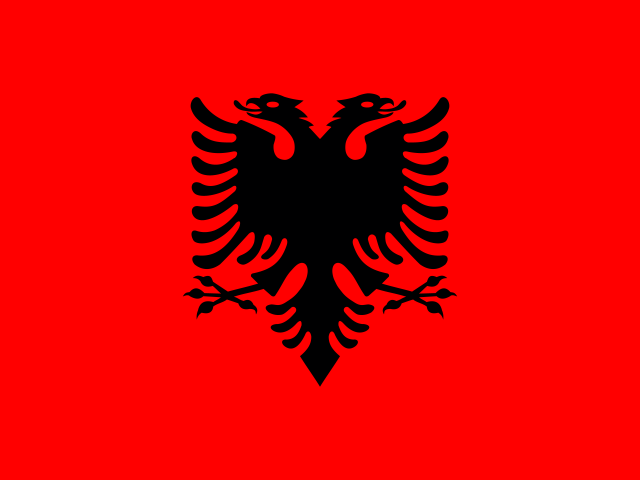
Overview
Albania, officially the Republic of Albania, is a country in Southeastern Europe, in the Balkans, with coasts on the Adriatic and Ionian Seas. It borders Montenegro to the northwest, Kosovo to the northeast, North Macedonia to the east and Greece to the south. Its area is 28,748 km2 (about 11,100 sq mi).
The landscape is varied: rugged snow-capped ranges (the Albanian Alps, Korab, Skanderbeg, Pindus and Ceraunian Mountains) give way to fertile lowland plains along the Adriatic and Ionian coasts. Tirana is both the capital and the biggest city; Durrës, Vlorë and Shkodër come next in size.
Albania is a parliamentary constitutional republic with an upper-middle income, developing economy driven mainly by services, with manufacturing and tourism (over 11 million visitors in 2024) playing big roles. The source estimates the illegal drug trade at around US$100 million a year. Citizens have universal health care and free primary and secondary education. Albania is an official EU candidate and has been negotiating accession since 2022. It joined NATO in 2009.
Biodiversity is rich: Albania is described as a biodiversity hotspot, with Balkan lynx, brown bear, grey wolf, golden eagle and the dalmatian pelican among its wildlife, about 3,500 plant species, 12 national parks and Europe's first wild river national park (Vjosa).
History
Mesolithic people lived in open-air sites near the Adriatic coast and in caves; the Neolithic began around 7000 BC, with sheep and goat herding and small-scale farming. In antiquity the land was home to Illyrian tribes (Ardiaei, Bylliones, Dassaretii, Enchele, Taulantians) and Epirote groups such as the Chaonians in the southwest, and Greek colonies were founded on the coast, Apollonia being the best known. After the Illyrian Wars the area joined the Roman Empire and later stayed within the Byzantine Empire.
In the Middle Ages several Albanian principalities arose, including Arbanon, the Kingdom of Albania, the Principality of Albania and Albania Veneta. The Ottomans reached the Ionian coast in 1385, set up garrisons across the south in 1415 and held most of Albania by 1431; many Albanians fled to Italy, while others took refuge in the mountains. In the 15th century Gjergj Kastrioti Skanderbeg led resistance that held back Ottoman advances for more than two decades.
Under about four centuries of Ottoman rule Albanians kept distinct cultural and social identities. The Albanian Renaissance (Rilindja), from the late 18th into the 19th century, strengthened national culture, literature and the arts. Independence was declared on 28 November 1912, a government was set up by the Assembly of Vlorë on 4 December, and the Conference of London recognised sovereignty. The Treaty of London (29 July 1913) fixed borders that left many Albanians in Montenegro, Serbia and Greece. An International Commission of Control, based in Vlorë, administered the country from October 1913.
The interwar years brought instability, economic hardship and foreign pressure from Greece, Italy and Yugoslavia. Albania was occupied during both World Wars. After the Second World War the People's Republic of Albania was established under Enver Hoxha, whose Marxist-Leninist regime banned religious practice, severely limited travel, abolished private property and relied on purges, repression and internal exile. The country was declared the world's first atheist state.
After the revolutions of 1989, student-led activism grew and the first multi-party elections were held in 1991; the Democratic Party won the 1992 elections. Pyramid investment schemes that drew in between a sixth and a third of the population began collapsing in late 1996. Protests turned violent in February 1997, police and the Republican Guard deserted in March, armouries were looted and a civil war followed, with foreign nationals evacuated. Prime Minister Aleksandër Meksi and President Sali Berisha resigned. In April 1997 Operation Alba, an Italian-led multinational force, entered to help evacuations and secure the ground for international organisations; a Western European Union police mission helped restructure the judiciary and police.
Albania then pursued Westernisation. It joined NATO in 2009, applied for EU membership on 28 April 2009 and became a candidate on 24 June 2014. Edi Rama of the Socialist Party won the 2013 and 2017 elections and a third consecutive win in 2021, when the party took enough seats to govern alone. His reforms targeted the economy, the judiciary and law enforcement, and roughly half of ministers have been women since 2017. A 6.4 magnitude earthquake struck on 26 November 2019 (epicentre about 16 km southwest of Mamurras), hitting Durrës and Kodër-Thumanë hardest. COVID-19 reached Albania on 9 March 2020 and a state of emergency ran from March to June 2020; vaccination began on 11 January 2021. EU accession negotiations have been under way since 2022.
Climate
Albania has five main climate types because of differences in latitude, longitude and altitude: Mediterranean and subtropical in the western half, oceanic, continental and subarctic in the east. The coast is warmest; the Albanian Alps and Korab Mountains in the north and east are coldest. Average monthly temperatures range from about -1 °C in winter to about 21.8 °C in summer. Records: 43.9 °C at Kuçovë (18 July 1973) and -29 °C at Shtyllë, Librazhd (9 January 2017).
Most rain falls in winter. Average precipitation is about 1,485 mm, with annual means from 600 to 3,000 mm depending on location. The northwestern and southeastern highlands are wettest; the Albanian Alps get at least 3,100 mm a year and are among Europe's most humid areas, with four low-altitude glaciers at about 2,000 m.
Major cities (approx., general knowledge): Tirana, Durrës and Vlorë on the western lowlands and coast have a Mediterranean to humid subtropical climate, with hot, dry summers around 30 °C or more in July and August and mild, wet winters, mostly above freezing. Shkodër in the northwest is similar but rainier. Korçë and other inland basins in the southeast are cooler and continental, with cold snowy winters. Coastal areas are the main summer beach destination.
Environmental points: the country is described as highly exposed to natural disasters, and rising sea levels threaten coastal communities and tourism. In 2023 it emitted 7.67 million tonnes of greenhouse gases (about 2.73 tonnes per person) and has pledged a 20.9% cut by 2030 and net zero by 2050. It ranked 62nd of 180 in the 2022 Environmental Performance Index. Forest covers around 29% of the land.
Government and politics
Albania has been a parliamentary constitutional republic since the 1998 constitution. Power is separated among the Parliament (legislature), the executive (a ceremonial president as head of state and a prime minister as head of government) and the judiciary, with constitutional and supreme courts plus appeal and administrative courts. The president is also supreme commander of the armed forces in wartime. Edi Rama (Socialist Party) has been prime minister since 2013 per the source's account of his election wins.
The legal system protects political rights regardless of ethnicity, language, race or religion, but the source notes concerns about judicial independence, media freedom and corruption in government bodies and law enforcement. The country is working on these areas to meet EU criteria.
Sub-national structure: Albania is informally divided into Northern, Central and Southern regions. Its principal units are 12 counties (qarqe), all with the same legal status. Within them lie 61 municipalities (bashki), which form the lowest tier of local government and handle local needs and the enforcement of law; in 2015 these merged earlier urban and rural municipalities and communes. Municipalities are subdivided into 373 administrative units, while about 2,980 villages, neighbourhoods and localities were previously used as administrative units. Because the country is unitary, counties and municipalities lack federal-style powers; national authorities set tax, health, law and education policy (general knowledge, approx.), and municipalities deliver local services. No special autonomous jurisdictions exist, although Macedonian is official in Pustec Municipality.
Foreign policy centres on sovereignty, Euro-Atlantic integration, support for Kosovo (which Albania recognised in 2008, with annual joint government meetings since 2014), concern over the expulsion of Cham Albanians and the rights of Albanians abroad. Albania joined the UN in 1955, NATO in 2009 and became an EU candidate in 2014.
The armed forces (land, air, naval) are under the Ministry of Defence. Service has been voluntary since 2010. Active troops fell from 65,000 in 1988 to 14,500 in 2009, and military spending has been roughly 1.5 to 2% of GDP. Human rights concerns in the source include violence against women, especially in rural areas, and a family registration law criticised as discriminatory; ILGA-Europe ranked Albania 28th of 49 European countries on LGBT rights in 2022.
Economy
Albania moved from central planning to an open market economy and is classed as upper-middle income. By the source's figures, services make up about 48.6% of GDP, industry 20.2% (notably construction), agriculture, forestry and fisheries 18.5% and manufacturing 6.3%. In 2025 nominal GDP is $26.9 billion, GDP per capita about $9,474, and growth is projected at 3.8% for 2025, easing to 3.5% by 2029.
Trade: a Stabilisation and Association Agreement with the EU (2006), a free trade agreement with EFTA (2009), membership in CEFTA and the Black Sea Economic Cooperation, and growing trade with Turkey, the UK and the US. Challenges include corruption, distorted competition, frequent tax-law changes, weak contract enforcement, a large informal sector and labour shortages.
Activity is concentrated in the Tirana–Durrës–Laç triangle ('Durana'). In 2021 Tirana County produced 44% of national GDP, Fier 11% and Durrës 10%. Elbasan, Sarandë and Vlorë are other centres; Berat and Korçë benefit from tourism.
Primary sector: fruit (olives, grapes, citrus, apples and others), vegetables, sugar beets, tobacco, honey, dairy, and medicinal and aromatic plants (a major producer of sage, rosemary and yellow gentian). Fishing is underdeveloped but has export potential. Viticulture is among Europe's oldest, with an estimated 17,500 tonnes of wine in 2009.
Secondary sector: electronics, textiles, food, cement, mining and energy. Albania is a leading chromium producer and also produces copper, nickel and coal. Patos-Marinza is Europe's largest onshore oil field, and the state company Albpetrol oversees petroleum agreements. Textile output grew 5.3% a year by 2016 with turnover around 1.5 billion euros.
Services and tourism: services employ about 36% of workers. Banking and telecoms (Vodafone, Telekom Albania, Albtelecom) are major parts. Tourism rose from 500,000 visitors in 2005 to about 11.7 million in 2024 (UN Tourism), concentrated on the Adriatic and Ionian coasts, including the Albanian Riviera (446 km coastline), and on historic towns such as Berat, Gjirokastër, Shkodër and Korçë.
Transport and energy: Tirana International Airport (over 3.3 million passengers in 2019) is the main hub of Air Albania. Motorways A1 (Durrës toward Kosovo), A2 (Fier–Vlorë) and A3 (Tirana–Elbasan, under construction) are planned to total about 759 km. Durrës is the busiest port and a Tirana–airport–Durrës railway is planned. Electricity is almost entirely hydroelectric, mainly on the Drin and Devoll rivers, and the Trans Adriatic Pipeline crosses 215 km of Albania. Albania was 67th in the 2025 Global Innovation Index, and launched two satellites in January 2023.
Demographics and urbanization
The 2023 census counted 2,402,113 people, down from 2,821,977 in 2011, owing to falling fertility and heavy emigration, and further decline is forecast. Density is about 83.6 per km2. Tirana and Durrës counties hold about 41% of the population (32% and 9%). The number of ethnic Albanians abroad is estimated to exceed the population inside Albania, and as much as a third of those born in the country now live elsewhere, mainly in Italy, Greece, the US, Canada, Switzerland, the UK and Australia (partly general knowledge).
Urbanisation rose from 47% in 2001 to 65% in 2023. The Tirana–Durrës corridor attracts internal migrants, while Dibër and Kukës are severely depopulating. Largest cities (approx., general knowledge): Tirana roughly 0.5 to 0.9 million depending on definition, Durrës about 0.1 to 0.2 million, and Vlorë, Elbasan and Shkodër roughly 0.1 million each.
Language: Albanian is official, with standard forms based more on the Tosk dialect than Gheg (the Shkumbin river is the rough dividing line). In 2023, 91.07% spoke Albanian at home. Greek is the main minority language, mostly in the south; Macedonian is official in Pustec. Young people show growing interest in English, German and Turkish.
Ethnicity (2023): Albanians 91.04%, Greeks 0.98%, Balkan Egyptians 0.5%, Roma 0.4%, Bulgarians 0.29%, Bosnians 0.12%, Aromanians 0.1%, Macedonians 0.09%, others small, and 5.6% unspecified.
Religion (2023): Sunni Muslims 45.86%, Catholics 8.38%, Orthodox 7.22%, Bektashi 4.81%, Evangelicals 0.4%, non-denominational believers 13.82%, atheists 3.55%, and 15.76% gave no answer. There is no official religion; Albania is among the least religious countries. Catholics live mainly in the north; Orthodox and Bektashi mostly in the south.
Education is secular, free and compulsory from age 6 to 16, with a literacy rate of 98.7% and school life expectancy of 16 years. Higher education follows the Bologna Process. Health care is constitutionally universal; life expectancy is 77.8 years and cardiovascular disease causes 52% of deaths.
Capital city
Tirana is Albania's capital and largest city, in the central-west of the country, a short distance inland from the Adriatic coast and close to Mount Dajti. Its population is about 0.5 to 0.9 million depending on whether the city or wider metro area is counted (approx.), and Tirana County holds about 32% of the national population.
Climate (approx.): hot, dry summers with July and August highs around 30 to 33 °C, and mild, rainy winters with occasional frost and little snow. It sits in the transitional zone between Mediterranean and continental influences.
Tirana is the political, administrative, economic and cultural centre. It hosts Parliament, the government and the main airport, Tirana International Airport. It is also the main economic city: Tirana County produced 44% of national GDP in 2021, and the Tirana–Durrës–Laç triangle ('Durana') is the principal economic centre. Albania has a single capital. Film events such as the Tirana International Film Festival (founded 2003) and the Kinostudio film studio are based there, and the Tirana–Durrës corridor is the main destination for internal migration.
About this summary
Capital-city details (approx. metro population, climate, role), city climates and populations of other cities, and a few recent political and economic details are from general knowledge and marked approx.